

Felony Charges Lawyer in St. Charles, IL. After a felony arrest in St. Charles, IL, the ground can shift quickly. Court dates, release conditions, police reports, prosecutor decisions, and possible penalties can start stacking up before you have a clear picture of what you are facing. And the questions usually come all at once:
What kind of felony am I facing? Could I go to prison? Can the charge be reduced? Should I talk to police? What happens next?
For clients in St. Charles, IL and across Illinois, Combs Waterkotte handles serious felony cases from the first investigation through trial preparation. Our felony defense team brings the pieces serious cases demand: 80+ years of combined experience, former prosecutor insight, a dedicated investigator, 500+ Google reviews, and a trial-ready approach. We can help you understand the charge, protect your rights, and start looking for the pressure points in the prosecution’s case.
Cases Handled
Over 10,000
Jail Days Saved
Over 1 Million
Google Reviews
500+ Perfect
Legal Experience
Over 80 Years
Call Combs Waterkotte at (314) 900-HELP or contact us online to speak with a criminal defense lawyer in St. Charles, IL today.
This page covers:
- How Illinois law defines a felony
- The difference between Class 4, Class 3, Class 2, Class 1, and Class X felonies
- Common felony cases our defense lawyers handle in St. Charles, IL
- What to do after a felony arrest or charge in St. Charles, IL
- How a felony defense lawyer can help build your case
- When a felony charge may be reduced, challenged, or dismissed
- How a felony conviction can affect work, housing, licensing, immigration status, firearm rights, family issues, and your future
- Common questions about felony arrests, penalties, probation, reductions, and defense options in St. Charles, IL
Legal Videos
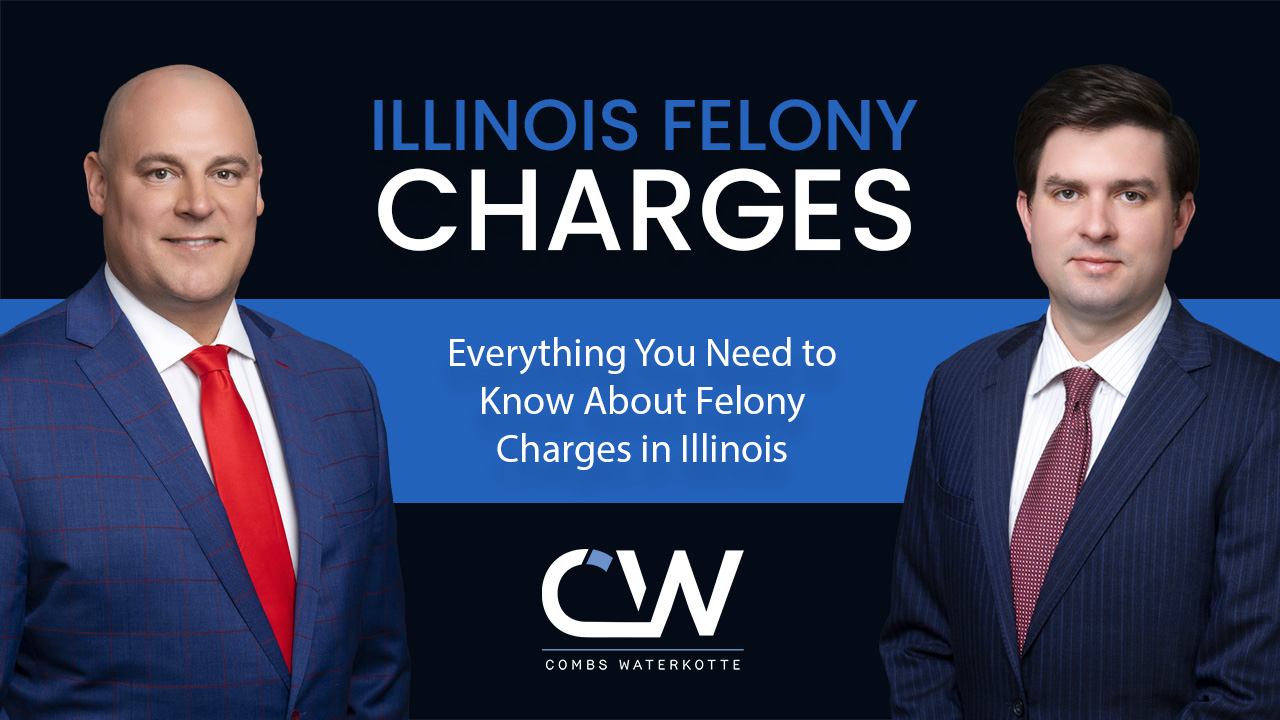
Everything You Need to Know About Felony Charges in Illinois
Everything You Need to Know About Felony Charges in the State of Illinois. Attorneys Steve Waterkotte and Joshua Boardman from Combs Waterkotte discuss everything you need to know about Illinois …
Can I Seal or Expunge My Criminal Record in Illinois?
Can I Seal or Expunge My Criminal Record in Illinois? Dealing with a criminal record in the state of Illinois? Combs Waterkotte attorney Joshua Boardman discusses the possibility of expunging your …
Can the Police Legally Search Me or My Property in Illinois?
Can the Police Legally Search Me or My Property in Illinois? Facing criminal charges in the state of Illinois? Combs Waterkotte attorney Joshua Boardman discusses probable cause and when police can …
Do I Need a Lawyer if I’m Innocent in Illinois?
Do I Need a Lawyer if I'm Innocent in Illinois? Facing criminal charges in the state of Illinois? Combs Waterkotte attorney Andrew Russek talks about it being more important to have a lawyer if …
What Penalties Could I Face Under Illinois Law?
What Penalties Could I Face Under Illinois Law? Facing criminal charges in the state of Illinois? Combs Waterkotte attorney Joshua Boardman talks about the possible penalties under Illinois …
What Are My Rights if I’m Arrested in Illinois?
What Are My Rights if I'm Arrested in Illinois? Facing criminal charges in the state of Illinois? Combs Waterkotte attorney Joshua Boardman discusses your rights following an arrest in …
Everything You Need to Know About Felony Charges in Illinois
Everything You Need to Know About Felony Charges in the State of Illinois. Attorneys Steve Waterkotte and Joshua Boardman from Combs Waterkotte discuss everything you need to know about Illinois …
Can I Seal or Expunge My Criminal Record in Illinois?
Can I Seal or Expunge My Criminal Record in Illinois? Dealing with a criminal record in the state of Illinois? Combs Waterkotte attorney Joshua Boardman discusses the possibility of expunging your …
Can the Police Legally Search Me or My Property in Illinois?
Can the Police Legally Search Me or My Property in Illinois? Facing criminal charges in the state of Illinois? Combs Waterkotte attorney Joshua Boardman discusses probable cause and when police can …
Do I Need a Lawyer if I’m Innocent in Illinois?
Do I Need a Lawyer if I'm Innocent in Illinois? Facing criminal charges in the state of Illinois? Combs Waterkotte attorney Andrew Russek talks about it being more important to have a lawyer if …
What Penalties Could I Face Under Illinois Law?
What Penalties Could I Face Under Illinois Law? Facing criminal charges in the state of Illinois? Combs Waterkotte attorney Joshua Boardman talks about the possible penalties under Illinois …
What Are My Rights if I’m Arrested in Illinois?
What Are My Rights if I'm Arrested in Illinois? Facing criminal charges in the state of Illinois? Combs Waterkotte attorney Joshua Boardman discusses your rights following an arrest in …
Charged With a Felony in St. Charles, IL? Start Here
A felony charge is serious, but it is not a verdict. The State still has to prove its case beyond a reasonable doubt, and every piece of that case can be tested. Important questions may involve:
- Whether your rights were violated during the stop, search, arrest, or investigation
- Whether witnesses are reliable, consistent, or able to identify the right person
- The handling and interpretation of forensic or digital evidence
- Whether any statements can be challenged or kept out of court
- Whether the charging decision fits the actual facts
What happens early can matter for the rest of the case. A felony defense lawyer can step in before the State’s version of events hardens, review the evidence, protect your rights, and start building a defense around the facts.
How Illinois Defines a Felony
A charge becomes a felony under Illinois law when the offense can be punished by one year or more of imprisonment. That makes felony cases more serious than misdemeanor cases, with possible penalties that may include prison, probation, fines, restitution, mandatory supervised release, and lasting damage to your record and future.
Illinois felony charges are grouped by class. Class 4 felonies are the lowest felony class, while Class X felonies are among the most serious felony charges short of first-degree murder.
Illinois Felony Classes and Penalties
Illinois felony penalties depend on the class of felony and the statute involved. The general sentencing ranges include:
| Felony Category | Possible Prison Range | Examples May Include |
|---|---|---|
| First-Degree Murder | 20 to 60 years, extended term, natural life, or other sentencing under Illinois murder statutes | First-degree murder and felony murder allegations |
| Class X Felony | 6 to 30 years | Armed robbery, home invasion, aggravated criminal sexual assault, and high-level firearm offenses |
| Class 1 Felony | 4 to 15 years | Residential burglary, second-degree murder, major theft offenses, and certain controlled substance offenses |
| Class 2 Felony | 3 to 7 years | Theft of property over $10,000, certain aggravated battery offenses, certain identity theft offenses, and possession of 5 to 15 grams of methamphetamine |
| Class 3 Felony | 2 to 5 years | Retail theft over $300, theft of property over $500, lower-level methamphetamine possession, and aggravated battery unless otherwise classified |
| Class 4 Felony | 1 to 3 years | Obstructing justice, some lower-level drug possession offenses, second or subsequent retail theft, and possession of burglary tools |
Sentencing does not always stop with the general range listed in the table. Some offenses carry special rules, prior convictions can raise the stakes, and certain facts can trigger enhanced penalties. A felony case may also involve fines, restitution, mandatory supervised release, registration requirements, immigration consequences, firearm restrictions, and other penalties tied to the specific charge.
Types of Felony Charges We Defend in St. Charles, IL
Felony cases in St. Charles, IL can start in many ways: a traffic stop, a search warrant, a police interview, an undercover investigation, an online accusation, a report from another person, or a federal agency referral. Combs Waterkotte defends clients at every stage of those cases.
Combs Waterkotte represents clients in St. Charles, IL in felony cases involving:
- Drug crimes: These cases can involve possession, intent to distribute, trafficking, manufacturing, conspiracy, controlled buys, informants, lab testing, or search and seizure issues.
- Weapons and firearm offenses: Firearm allegations often raise the stakes quickly, especially when the case involves prior convictions, alleged possession in a vehicle, or enhancements connected to another offense.
- Violent crimes: In violent crime cases, the defense may focus on intent, mistaken identity, injury evidence, witness credibility, surveillance footage, or whether the facts support self-defense.
- Property crimes: Burglary, theft, retail theft, and fraud cases can depend on value, location, prior record, and whether prosecutors can prove intent.
- Sex crimes: A felony sex crime accusation can affect nearly every part of a person’s life, including freedom, reputation, employment, family relationships, and possible registration requirements.
- Domestic violence-related felonies: These cases may involve no-contact orders, family consequences, witness issues, and allegations that overlap with assault, battery, weapons, or protection order violations.
- Homicide-related charges: Cases involving murder, felony murder, second-degree murder, reckless homicide, or manslaughter may turn on what caused the death, what the accused intended, whether self-defense applies, and what the forensic evidence actually shows.
- White collar and financial crimes: White collar cases often come down to paper trails, digital records, financial transactions, and whether the evidence shows fraud or a misunderstanding, mistake, or civil dispute.
- Probation violations: Felony probation violations can involve missed appointments, failed tests, new arrests, unpaid fines, travel issues, or claims that someone violated a court-ordered condition.
- Federal felony charges: A federal felony case may involve agencies like the FBI, DEA, ATF, Homeland Security, or federal prosecutors, with different rules and heavier sentencing pressure than many state cases.
Two people can face similar-sounding felony charges and still have very different cases. Classification, enhancements, criminal history, evidence strength, and the specific facts all matter.
What Should You Do After Being Charged With a Felony in St. Charles, IL?
The first few days after a felony arrest can feel chaotic. That is also when people often make mistakes that give prosecutors more to work with.
If a felony case may be forming against you, do not treat the first few days casually. Take these steps:
- Immediately invoke your right to remain silent and your right to an attorney.
- Do not try to explain your side to police without your lawyer there.
- Do not try to clear things up with the alleged victim, witnesses, or co-defendants. Those conversations can create new problems.
- Stay off social media when it comes to the case. Posts, comments, photos, videos, and messages can all become evidence.
- Do not erase anything connected to the case. What seems unimportant now may matter once a defense lawyer reviews the evidence.
- Write down witness names, preserve screenshots, save receipts, keep videos, and gather anything that may help your lawyer understand the timeline.
- Do not guess about your bond or pretrial release conditions. Follow them closely and ask your lawyer before taking any risk.
- Talk to a criminal defense lawyer in St. Charles, IL before speaking with police, prosecutors, or anyone connected to the case.
Even a short conversation can create problems. Police may seem casual, like they only want “your side of the story,” but they may already have a theory of the case. Before you make a statement, sign anything, consent to a search, or try to explain your way out of the situation, talk to a lawyer.
What a Felony Defense Lawyer Does in St. Charles, IL
In a felony case, the first job is to get control of the facts. That means reviewing what the State claims, what the evidence actually shows, and what legal issues may change the direction of the case.
Combs Waterkotte can help by:
- Going through the charges, reports, video evidence, witness statements, and discovery to understand what the State is relying on
- Investigating the facts independently
- Working with an investigator to locate witnesses, review evidence, and test the State’s version of events
- Challenging unlawful stops, searches, seizures, arrests, and interrogations
- Filing suppression motions when police obtained evidence or statements unlawfully
- Digging into forensic, digital, firearm, medical, financial, and lab evidence to see what it proves and what it does not
- Identifying weaknesses in witness testimony or police reports
- Negotiating from a position built on evidence, investigation, and the weaknesses in the prosecution’s case
- Getting the case ready for trial when negotiations do not produce a fair result
Felony cases can move in different directions. A suppression motion may change the case. A reduction may become possible after weaknesses are exposed. A trial may be necessary when the State will not back down. Trial preparation matters either way because it gives the defense leverage and shows prosecutors the case will be challenged.
Can Felony Charges in St. Charles, IL Be Reduced or Dismissed?
Reduction and dismissal are both possible in some felony cases. What matters is the strength of the evidence, whether police followed the law, whether the prosecution can prove each required element, and whether the facts support the charge.
A felony may be reduced when prosecutors overcharge the case, the evidence supports a lesser offense, intent or possession is hard to prove, or the surrounding facts make a lower charge more appropriate. That kind of reduction can affect sentencing exposure, probation eligibility, and the long-term impact of the case.
Combs Waterkotte looks early for the issues that can change a felony case: illegal searches, weak identification, unreliable witnesses, suppressed evidence, overcharging, missing elements, and facts that undercut the State’s version of events.
Read more: Can Criminal Charges be Dropped in Illinois?
The Long-Term Consequences of a Felony Conviction in St. Charles, IL
A felony conviction can follow a person long after the criminal case ends. Prison is often the first fear, but it is not the only consequence.
Consequences of a felony conviction may include:
- Current employment and future hiring opportunities
- Rental applications and housing access
- Professional licenses
- Education options, admissions, and financial aid
- Immigration consequences for non-citizens
- Firearm rights
- Family court issues involving custody, parenting time, or household stability
- Enhanced sentencing if you are ever charged again
At Combs Waterkotte, our goal is to protect you now while also thinking about what your life looks like after the case. For many clients, the biggest questions are practical: Can I keep working? Can I stay with my family? Can I avoid prison? Can this stay off my record? How can I move on with my life?
DuPage County Resources
Below are quick links to important websites that may assist you with your legal matters in DuPage County and Illinois.
- Illinois Criminal Defense Resources
- Illinois Criminal Defense Practice Areas
- Illinois Compiled Statutes
- Illinois Courts
- Illinois Supreme Court Rules
- Illinois Secretary of State
- Illinois State Police
- Illinois Department of Corrections
- DuPage County Website
- DuPage County Court
- DuPage County Jail
- DuPage County Sheriff’s Office
- Christopher Combs
- Steven Waterkotte
Felony Charges Lawyer in St. Charles, IL FAQ
What makes a charge a felony in Illinois?
A felony in Illinois is an offense that can be punished by imprisonment in a penitentiary for one year or more. Felony charges are more serious than misdemeanors and may carry prison time, probation, fines, mandatory supervised release, and long-term consequences.
What are the felony classes in Illinois?
Most Illinois felonies are classified from Class 4 through Class X. The class affects the possible prison range, probation options, and sentencing exposure, although the exact risk depends on the charge and facts.
Is probation possible for a felony charge in St. Charles, IL?
Probation depends on the felony class, the specific offense, prior history, and whether any mandatory sentencing rules apply. Some lower-class felony cases may allow probation, while Class X felonies generally do not.
Can felony charges be reduced in Illinois?
A felony charge may be reduced when the evidence supports a lesser offense, prosecutors overcharged the case, intent or possession is hard to prove, or the defense exposes problems with the State’s theory.
When can felony charges be dismissed?
Felony charges may be dismissed if the prosecution cannot prove the case, evidence is suppressed, witnesses are unreliable or unavailable, police violated your rights, or the facts do not support the charge. A defense lawyer can identify those issues and push them early.
What should I say to police if I am under felony investigation?
No. If you are accused of a felony or believe you are under investigation, speak with a criminal defense lawyer before answering questions from police, prosecutors, or investigators. Statements made early in the case can be used against you later.
When do I need a lawyer for felony charges in St. Charles, IL?
The sooner a lawyer gets involved, the sooner your defense can begin reviewing evidence, protecting your rights, identifying weaknesses, and helping you avoid decisions that create problems later.
Facing Felony Charges in St. Charles, IL? Call Combs Waterkotte
Felony charges in St. Charles, IL can put pressure on your freedom, record, work, and family right away. The sooner a defense lawyer gets involved, the sooner the case can be reviewed and the defense can begin pushing back.
Combs Waterkotte helps clients understand the charge, protect their rights, and prepare for the next stage of the case. Whether the allegation involves drugs, weapons, violence, theft, sex offenses, homicide-related charges, or a federal felony, our team can get to work quickly.
Call (314) 900-HELP or reach out online to discuss your case with a felony defense lawyer in St. Charles, IL.

