Federal Violent Crimes Lawyer West Virginia. A federal violent crime case can move before you have time to catch your breath. You may already be on the government’s radar before charges are filed. You may already be facing charges in federal court. Or you may be searching for answers after someone you love was arrested or contacted by federal authorities.
Combs Waterkotte helps people in West Virginia take action before a federal case starts controlling every decision. We represent clients nationwide in serious federal violent crime cases and help them get a clear picture of what prosecutors must prove, what penalties may be on the table, and how to start protecting themselves now.
If you need help with a federal violent crime investigation, arrest, or indictment in West Virginia, call Combs Waterkotte at (314) 900-HELP or contact us online for a confidential consultation. We offer free consultations and are available 24/7.
Cases Handled
Over 10,000
Jail Days Saved
Over 1 Million
Google Reviews
500+ Perfect
Legal Experience
100+ Years
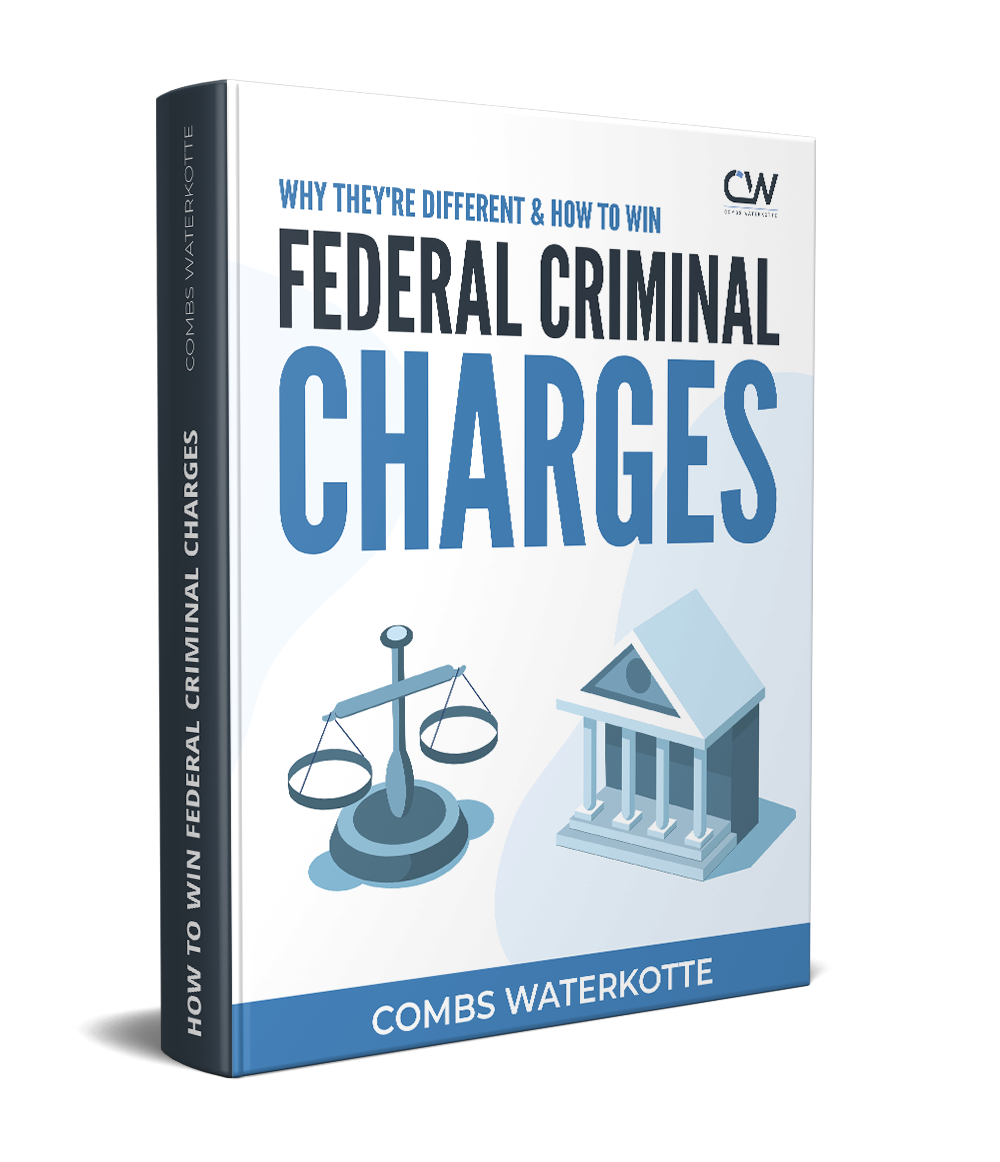
Free book
Facing Federal Criminal Charges? Why They’re Different and How to Win
Combs Waterkotte, a leading federal criminal defense law firm, has handled over 10,000 cases successfully. This ebook guides you through the federal criminal defense process, how federal charges are different, and how to win.
On this page, we cover:
- How to respond if federal agents contact you in West Virginia
- Why certain violent crime allegations are charged in federal court
- Why federal violent crime cases are different from West Virginia state cases
- Common federal violent crime charges, including Hobbs Act robbery, carjacking, kidnapping, firearm-related offenses, RICO, and conspiracy allegations
- How Combs Waterkotte approaches serious federal criminal defense
Legal Videos
Can Federal Charges Be Reduced Or Dismissed?
Can Federal Charges Be Reduced Or Dismissed? Chris Combs and Andrew Russek, lawyers with Combs Waterkotte, a leading federal criminal defense firm, talk about proffers, probation, and federal …
Should I Hire A Lawyer Experienced In Federal Defense?
Should I Hire A Lawyer Experienced In Federal Defense? Chris Combs and Andrew Russek from the leading federal criminal defense firm Combs Waterkotte discuss the importance of hiring a lawyer with …
What Penalties Apply To Federal Sex Crime Convictions?
What Penalties Apply To Federal Sex Crime Convictions? Andrew Russek and Chris Combs from Combs Waterkotte federal criminal defense firm discuss potential penalties related to federal sex crime …
Do Federal Sex Crimes Require Sex Offender Registration?
Do Federal Sex Crimes Require Sex Offender Registration? Andrew Russek, a lawyer with leading federal criminal defense firm Combs Waterkotte, discusses the sex offender registry and federal sex …
What Makes A Sex Crime Federal Rather Than State?
What Makes A Sex Crime Federal Rather Than State? Andrew Russek and Chris Combs of Combs Waterkotte discuss factors that play into a sex crime being classified as federal, rather than …
What Are Federal Sex Crime Charges?
What Are Federal Sex Crime Charges? Chris Combs and Andrew Russek of Combs Waterkotte discuss the most common federal sex crime charges. Interview Transcript Scott Michael Dunn: Well, let's …
Can Federal Charges Be Reduced Or Dismissed?
Can Federal Charges Be Reduced Or Dismissed? Chris Combs and Andrew Russek, lawyers with Combs Waterkotte, a leading federal criminal defense firm, talk about proffers, probation, and federal …
Should I Hire A Lawyer Experienced In Federal Defense?
Should I Hire A Lawyer Experienced In Federal Defense? Chris Combs and Andrew Russek from the leading federal criminal defense firm Combs Waterkotte discuss the importance of hiring a lawyer with …
What Penalties Apply To Federal Sex Crime Convictions?
What Penalties Apply To Federal Sex Crime Convictions? Andrew Russek and Chris Combs from Combs Waterkotte federal criminal defense firm discuss potential penalties related to federal sex crime …
Do Federal Sex Crimes Require Sex Offender Registration?
Do Federal Sex Crimes Require Sex Offender Registration? Andrew Russek, a lawyer with leading federal criminal defense firm Combs Waterkotte, discusses the sex offender registry and federal sex …
What Makes A Sex Crime Federal Rather Than State?
What Makes A Sex Crime Federal Rather Than State? Andrew Russek and Chris Combs of Combs Waterkotte discuss factors that play into a sex crime being classified as federal, rather than …
What Are Federal Sex Crime Charges?
What Are Federal Sex Crime Charges? Chris Combs and Andrew Russek of Combs Waterkotte discuss the most common federal sex crime charges. Interview Transcript Scott Michael Dunn: Well, let's …
What You Should Do If Federal Agents Contact You in West Virginia
If federal agents reach out, come to your home, call you, or send a target letter, you should treat the situation as serious immediately. You may not know whether you are a witness, a target, or someone they believe has information. In a federal violent crime investigation, a brief conversation can still become evidence.
You do not have to explain yourself, answer questions, or guess your way through an interview without legal counsel. Federal agents often ask questions after they have already gathered records, interviews, surveillance, or other evidence. A person who talks without a lawyer can make the case harder to defend, especially if prosecutors later claim the statement was false, misleading, or inconsistent.
If federal investigators contact you in West Virginia, take these steps:
- Stay calm and be polite
- Do not lie, guess, exaggerate, or try to explain your way out of the situation
- Do not discuss what happened, who was involved, or what you know without legal counsel
- Ask whether you are free to leave if agents approach you in person
- Do not agree to a search until you have spoken with an attorney
- Do not delete messages, throw away records, or contact witnesses about what to say
- Keep copies of business cards, voicemails, letters, subpoenas, search warrants, and any paperwork agents provide
- Speak with a West Virginia federal criminal defense attorney before the situation moves further
Asking for a lawyer is one of the most important steps you can take before statements are recorded, decisions are made, or charges are filed. Combs Waterkotte’s West Virginia federal violent crimes lawyers can deal with agents or prosecutors for you, help determine where you stand, and begin preparing a defense before the case advances.
When Does a Violent Crime Become a Federal Case?
A violent crime may become federal for several reasons. Sometimes the alleged conduct involves movement, communication, people, or activity across state lines. In other cases, federal agencies are part of the investigation from the start. In other cases, prosecutors argue that the conduct affected interstate commerce, involved firearms, involved a federal victim or location, or was connected to drugs, organized activity, or a broader conspiracy.
Federal cases are handled differently than state cases in West Virginia. These cases may include grand jury subpoenas, federal agents, detention hearings, large discovery productions, sentencing guidelines, and months of investigation before anyone is arrested.
Examples of federal violent crime charges in West Virginia include:
- Federal assault
- Armed robbery
- Hobbs Act robbery
- Carjacking
- Kidnapping
- Firearm-related violent offenses
- Gang-related or RICO-related allegations
- Murder-for-hire
- Conspiracy to commit a violent crime
- Violent crimes connected to drug trafficking
Federal violent crime charges can expose a person to long prison sentences, mandatory minimums in some cases, supervised release, fines, and collateral consequences that affect work, family, reputation, and the rest of their life. An allegation is not a conviction, and a West Virginia federal violent crimes lawyer can start examining the weaknesses in the government’s case immediately.
Why Federal Violent Crime Charges in West Virginia Require a Different Defense
Federal court is not just another version of West Virginia state court. The federal government may have agencies, analysts, prosecutors, task forces, and months of investigative work behind the charge. Depending on the allegations, agencies such as the FBI, ATF, DEA, U.S. Marshals, or local task forces may be involved.
By the time you learn the government is looking at you, prosecutors may already have interviews, surveillance, phone records, search warrants, cooperating witnesses, forensic evidence, or grand jury testimony. That does not mean the government’s case is airtight. It means your defense needs to be organized, deliberate, and early.
How Combs Waterkotte Defends Federal Violent Crime Cases in West Virginia
Combs Waterkotte brings former prosecutors, federal court experience, and trial-tested defense strategy to serious federal criminal cases in West Virginia. We understand how prosecutors build cases, how charging decisions develop, and why small facts can change leverage, strategy, and outcome.
A federal violent crime defense strategy may involve:
- Reviewing the indictment, complaint, warrants, and discovery
- Looking beyond the government’s version of events
- Filing motions to challenge unlawful searches, seizures, or statements
- Challenging whether prosecutors can prove the federal elements of the offense
- Looking closely at cooperating witnesses, informants, and anyone receiving a benefit from the government
- Fighting for release when prosecutors seek detention before trial
- Engaging federal prosecutors when negotiation serves the defense strategy
- Preparing as though the case may need to be fought in court
- Preparing sentencing arguments when reducing exposure becomes critical
Some federal violent crime cases need to be prepared for trial from day one. Others require careful negotiation to reduce exposure. Often, the strongest approach is to prepare for trial while also building leverage for negotiation. Our job is to give you a clear view of your options, explain what each decision means, and fight for the best possible outcome at every stage.
Examples of Federal Violent Crime Cases We Handle in West Virginia
Federal Assault
A federal assault case may involve alleged violence on federal property, against a protected person, or under circumstances that bring the case into federal court. These cases often turn on details such as intent, self-defense, the extent of injury, witness accounts, and whether the government’s evidence supports the charge.
Hobbs Act Robbery
The Hobbs Act, 18 U.S.C. § 1951, makes it a federal crime to commit, attempt to commit, or conspire to commit robbery or extortion in a way that affects interstate or foreign commerce. Prosecutors often use it when they claim a robbery had some connection to business, commerce, or goods moving between states.
Carjacking
Federal carjacking charges can bring severe penalties, particularly when the government alleges a weapon, injury, or multiple people acting together. These cases may require a close look at identification, intent, alleged force or intimidation, witness statements, and whether the evidence actually supports a federal carjacking charge.
Kidnapping
Kidnapping allegations may become federal when prosecutors claim interstate movement, unlawful restraint, or another jurisdictional hook. These cases are highly fact-specific and require close review of timelines, communications, witness accounts, and the government’s theory of restraint or movement.
Firearm-Related Violent Offenses
When prosecutors connect a firearm to an alleged violent crime, the potential penalties may become much more serious. Federal firearm charges are often paired with robbery, drug trafficking, conspiracy, or other serious allegations. The defense may challenge possession, use, knowledge, intent, and whether the evidence actually supports the firearm enhancement or charge.
RICO, Gang, and Conspiracy Allegations
Federal prosecutors sometimes use conspiracy, racketeering, or gang-related theories to connect multiple people to alleged violent acts. These cases can be complicated because the government may try to use one person’s conduct against another. The defense must focus on what you personally knew, what you actually did, and whether prosecutors can prove an agreement, participation, and intent.
Murder-for-Hire and Violent Crime Conspiracies
Murder-for-hire and violent crime conspiracy allegations often depend on messages, recordings, informants, undercover activity, digital evidence, and witness credibility. These cases require a detailed defense review of words, actions, context, intent, and whether the government’s version of events is stronger than the evidence allows.
Questions About Federal Violent Crime Charges in West Virginia
What makes a violent crime federal?
A violent crime may be charged federally if the case involves interstate commerce, movement across state lines, federal property, firearms, drug trafficking, conspiracy allegations, racketeering, or another federal interest. The answer depends on the statute, the facts, and why federal prosecutors believe the case belongs in federal court.
Should I talk to federal agents if I have nothing to hide?
Before answering questions about a federal investigation, speak with a federal criminal defense lawyer. A statement does not have to be intentionally harmful to create problems for your defense. Asking for a lawyer is a lawful way to protect yourself.
What happens after a federal indictment?
Once an indictment is filed, the case usually moves through court appearances, arraignment, bond or detention issues, discovery, motion practice, negotiations, and trial preparation. Some cases resolve through plea negotiations, while others go to trial. The best approach depends on what prosecutors can prove, what defenses are available, and what outcome is realistically possible.
Can federal violent crime charges be reduced?
In some cases, yes. Charges or sentencing exposure may be reduced through negotiation, motions, evidentiary challenges, cooperation issues, or weaknesses in the prosecution’s case. Sometimes the defense position is strongest when the case is prepared to be fought in court. A federal defense lawyer can review the facts and explain what options are realistic.
Are federal violent crimes punished more harshly than state crimes?
Federal violent crime cases may create major sentencing risks, especially when prosecutors allege firearms, conspiracy, mandatory minimums, or prior criminal history. Federal sentencing also involves advisory guidelines that can heavily influence the outcome. Early defense strategy matters.
Can Combs Waterkotte help before charges are filed?
Yes. If you think you may be under federal investigation, getting legal help before charges are filed can make a major difference. A lawyer may be able to communicate with investigators, protect you from harmful statements, respond to subpoenas, preserve evidence, and prepare for possible next steps.
Contact a Federal Violent Crimes Lawyer in West Virginia
Federal violent crime allegations can threaten your freedom, your future, and your family. But you still have rights. You still have decisions to make and defenses to explore. And prosecutors still carry the burden of proof.
Combs Waterkotte represents clients nationwide in high-stakes federal criminal cases. With former prosecutors, federal court experience, trial-tested defense work, 24/7 availability, and free consultations, we help clients understand the next step and start protecting their future.
Call Combs Waterkotte at (314) 900-HELP or contact us online today for a confidential consultation with a federal violent crimes lawyer in West Virginia.