

Federal Drug Trafficking Lawyer San Francisco, CA. A federal drug trafficking case can get serious fast, especially when prosecutors attach drug quantities and allegations to you that do not tell the whole story. Prosecutors may try to connect you to every transaction in a larger investigation, lean on cooperating witnesses with something to gain, or argue that proximity to drugs proves possession.
You do not have to accept the government’s account of what happened. Combs Waterkotte defends clients in San Francisco, CA, and nationwide against federal drug trafficking investigations, indictments, and related charges. Our attorneys scrutinize how the government built its case, push back on unsupported allegations, and prepare to fight the charges in court when necessary.
Whether you have just been contacted by federal agents or a loved one is already being held, call (314) 900-HELP or contact Combs Waterkotte to speak confidentially with a federal drug trafficking lawyer in San Francisco, CA during a free consultation.
Cases Handled
Over 10,000
Jail Days Saved
Over 1 Million
Google Reviews
500+ Perfect
Legal Experience
100+ Years
On this page, you’ll learn:
- What can cause a drug trafficking case to be prosecuted at the federal level
- What steps to take if federal agents are investigating you or charges have already been filed
- What the government has to establish to convict someone of federal drug trafficking or conspiracy
- Why drug type, weight, and purity can play such a large role in federal sentencing
- When firearm allegations can add additional federal penalties
- Where the defense may be able to challenge the government’s evidence, from search warrants to cooperating witnesses
Legal Videos
Can Federal Charges Be Reduced Or Dismissed?
Can Federal Charges Be Reduced Or Dismissed? Chris Combs and Andrew Russek, lawyers with Combs Waterkotte, a leading federal criminal defense firm, talk about proffers, probation, and federal …
Should I Hire A Lawyer Experienced In Federal Defense?
Should I Hire A Lawyer Experienced In Federal Defense? Chris Combs and Andrew Russek from the leading federal criminal defense firm Combs Waterkotte discuss the importance of hiring a lawyer with …
What Penalties Apply To Federal Sex Crime Convictions?
What Penalties Apply To Federal Sex Crime Convictions? Andrew Russek and Chris Combs from Combs Waterkotte federal criminal defense firm discuss potential penalties related to federal sex crime …
Do Federal Sex Crimes Require Sex Offender Registration?
Do Federal Sex Crimes Require Sex Offender Registration? Andrew Russek, a lawyer with leading federal criminal defense firm Combs Waterkotte, discusses the sex offender registry and federal sex …
What Makes A Sex Crime Federal Rather Than State?
What Makes A Sex Crime Federal Rather Than State? Andrew Russek and Chris Combs of Combs Waterkotte discuss factors that play into a sex crime being classified as federal, rather than …
What Are Federal Sex Crime Charges?
What Are Federal Sex Crime Charges? Chris Combs and Andrew Russek of Combs Waterkotte discuss the most common federal sex crime charges. Interview Transcript Scott Michael Dunn: Well, let's …
Can Federal Charges Be Reduced Or Dismissed?
Can Federal Charges Be Reduced Or Dismissed? Chris Combs and Andrew Russek, lawyers with Combs Waterkotte, a leading federal criminal defense firm, talk about proffers, probation, and federal …
Should I Hire A Lawyer Experienced In Federal Defense?
Should I Hire A Lawyer Experienced In Federal Defense? Chris Combs and Andrew Russek from the leading federal criminal defense firm Combs Waterkotte discuss the importance of hiring a lawyer with …
What Penalties Apply To Federal Sex Crime Convictions?
What Penalties Apply To Federal Sex Crime Convictions? Andrew Russek and Chris Combs from Combs Waterkotte federal criminal defense firm discuss potential penalties related to federal sex crime …
Do Federal Sex Crimes Require Sex Offender Registration?
Do Federal Sex Crimes Require Sex Offender Registration? Andrew Russek, a lawyer with leading federal criminal defense firm Combs Waterkotte, discusses the sex offender registry and federal sex …
What Makes A Sex Crime Federal Rather Than State?
What Makes A Sex Crime Federal Rather Than State? Andrew Russek and Chris Combs of Combs Waterkotte discuss factors that play into a sex crime being classified as federal, rather than …
What Are Federal Sex Crime Charges?
What Are Federal Sex Crime Charges? Chris Combs and Andrew Russek of Combs Waterkotte discuss the most common federal sex crime charges. Interview Transcript Scott Michael Dunn: Well, let's …
What Makes a Drug Trafficking Case in San Francisco, CA a Federal Crime?
A drug case does not need to involve an interstate shipment before federal prosecutors can step in. Federal controlled-substance statutes can reach conduct entirely within one state, as the Supreme Court explained in Gonzales v. Raich. No one-size-fits-all quantity determines whether a drug trafficking case belongs in state or federal court.
Some federal drug investigations involve interstate distribution networks, international sources, several alleged participants, or joint work between federal and local authorities. Even a case that starts on the side of the road with state or local police can later be referred to a U.S. Attorney’s Office. The badge on the officer who arrested you does not settle which court will prosecute the case.
Once federal prosecutors enter the picture, your San Francisco, CA criminal defense lawyer needs to assess everything from pretrial detention to the charged offenses and potential federal sentence. Federal court plays by a different rulebook, and outcomes that may be possible in a state case are not guaranteed to be available there.
What to Do If Federal Agents Contact You About Drug Trafficking in San Francisco, CA
An indictment does not have to come first for you to get legal help. A search warrant, subpoena, or federal target letter is a clear sign that you should take the situation seriously. Do not assume a casual request to talk about another person’s drug activity is harmless just because you have not been charged.
- Do not get into the facts without a lawyer. Stay calm, be respectful, and tell agents that you want to speak with a federal drug trafficking attorney in San Francisco, CA before discussing the case.
- Do not make up an answer just because an agent keeps pressing. Knowingly making materially false statements in a federal matter can create separate exposure under 18 U.S.C. § 1001.
- Do not destroy or alter potential evidence. Do not delete messages, alter records, destroy items, or ask anyone to coordinate accounts of what happened.
- Have a lawyer review any federal paperwork you receive. A subpoena or court order should not be ignored, and a lawful search should not be obstructed. Give the paperwork to your lawyer so they can determine what must be done and what can be challenged.
A spur-of-the-moment explanation can hand investigators admissions before you even know the full scope of the case. A federal drug trafficking lawyer in San Francisco, CA can evaluate where you stand and help decide whether, when, and how any communication with federal investigators should happen.
Free book
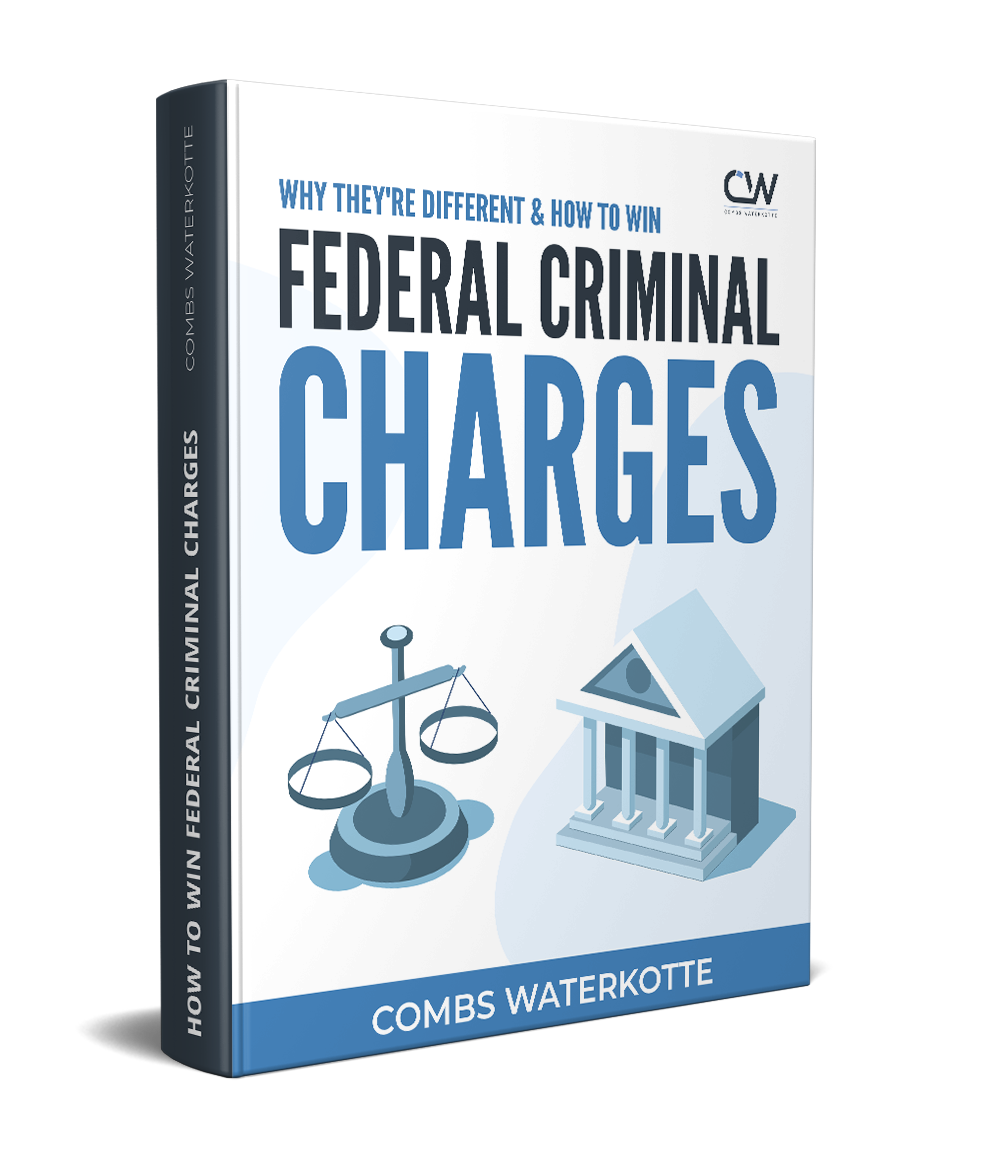
Facing Federal Criminal Charges? Why They’re Different and How to Win
Combs Waterkotte, a leading federal criminal defense law firm, has handled over 10,000 cases successfully. This ebook guides you through the federal criminal defense process, how federal charges are different, and how to win.
Federal Drug Trafficking Statutes and Related Charges
Most federal drug trafficking prosecutions begin with 21 U.S.C. § 841. It prohibits unauthorized, knowing or intentional manufacturing, distribution, dispensing, and possession with intent to manufacture, distribute, or dispense a controlled substance.
Distribution, Manufacturing, and Possession With Intent
Money changing hands is not required for every federal trafficking charge. A possession with intent to distribute charge can rest on an allegation that you knowingly possessed drugs and intended to transfer them to someone else. Giving or transferring drugs to another person can potentially qualify as distribution even without payment.
These cases may involve fentanyl, methamphetamine, cocaine, heroin, marijuana, or controlled prescription medications. Drug type matters for charging and sentencing, but it does not replace the need for evidence tying you to the alleged trafficking.
Federal Drug Importation Charges
Drug trafficking allegations involving substances brought into the country can result in importation of controlled substances charges. Related penalties appear in 21 U.S.C. § 960, where penalties can depend on drug type, quantity, and additional facts specified in the statute.
Continuing Criminal Enterprise Under Federal Drug Law
A continuing criminal enterprise charge under § 848 is aimed at conduct beyond ordinary participation in an alleged drug distribution agreement. It addresses a continuing series of qualifying drug violations involving an organizer, supervisor, or manager of at least five other people, along with substantial income or resources. A large indictment does not, by itself, establish those requirements.
What Must Federal Prosecutors Prove in a Drug Trafficking Case in San Francisco, CA?
For prosecutors to secure a conviction for possession with intent to distribute, they generally must prove that you knowingly possessed the drugs and intended to distribute them, and they must do so beyond a reasonable doubt. The federal model jury instruction for possession with intent to distribute lays out these basic elements.
Finding drugs directly on you is not the same as finding a suspicious package at a San Francisco, CA address you share with other people. Who ordered it? Who could access the property? What shows you knew the package contained drugs? Physical location is only part of the story. The defense should examine who actually knew about and controlled the drugs.
The government may point to scales, packaging materials, text messages, cash, alleged customer testimony, or the amount of drugs involved as evidence of an intent to distribute. But those details can look very different once the full context is known. A prosecutor may call a message incriminating when it is ambiguous, treat legitimate cash as drug proceeds, or rely on a witness whose version of events clashes with the records.
There is an important limit, though: not knowing the drug’s exact identity is not necessarily a defense if you knew you possessed a controlled substance. Drug identity and quantity can still become critical when they raise the available statutory penalties, and the government must establish those facts through the required verdict findings or valid admissions in a plea.
Federal Drug Conspiracy Charges in San Francisco, CA
Under 21 U.S.C. § 846, a person convicted of attempting or conspiring to commit a federal drug offense faces the same statutory penalties as someone convicted of the underlying offense. The same statutory range can apply to several defendants even though their ultimate sentences may be very different.
A federal drug conspiracy allegation focuses on whether there was an unlawful agreement and whether you knowingly chose to take part in it. The government does not need to seize drugs from each person named in the alleged conspiracy. And unlike some other federal conspiracy statutes, § 846 does not require prosecutors to prove a separate overt act, as the Supreme Court held in United States v. Shabani.
Association is not automatically agreement. You can know someone involved in drug trafficking, live with them, or appear repeatedly in their communications without necessarily joining their alleged conspiracy. We look at what prosecutors say you agreed to do, when you allegedly joined, and what actually supports that account.
Drug quantities require separate scrutiny. Under the Guidelines’ relevant-conduct rules, another person’s conduct is not simply dumped into your Guidelines calculation. It generally must be within the jointly undertaken activity, in furtherance of it, and reasonably foreseeable to you. You are not automatically responsible under the Guidelines for every gram prosecutors attribute to the conspiracy as a whole. Statutory mandatory-minimum quantities raise different legal questions and must be analyzed separately.
Penalties for Federal Drug Trafficking
The federal drug trafficking penalty provisions can change the sentencing range dramatically depending on what drug is involved and how much prosecutors say was involved. These common thresholds illustrate when the ordinary five-year and ten-year mandatory minimum tiers can come into play, before other enhancements are considered.
| Controlled Substance | Threshold for 5 to 40 Years | Threshold for 10 Years to Life |
|---|---|---|
| Heroin | 100 grams | 1 kilogram |
| Cocaine | 500 grams | 5 kilograms |
| Cocaine base / crack | 28 grams | 280 grams |
| Fentanyl | 40 grams | 400 grams |
| Fentanyl analogue or fentanyl-related substance | 10 grams | 100 grams |
| Methamphetamine, actual | 5 grams | 50 grams |
| Methamphetamine, mixture | 50 grams | 500 grams |
| Marijuana | 100 kilograms or 100 plants | 1,000 kilograms or 1,000 plants |
These thresholds show where the listed statutory sentencing ranges begin to apply. Once the higher threshold applies, its ordinary range replaces the lower tier. Most of these quantity thresholds are based on the weight of a mixture or substance containing the drug, while actual methamphetamine and marijuana plant counts are treated differently. For methamphetamine, “actual” means the weight of the methamphetamine itself rather than the total weight of the mixture containing it.
Falling below these quantity thresholds does not mean the charge is minor. A lower quantity can still expose someone to substantial prison time. Under § 841(b)(1)(C), many Schedule I and II offenses carry up to 20 years even without a quantity-based mandatory minimum, before other enhancements are considered. Other drugs and charging provisions are governed by their own penalty rules. The sentence may also include major financial penalties and years of supervised release after incarceration.
When a Prior Conviction Can Increase a Federal Drug Sentence
For the highest quantity tier under § 841(b)(1)(A), the ordinary 10-year minimum can jump to 15 years if prosecutors establish a qualifying serious drug felony or serious violent felony. Two or more can raise it to 25 years. For § 841(b)(1)(B), one qualifying prior can change the usual range from 5 to 40 years into 10 years to life.
Having a prior felony is not enough by itself to increase the statutory minimum. Under 21 U.S.C. § 851, prosecutors generally must file written notice identifying the convictions before trial or a guilty plea to seek the increased punishment. That makes both the prior conviction itself and the government’s compliance with the notice requirements important defense issues.
Death and Serious Bodily Injury Enhancements in San Francisco, CA Federal Drug Cases
If prosecutors can prove that death or serious bodily injury resulted from use of the drug involved in the offense, the statutory range can increase to 20 years to life. An overdose by itself does not automatically trigger that punishment. Prosecutors still have to establish the required causal link between the substance involved and the resulting injury or death.
In Burrage v. United States, the Supreme Court held that but-for causation is required for the death-results enhancement when the drug itself was not independently sufficient to cause death. The defense may need to dig deeply into toxicology, other substances in the person’s system, medical evidence, and whether the government can reliably trace the drug back to the accused.
When Firearms Increase Federal Drug Trafficking Penalties in San Francisco, CA
When firearms enter the picture, the sentencing stakes can rise quickly in a federal drug trafficking case. Under 18 U.S.C. § 924(c), using or carrying a firearm during and in relation to drug trafficking, or possessing one in furtherance of it, can carry a consecutive mandatory minimum of five years. Brandishing can push the minimum to seven years, and firing the weapon can raise it to ten. Some cases can carry even harsher firearm penalties depending on the weapon and conduct alleged.
Finding a firearm in the same home as drugs does not automatically prove a § 924(c) charge. That means digging into who controlled the weapon, where officers found it, who had access to it, and whether the government can prove a meaningful connection to the trafficking allegation.
Is It Possible to Get Below a Federal Drug Trafficking Mandatory Minimum?
A judge generally cannot disregard an applicable statutory minimum simply because a lower sentence seems fair. There are, however, limited legal mechanisms that can authorize a sentence below the statutory floor.
Can the Federal Safety Valve Apply?
The federal safety-valve provision can allow qualifying defendants in certain federal drug cases to be sentenced without regard to an otherwise applicable statutory minimum. Eligibility depends on all the statutory requirements, including:
- A criminal record that falls within the statute’s criminal-history limits
- No qualifying use or threat of violence and no disqualifying firearm or dangerous-weapon conduct connected to the offense, including inducing another participant to engage in it
- The offense did not result in death or serious bodily injury
- No disqualifying leadership or management role and no involvement as a principal in a continuing criminal enterprise
- Providing the government, truthfully and on time, all information and evidence required by the statute
Safety-valve eligibility in San Francisco, CA cannot be reduced to a simple first-offense-versus-prior-record question. Your eligibility depends on the details, which means your San Francisco, CA federal drug trafficking lawyer has to evaluate the actual record instead of relying on assumptions. Safety-valve relief also does not guarantee probation or eliminate a separate firearm sentence.
Can Cooperation Lead to a Sentence Below the Mandatory Minimum?
Under 18 U.S.C. § 3553(e), the government can ask the court to impose a sentence below the statutory minimum when a defendant provides substantial assistance. Merely asking for a lower Guidelines sentence does not necessarily authorize the judge to cross below the statutory floor.
Cooperation can matter, but a verbal assurance from an agent is not the same thing as a guaranteed sentencing reduction. Before any interview, proffer, or cooperation agreement, your lawyer should examine the written terms, possible risks, and exactly what legal mechanism would be needed to obtain the promised benefit.
There are other ways the sentencing picture can shift. If prosecutors cannot establish the quantity, prior conviction, or charge supporting the minimum, a different statutory range may apply. Before treating any mandatory minimum as inevitable, we examine what facts and legal findings it actually depends on.
Defense Strategies for Federal Drug Trafficking Cases in San Francisco, CA
Federal drug trafficking defenses can take very different paths. Sometimes the issue is knowledge or participation; other times, it is whether the evidence itself survives legal scrutiny. The strategy should be built around the actual weaknesses in the government’s case, not pulled from a generic defense checklist.
Reviewing Search Warrants, Stops, and Seizures
We review the basis for a traffic stop, detention, search, and seizure, including consent and the scope of any warrant. Federal Rule of Criminal Procedure 41 plays an important role in federal warrant practice and motions seeking to keep unlawfully obtained evidence out of court.
A warrant is not a blank check. We look at whether it was properly supported, whether officers stayed within its limits, and whether the government’s account of consent or access matches the actual record. If a suppression motion succeeds, prosecutors may lose access to evidence central to their case. That said, not every mistake requires suppression, and suppressed evidence does not automatically mean the charges disappear.
Scrutinizing Informant Testimony
Someone hoping for a reduced sentence may have a reason to overstate your involvement. That does not mean every cooperating witness is lying, but it does mean the defense should examine promised benefits, prior statements, what the witness could actually observe, and whether other evidence backs up the story.
We compare the witness’s earlier statements with what they said after cooperation entered the picture, then check that account against recordings, messages, and records.
Testing the Government’s Drug-Quantity Calculations
We examine laboratory results, sampling, handling records, and how the prosecution calculated the alleged quantity. Methamphetamine calculations can be especially important because federal law treats actual methamphetamine weight differently from mixture weight. Even perfect lab work does not settle attribution in a conspiracy case. Prosecutors still have to connect particular conduct and quantities to the individual defendant under the applicable rules.
The government may be able to prove the contents of a package and still face a separate problem proving that you knew what was there or agreed to take part in trafficking it.
Evaluating a Possible Entrapment Defense
Federal entrapment law focuses on government inducement and whether the defendant was predisposed to commit the crime. An undercover officer offering an opportunity is not enough by itself. The communications, pressure involved, and sequence of events determine whether this defense fits.
What Happens Next After a Federal Drug Trafficking Arrest in San Francisco, CA?
A federal indictment marks the beginning of a prosecution, not the end of the story. A grand jury only decides whether there is probable cause to move the case forward, which is very different from what prosecutors must ultimately prove to convict you.
An early priority is whether you will remain in custody. Under 18 U.S.C. § 3142, a qualifying federal drug charge carrying ten years or more can shift the starting point toward detention when the statutory conditions are satisfied. That does not make detention inevitable, but the defense should come prepared with a serious release plan.
Your attorney can put together a practical release proposal addressing where you will live, how you will be supervised, whether you are working, and what other conditions may reduce the court’s concerns. Even while detention is being addressed, the federal court process continues with discovery, motions, negotiations, and trial strategy. A good federal defense keeps both tracks moving: the immediate custody question and the larger fight over the charges.
Federal Drug Trafficking Sentencing in San Francisco, CA
Federal drug sentencing has two different guardrails: the penalties set by statute and the advisory range calculated under the Guidelines. The U.S. Sentencing Guidelines are advisory rather than mandatory, yet federal judges are still required to calculate and consider the applicable range. Whatever the Guidelines say, the sentence still has to fit within the applicable statutory limits unless a lawful exception changes the picture.
Drug quantity, criminal history, your role, and other findings can affect the calculation. The judge must also consider the broader sentencing factors in § 3553(a), including the nature of the offense and your personal history and characteristics.
Before sentencing, your lawyer should review the presentence report line by line, object where the record does not support an allegation, and present evidence that gives the court a fuller picture of you. A claim repeated in that report does not become accurate simply because it appears in an official document.
Probation in a federal case depends on the offense and applicable restrictions. Avoiding a mandatory minimum is important, but it does not automatically open the door to probation. We want you making decisions from the real sentencing picture, not from guesswork about what a judge might do.
Federal Asset Forfeiture in Drug Trafficking Cases
A federal drug case can also threaten property. Under 21 U.S.C. § 853, criminal forfeiture can reach proceeds of qualifying offenses and property used or intended to facilitate them.
Forfeiture has limits. The government still has to establish the required legal connection between the property and the offense. The defense should examine why the government says the property is forfeitable, where the money came from, who actually owns the asset, and how strong the alleged connection to the offense really is.
If property has been seized or threatened, preserve the paperwork and financial records showing where it came from and who owns it. Tell your attorney immediately when property belongs partly or entirely to someone else. Claims by third parties have separate procedural requirements and deadlines that should not be ignored.
Why Hire Combs Waterkotte for Federal Drug Trafficking Defense in San Francisco, CA?
Federal drug trafficking cases in San Francisco, CA can come with mountains of evidence, including phone extractions, recordings, lab reports, financial records, and allegations involving multiple defendants. That calls for a team capable of digging through the details, finding the pressure points in the prosecution’s case, and preparing to fight when necessary.
- A full defense team: Your case can draw on attorneys, investigators, paralegals, and support staff working together on a federal drug trafficking defense in San Francisco, CA.
- Experience on both sides: Our federal drug trafficking attorneys serving San Francisco, CA bring experience from both sides of the courtroom and understand how prosecutors build, evaluate, and pursue serious federal cases.
- Prepared to go the distance: We do not assume every federal indictment must end in a guilty plea. We investigate the evidence, identify weaknesses in the government’s case, and prepare for trial when that is the right path forward.
- You are more than a case file: You should not have to chase your lawyer for answers while your future is on the line. We keep you informed about the case, your options, and the strategy moving forward.
- Defense tailored to the case in front of us: We assess detention, disputed drug quantities, possible motions, sentencing exposure, and trial options so you can make informed decisions about your case.

Talk to a Federal Drug Trafficking Lawyer in San Francisco, CA
When you call, let us know what has happened so far, which agency contacted you, and whether anything is coming up quickly. If you received an indictment, warrant, target letter, or other documents, bring them with you or have them ready to review. You do not need to have the legal questions sorted out before you call.
Combs Waterkotte provides federal criminal defense in San Francisco, CA, and throughout the United States. Call (314) 900-HELP or reach out for a free, confidential consultation to speak with a federal drug trafficking lawyer about your case.

