

Theft Lawyer in Kansas City. If you’ve been accused of a theft crime, stealing, or larceny in Kansas City, the criminal justice system can move fast. Within days, you can be arrested, interrogated, and charged with breaking the law. On your own, it can feel like an impossible fight.
Combs Waterkotte is here to help. With our Kansas City theft lawyers in your corner, you’re getting help from an experienced team of leading criminal attorneys. It doesn’t matter what you’ve been charged with – we won’t stop fighting until you get the justice you deserve.
Arrested for Theft in Kansas City? Call Now
The longer you wait, the more of a head start you’re giving the prosecution. Our team is ready 24/7 for your call and will start building your defense right away.
Start building your defense now by calling (314) 900-HELP or using our online contact form.
Cases Handled
Over 10,000
Jail Days Saved
Over 1 Million
Google Reviews
500+ Perfect
Legal Experience
100+ Years
Page Overview:
On this page, you will learn about:
- How theft is defined in Missouri
- Steps to take if you’re facing larceny accusations
- The role that a defense attorney plays in your case
- The different classifications of stealing in Kansas City
- Charges that are either related to theft or often charged alongside theft
- Defenses that can be effective in theft cases
- Why Combs Waterkotte’s defense attorneys are the right choice for your case
- How to get started building your defense today
What is a Theft Crime in Kansas City?
Missouri has several laws regarding theft, but the main one is Missouri Revised Statutes § 570.030. It gives three definitions for what counts as stealing in Kansas City:
- Taking someone else’s property and not planning to give it back, either without their permission, by tricking them, or by threatening them.
- Attempting to take anhydrous ammonia or liquid nitrogen under the same conditions.
- Receiving and/or selling stolen property.
Depending on the item stolen, how it was stolen, and its value, you could face additional charges and/or elevated penalties, which we will discuss in more detail below. Regardless, it’s always important to contact a stealing charges lawyer who can help you understand the potential penalties.
What Makes Theft Crimes Different From Other Kansas City Criminal Charges?
Theft charges in Kansas City are distinct for two reasons: What was stolen and the method used.
The stolen property could be anything from a firearm to an animal, and Missouri sets different penalties for certain specified items. Additionally, the monetary value can change the potential penalty.
Both of these factors can drastically affect defensive strategies: Sometimes, your criminal defense attorney will show evidence that the allegedly stolen property is of a lesser value than the prosecution is stating. Other times, your defense could hinge on whether or not you had permission to use the item.
Prior stealing convictions can also play a role in Kansas City theft crime penalties.
Is Shoplifting Considered Theft in Missouri?
Yes, shoplifting counts as theft in Missouri. Because Missouri does not have a separate law for shoplifting, it falls under the same statute as standard theft.
Shoplifting, also known as “retail theft,” is when a person allegedly steals merchandise from a store while it is open. The supposed perpetrator will often hide the item(s) while pretending to shop, then leave the store without paying for it. For example, a grocery customer might sneak a candy bar into their pocket and only pay for their other groceries when checking out.
Some other states have dedicated shoplifting laws. In addition to stealing merchandise, they often include changing price tags and/or otherwise modifying items to avoid paying full price for them.
What to Do if You’ve Been Accused of Stealing
If you’ve been accused of or arrested for stealing in Kansas City, don’t panic. It’s normal to feel overwhelmed at first, but if you take the right steps, you can set up your case for a positive outcome. Avoid talking with police, reach out to your attorney, and gather evidence that can support your defense.
Follow these steps to protect your future:
- Remain Silent — The Fifth Amendment gives you the right to remain silent. Politely but firmly tell any investigators that you are invoking this right.
- Call Your Stealing Charges Lawyer — The Sixth Amendment gives you the right to have an attorney during judicial proceedings. They can give you guidance on how to proceed.
- Obey Release Conditions — If you are given pretrial release, obey any conditions set by the court.
- Be Honest With Your Attorney — Anything you tell your lawyer is protected by attorney-client confidentiality. Tell your defense attorney the full story.
- Research Your Case — Your lawyer can help you understand the statute(s) you’re accused of violating, and the potential penalties for a conviction.
- Gather Evidence — Look for anything that can help your defense, and send it to your defense team.
- Discuss Defense Strategies — Taking into account your story, your record, and the evidence, you can work with your attorney to decide on a strong defensive plan.
Why You Need an Experienced Kansas City Theft Lawyer
Your theft defense attorney plays a key role in protecting your rights. Whatever stage you’re at in the criminal justice process, it’s essential to have a lawyer at your side, guiding you through it.
Here are some examples of the difference that a lawyer can make:
| Stage | Without a Lawyer | With a Lawyer |
|---|---|---|
| Interrogations | Police may use high-pressure techniques to elicit a confession. | You can put your lawyer between you and the police, and get advice on how to respond. |
| Arraignment | You’ll be given the charges against you with minimal context and asked to make a plea. | Your attorney can help explain the charges and accusations in detail. |
| Bail Hearing | The judge may set high bail or release conditions. | Your lawyer will argue for pretrial release with reasonable requirements. |
| Legal Research | You’ll have to look up the statute on your own and try to decipher complicated language. | You’ll get a breakdown of the charges in plain English, with an explanation you can understand. |
| Pretrial Negotiations | You’ll be going up against a professional prosecutor on your own. | An attorney can leverage relationships in the court to access better deals. |
| Trial | It’s easy to make mistakes if you’re stressed and unfamiliar with legal procedures. | Your case will be in the hands of professionals who have gone to trial before. |
Don’t try to fight these charges alone. An attorney from Combs Waterkotte can make all the difference. Call now to start building your defense: (314) 900-HELP
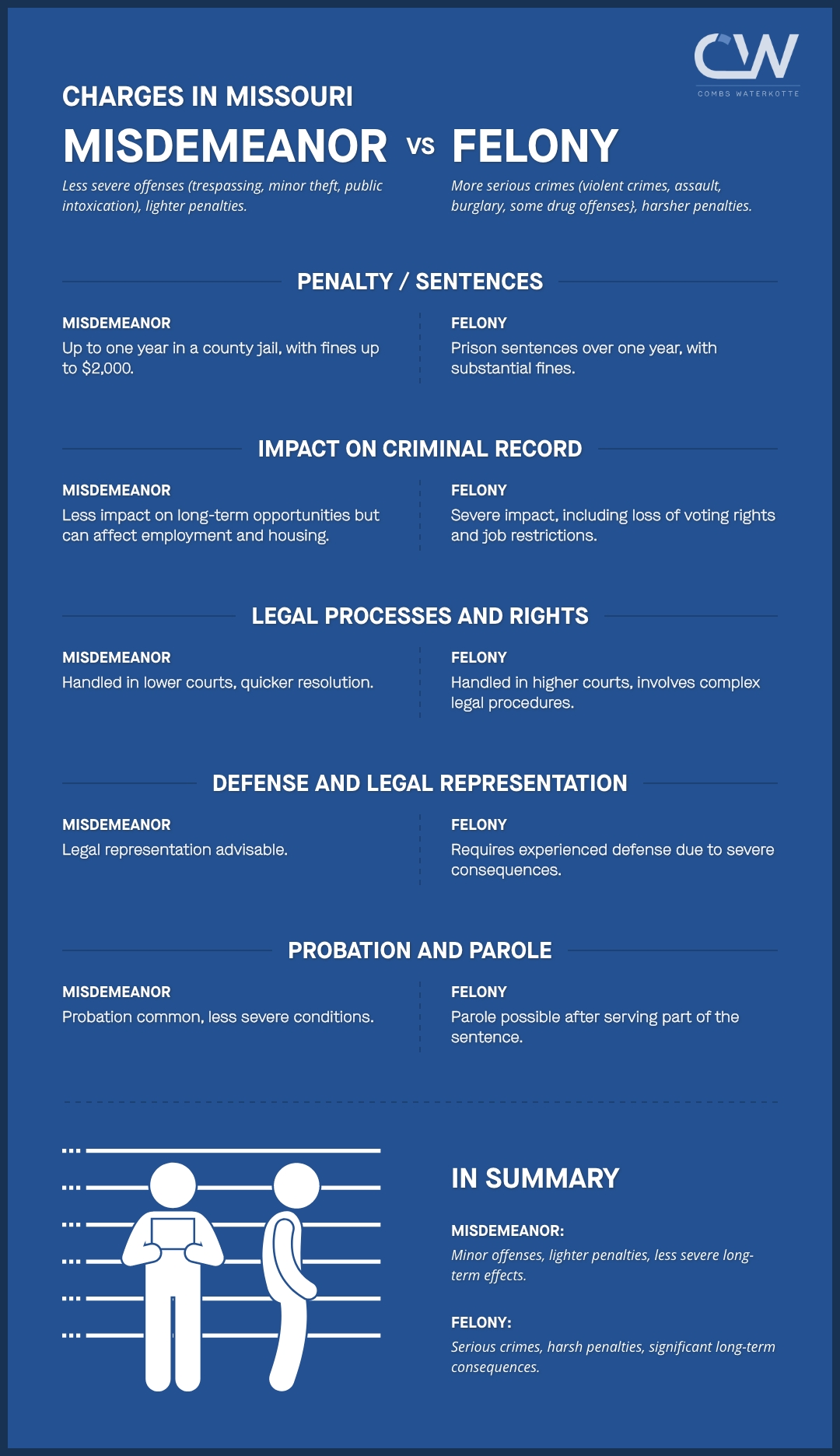
Misdemeanor vs. Felony Theft Charges in Missouri
A theft accusation could be either a misdemeanor or a felony depending on several factors. In general, the higher the value of the supposedly stolen property, the more serious the accusation. Below is a breakdown of why a theft accusation could fit into a given category:
- Stealing a storage tank or other container with any amount of anhydrous ammonia.
- Stealing or attempting to steal anhydrous ammonia or liquid nitrogen.
- Stealing livestock over $3,000 in value, with a prior livestock theft conviction.
- Stealing livestock over $10,000 in value, regardless of criminal record.
- Stealing a vehicle, with at least two prior theft-related convictions within 10 years, on separate occasions.
- Stealing money from a financial institution by physically trying to take it from a worker.
- Stealing over $10,000 worth of property as part of an organized retail theft.
- Stealing an ATM, or anything inside one.
- Stealing $750 or more worth of property, but less than $10,000, as a part of an organized retail theft.
- General theft of property or services worth more than $25,000.
- Stealing something the alleged victim was currently carrying or holding.
- The item stolen was:
- A motor vehicle.
- A will.
- A credit or debit card.
- A gun.
- An explosive.
- A U.S. flag for public display.
- An original copy of a Missouri legal bill.
- A court document.
- A voter registration book.
- Live fish, raised for sale, with a value of $75 or more.
- Captive wildlife held under permit.
- Drugs.
- Ammonium nitrate.
- Power, phone, or fuel lines.
- Anything to be used in the creation of methamphetamine.
- General theft of property or services worth $750 or more.
- Stealing an animal.
- Stealing a catalytic converter.
- Stealing anything with at least three prior theft-related convictions within 10 years, on separate occasions.
- Stealing mail before it reaches the recipient.
- Stealing property that fits none of the above categories, is worth less than $150, and the alleged offender has no prior theft convictions on their criminal record.
In cases that don’t fit any of the contexts listed above, theft is considered a class A misdemeanor.
Theft-Related Charges and Their Penalties
While § 570.030 RSMo is the main theft statute in Kansas City, there are several other statutes dedicated to either specific types of theft or related charges. Charges like burglary are often levied alongside stealing/larceny, while identity theft is more likely to be treated as a separate offense.
Burglary
Missouri defines burglary as breaking into a building when you aren’t allowed to be there, and intending to commit a crime. This crime is often a form of theft, but not always.
Robbery
Robbery is a particular kind of theft, where one person uses force or threats to coerce another person into giving away their valuables. In Missouri, for a crime to count as robbery, the alleged victim must have been threatened/hurt, or a weapon is involved.
Embezzlement
Embezzlement is when a person misuses funds that were not their own, but they were given control over. This is different from typical theft in that the alleged perpetrator had permission to access the money, but supposedly used it improperly.
Identity Theft
Identity theft is a particular kind of theft that involves stealing someone else’s identity, or manufacturing a fake one. Missouri specifically requires that the alleged perpetrator does so with the intent to steal something of value.
Credit Card Fraud
In Kansas City, credit card fraud could mean either using a fake/stolen credit/debit card, or, less commonly, lying on an application for a credit or debit card. This can include using a card that has been either cancelled or revoked.
Theft-Related Offenses: Penalties Table
| Charge Type | Statute(s) | Short Description | Penalty Range |
|---|---|---|---|
| Burglary | § 569.160 RSMo and § 569.170 RSMo | Breaking into a property to commit another crime. | Class D Felony or Class B Felony |
| Robbery | § 570.023 RSMo and § 570.025 RSMo | Using force to take something directly from another person. | Class B Felony or Class A Felony |
| Embezzlement | § 570.030 RSMo | Misusing money or property which you had legitimate access to. | Class B Felony or Class A Felony |
| Identity theft | § 570.223 RSMo | Taking another person’s identity or creating a fake identity to commit fraud. | Class B Misdemeanor to Class B Felony |
| Credit Card Fraud | § 570.130 RSMo and § 570.135 RSMo | Using a credit card that you aren’t supposed to, or lying on a credit card application. | Class A Misdemeanor or Class E Felony |
Combs Waterkotte’s stealing charges lawyers offer expert criminal defense for all of the above allegations. If you want to learn more about these individual charges, check out our ultimate guide to theft crimes in Missouri.
Strong Defenses Against Stealing Charges
Theft, stealing, and larceny charges can be defended using unique strategies like claim of right or ownership, and through more universal defenses like necessity and mistaken identity. Your attorney will research your case and listen to your story, then build a defense based on a tactic like the ones below:
- Claim of Right — Claim of right applies when the alleged offender believed they had permission to take the property.
- Actual Ownership — Actual ownership can help in cases where someone is accused of stealing something but actually has ownership rights.
- Perceived Ownership — Perceived ownership defenses can occur if a person honestly believed they had ownership rights of something, even if they didn’t. This can be challenging to prove.
- Lack of Intent — Particularly effective in shoplifting cases where a person forgot to add an item to their cart, rather than intentionally stealing it.
- Necessity — Sometimes theft is committed to prevent greater harm; for example, stealing medical supplies to help someone who’s been injured.
- Alibi — An alibi shows that the alleged offender was elsewhere at the time of the offense and could not have committed it.
- Mistaken Identity — Grainy security footage can be hard to interpret. It’s possible that the wrong person was accused.
- Lack of Evidence — In some cases, the prosecution fails to provide proof beyond a reasonable doubt, and the defense attorney can highlight this.
- Evidentiary Issues — If key evidence was obtained illegally or did not follow chain of custody rules, it can be challenged and thrown out.
Your larceny defense lawyer from Combs Waterkotte will help you pick the best defensive strategy for your case.
Why Choose Combs Waterkotte for Your Theft Defense Attorney
Combs Waterkotte is Missouri’s leading criminal defense law firm. Our team has over 100 years of combined legal experience and has handled over 10,000 cases — many of them theft cases, just like yours. We are dedicated to our clients and make sure we are always available to help.
Here’s what sets us apart:
- Our team includes a former prosecutor who can give insights on how the state builds its case against you.
- We take a client-first approach and have someone available 24/7 via phone.
- Every defense we build is trial-ready, which also gives us leverage in plea negotiations.
- Our former clients have given us over 500 five-star reviews.
- We employ a former police officer for investigation and evidence review.
When you are facing theft accusations, you need an experienced stealing charges lawyer to protect your freedom. You need Combs Waterkotte.

Start Building Your Theft Defense Today
Theft charges shouldn’t be taken lightly. A conviction could mean a felony on your record, years in prison, and long-lasting collateral consequences. Your defense attorney from Combs Waterkotte will help you fight against it.
Talk to a theft lawyer today by calling (314) 900-HELP or send us a message to schedule a free case review.

