

Federal Drug Trafficking Lawyer San Diego, CA. Federal drug trafficking charges can carry enormous consequences, and the government’s version of the case may already include drug quantities and alleged conduct you strongly dispute. Sometimes the government’s theory casts a very wide net, sweeping in alleged sales you were not part of, testimony from people trying to help themselves, or drugs found in shared spaces.
An indictment tells you what prosecutors allege, not what they can ultimately prove. Our federal defense team represents clients facing drug trafficking investigations and prosecutions in San Diego, CA, and throughout the United States. We examine the evidence behind each accusation, challenge unsupported sentencing allegations, and prepare to take the case to trial when that is the right course.
Whether you have just been contacted by federal agents or a loved one is already being held, call (314) 900-HELP or contact Combs Waterkotte to discuss your case in a free, confidential consultation with a federal drug trafficking lawyer in San Diego, CA.
Cases Handled
Over 10,000
Jail Days Saved
Over 1 Million
Google Reviews
500+ Perfect
Legal Experience
100+ Years
Below, we explain:
- When federal prosecutors may step into a drug trafficking case
- How to respond if you learn that you are the target of a federal drug investigation
- Which elements prosecutors must prove beyond a reasonable doubt in federal trafficking and conspiracy cases
- How alleged drug quantity can trigger mandatory minimum sentences and increase federal sentencing exposure
- How a firearm allegation can add years to a federal drug sentence
- How defense attorneys scrutinize searches, witness credibility, drug calculations, and the evidence tying you to the alleged trafficking
Legal Videos
Can Federal Charges Be Reduced Or Dismissed?
Can Federal Charges Be Reduced Or Dismissed? Chris Combs and Andrew Russek, lawyers with Combs Waterkotte, a leading federal criminal defense firm, talk about proffers, probation, and federal …
Should I Hire A Lawyer Experienced In Federal Defense?
Should I Hire A Lawyer Experienced In Federal Defense? Chris Combs and Andrew Russek from the leading federal criminal defense firm Combs Waterkotte discuss the importance of hiring a lawyer with …
What Penalties Apply To Federal Sex Crime Convictions?
What Penalties Apply To Federal Sex Crime Convictions? Andrew Russek and Chris Combs from Combs Waterkotte federal criminal defense firm discuss potential penalties related to federal sex crime …
Do Federal Sex Crimes Require Sex Offender Registration?
Do Federal Sex Crimes Require Sex Offender Registration? Andrew Russek, a lawyer with leading federal criminal defense firm Combs Waterkotte, discusses the sex offender registry and federal sex …
What Makes A Sex Crime Federal Rather Than State?
What Makes A Sex Crime Federal Rather Than State? Andrew Russek and Chris Combs of Combs Waterkotte discuss factors that play into a sex crime being classified as federal, rather than …
What Are Federal Sex Crime Charges?
What Are Federal Sex Crime Charges? Chris Combs and Andrew Russek of Combs Waterkotte discuss the most common federal sex crime charges. Interview Transcript Scott Michael Dunn: Well, let's …
Can Federal Charges Be Reduced Or Dismissed?
Can Federal Charges Be Reduced Or Dismissed? Chris Combs and Andrew Russek, lawyers with Combs Waterkotte, a leading federal criminal defense firm, talk about proffers, probation, and federal …
Should I Hire A Lawyer Experienced In Federal Defense?
Should I Hire A Lawyer Experienced In Federal Defense? Chris Combs and Andrew Russek from the leading federal criminal defense firm Combs Waterkotte discuss the importance of hiring a lawyer with …
What Penalties Apply To Federal Sex Crime Convictions?
What Penalties Apply To Federal Sex Crime Convictions? Andrew Russek and Chris Combs from Combs Waterkotte federal criminal defense firm discuss potential penalties related to federal sex crime …
Do Federal Sex Crimes Require Sex Offender Registration?
Do Federal Sex Crimes Require Sex Offender Registration? Andrew Russek, a lawyer with leading federal criminal defense firm Combs Waterkotte, discusses the sex offender registry and federal sex …
What Makes A Sex Crime Federal Rather Than State?
What Makes A Sex Crime Federal Rather Than State? Andrew Russek and Chris Combs of Combs Waterkotte discuss factors that play into a sex crime being classified as federal, rather than …
What Are Federal Sex Crime Charges?
What Are Federal Sex Crime Charges? Chris Combs and Andrew Russek of Combs Waterkotte discuss the most common federal sex crime charges. Interview Transcript Scott Michael Dunn: Well, let's …
When Does Drug Trafficking in San Diego, CA Become a Federal Case?
Crossing state lines is not a requirement for a drug trafficking case to become federal. Federal controlled-substance law can apply even when the alleged conduct occurs entirely within a single state, as the Supreme Court recognized in Gonzales v. Raich. Drug quantity can matter enormously to charging and sentencing, but there is no universal amount that automatically makes every case federal.
Federal prosecutors may become involved in cases tied to broader distribution networks, interstate activity, foreign suppliers, multiple defendants, or investigations conducted alongside local law enforcement. But a case can also start with a traffic stop by a state trooper and later reach a U.S. Attorney’s Office. The agency that first encounters you is only one piece of the puzzle when prosecutors decide where charges will be brought.
Once federal prosecutors enter the picture, your San Diego, CA criminal defense lawyer needs to assess everything from pretrial detention to the charged offenses and potential federal sentence. A result that might be available in state court is not automatically available in federal court.
What to Do If Federal Agents Contact You About Drug Trafficking in San Diego, CA
You do not need to wait for an indictment to get legal advice. A search warrant, subpoena, or federal target letter is a clear sign that you should take the situation seriously. Do not assume a casual request to talk about another person’s drug activity is harmless just because you have not been charged.
- Do not get into the facts without a lawyer. Stay calm, be respectful, and tell agents that you want to speak with a federal drug trafficking attorney in San Diego, CA before discussing the case.
- If you do speak, do not invent answers or guess. A materially false statement made knowingly in a federal matter can itself create criminal exposure under 18 U.S.C. § 1001.
- Preserve evidence. Do not erase messages, change documents, get rid of physical evidence, or ask other people to get their stories straight.
- Get legal help with paperwork and deadlines. Do not toss a subpoena in a drawer or interfere with officers executing a lawful search. Your attorney can review the paperwork, identify deadlines, and determine whether any objections are available.
Talking first and figuring out the stakes later can box you into statements you did not need to make. A federal drug trafficking lawyer in San Diego, CA can evaluate where you stand and help decide whether, when, and how any communication with federal investigators should happen.
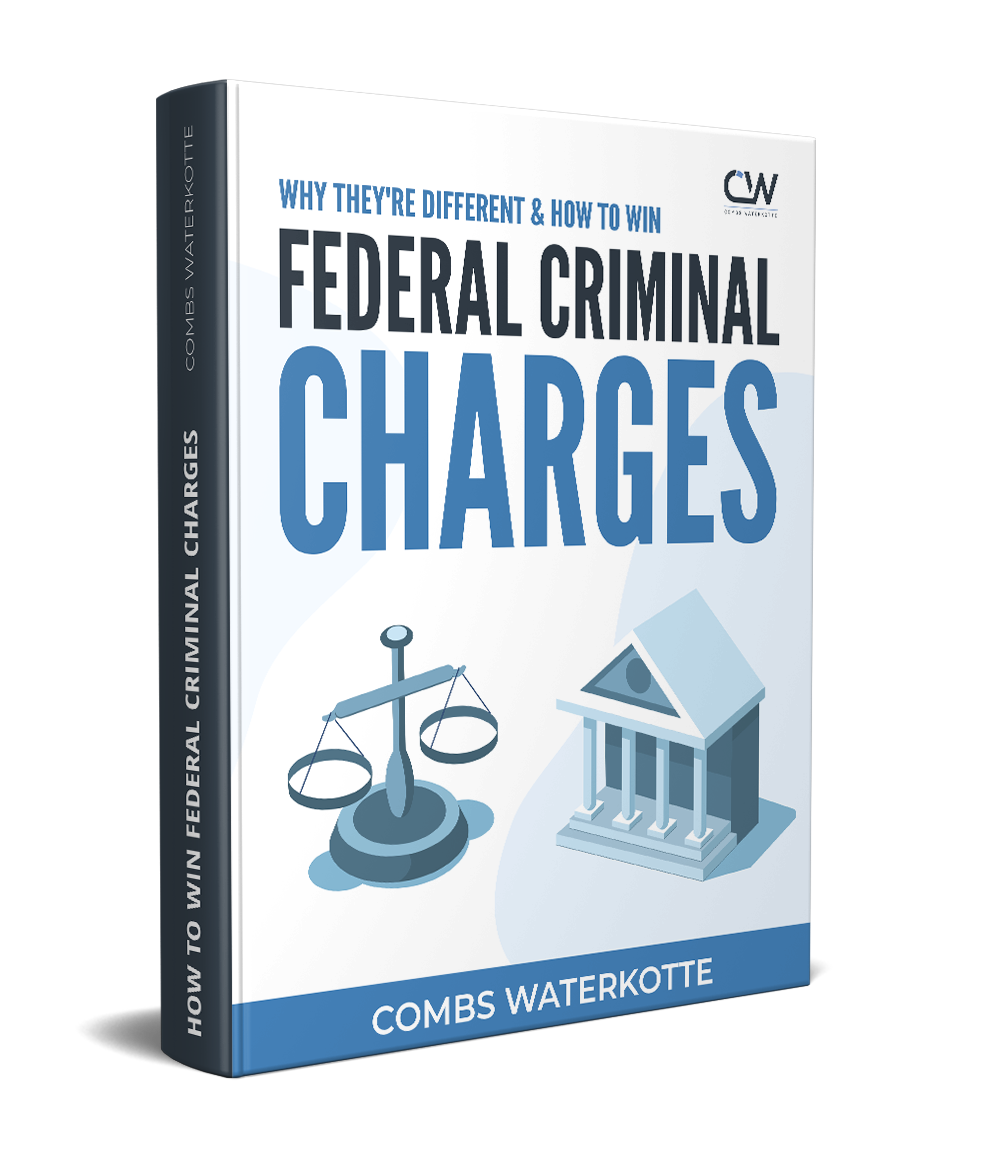
Free book
Facing Federal Criminal Charges? Why They’re Different and How to Win
Combs Waterkotte, a leading federal criminal defense law firm, has handled over 10,000 cases successfully. This ebook guides you through the federal criminal defense process, how federal charges are different, and how to win.
What Federal Laws Apply to Drug Trafficking Charges?
The central federal trafficking statute is 21 U.S.C. § 841. The statute prohibits knowingly or intentionally manufacturing, distributing, dispensing, or possessing a controlled substance with intent to manufacture, distribute, or dispense it without legal authorization.
Drug Distribution and Possession With Intent
The government does not always need a completed sale. A possession with intent to distribute charge may be based on evidence that you knowingly possessed a controlled substance and intended to distribute it to another person. Distribution does not necessarily require payment or a traditional sale.
These cases may involve fentanyl, methamphetamine, cocaine, heroin, marijuana, or controlled prescription medications. The type of drug can affect the case significantly, but prosecutors still have to connect you to the conduct they are alleging.
When Federal Drug Charges Involve Importation
Drug trafficking allegations involving substances brought into the country can result in importation of controlled substances charges. Potential punishment for many of these offenses is addressed by 21 U.S.C. § 960, with sentencing exposure determined in part by the substance involved, its quantity, and other statutory circumstances.
Federal Continuing Criminal Enterprise Charges
A continuing criminal enterprise charge under § 848 requires more than participation in an ordinary drug conspiracy. It addresses a continuing series of qualifying drug violations involving an organizer, supervisor, or manager of at least five other people, along with substantial income or resources. A case involving many defendants or alleged transactions does not automatically become a continuing criminal enterprise.
What Does the Government Have to Prove in a Federal Drug Trafficking Case in San Diego, CA?
In a typical possession-with-intent case, prosecutors must establish beyond a reasonable doubt both knowing possession of a controlled substance and an intent to distribute it. The federal model jury instruction for possession with intent to distribute lays out these basic elements.
A package addressed to your San Diego, CA home raises very different questions from drugs found in your pocket. Who ordered it? Who could access the property? What shows you knew the package contained drugs? The defense needs to examine knowledge and control, not simply where officers found something.
The government may point to scales, packaging materials, text messages, cash, alleged customer testimony, or the amount of drugs involved as evidence of an intent to distribute. Those facts need context. A prosecutor may call a message incriminating when it is ambiguous, treat legitimate cash as drug proceeds, or rely on a witness whose version of events clashes with the records.
Knowing exactly which controlled substance was involved is not always required if the evidence shows that you knowingly possessed some controlled substance. But when drug type or quantity increases the statutory punishment, those facts carry their own proof requirements and generally must be established through the proper jury findings or a valid plea.
Federal Drug Conspiracy Cases in San Diego, CA
Under 21 U.S.C. § 846, federal drug conspiracy and attempt charges carry the same statutory punishment as the drug offense at the center of the alleged agreement. That does not mean everyone named in the conspiracy will necessarily receive the same sentence.
A federal drug conspiracy allegation is built around two core ideas: an unlawful agreement and your knowing participation in that agreement. A person can be charged in a drug conspiracy even if officers never recover drugs directly from them. There is another important distinction: a § 846 drug conspiracy does not require proof of a separate overt act, according to United States v. Shabani.
Knowing a dealer, living with a relative who sells drugs, or appearing in someone’s contacts does not automatically prove that you joined an agreement. That makes the details critical. What exactly do prosecutors say you agreed to? When did they say you joined? And what evidence proves it was more than association or suspicion?
The amount of drugs attributed to you deserves its own careful analysis. Under the Guidelines’ relevant-conduct rules, another person’s conduct is not simply dumped into your Guidelines calculation. It generally must be within the jointly undertaken activity, in furtherance of it, and reasonably foreseeable to you. The entire conspiracy’s drug quantity is not automatically your Guidelines quantity. A drug quantity that triggers a statutory mandatory minimum involves a separate legal analysis.
What Are the Penalties for Federal Drug Trafficking?
The federal trafficking penalty provisions tie potential sentencing ranges in part to the type and quantity of controlled substance involved. The following table shows common thresholds before qualifying prior-conviction enhancements or other provisions change the range.
| Controlled Substance | Threshold for 5 to 40 Years | Threshold for 10 Years to Life |
|---|---|---|
| Heroin | 100 grams | 1 kilogram |
| Cocaine | 500 grams | 5 kilograms |
| Cocaine base / crack | 28 grams | 280 grams |
| Fentanyl | 40 grams | 400 grams |
| Fentanyl analogue or fentanyl-related substance | 10 grams | 100 grams |
| Methamphetamine, actual | 5 grams | 50 grams |
| Methamphetamine, mixture | 50 grams | 500 grams |
| Marijuana | 100 kilograms or 100 plants | 1,000 kilograms or 1,000 plants |
These are minimum quantities for each tier. When the higher quantity threshold is met, the higher statutory range generally applies instead of the lower one. Most of these quantity thresholds are based on the weight of a mixture or substance containing the drug, while actual methamphetamine and marijuana plant counts are treated differently. For methamphetamine, “actual” means the weight of the methamphetamine itself rather than the total weight of the mixture containing it.
Below-threshold does not mean misdemeanor. A lower quantity can still expose someone to substantial prison time. Under § 841(b)(1)(C), many Schedule I and II offenses carry up to 20 years even without a quantity-based mandatory minimum, before other enhancements are considered. Other substances and provisions have different limits. Convictions can also bring substantial fines and supervised release after prison.
How Prior Felonies Can Increase Federal Drug Penalties
For the highest quantity tier under § 841(b)(1)(A), one qualifying serious drug felony or serious violent felony can increase the minimum from 10 to 15 years. With two or more qualifying convictions, the mandatory minimum can climb to 25 years. For § 841(b)(1)(B), the ordinary 5-to-40-year sentencing range can become 10 years to life when a qualifying prior applies.
Not every prior felony qualifies. Under 21 U.S.C. § 851, the prosecution generally cannot spring the enhancement on you at sentencing; it must file written notice identifying the qualifying conviction before trial or a guilty plea. The conviction’s legal qualifications and the government’s compliance with that process both matter.
Federal Drug Charges Involving Death or Serious Bodily Injury in San Diego, CA
An allegation that the distributed drug caused death or serious bodily injury can put a defendant in a 20-years-to-life sentencing range if the government proves the required elements. But an overdose alone does not establish the enhancement. There still has to be legally sufficient proof tying the distributed drug to the death or serious bodily injury.
In Burrage v. United States, the Supreme Court held that the government must prove but-for causation in cases where the controlled substance was not independently sufficient to produce the death. That can make toxicology results, the presence of other drugs, medical records, and proof of where the substance came from critical to the defense.
When Firearms Increase Federal Drug Trafficking Penalties in San Diego, CA
A gun allegation can add years to a federal drug sentence rather than simply increasing the punishment for the trafficking charge itself. Under 18 U.S.C. § 924(c), a qualifying firearm offense tied to drug trafficking can add a consecutive five-year mandatory minimum to whatever sentence is imposed for the drug charge. Brandishing raises that minimum to seven years; discharging raises it to ten. Additional facts involving the firearm can lead to still greater penalties.
Finding a firearm in the same home as drugs does not automatically prove a § 924(c) charge. That means digging into who controlled the weapon, where officers found it, who had access to it, and whether the government can prove a meaningful connection to the trafficking allegation.
Ways a Federal Drug Trafficking Mandatory Minimum May Not Apply
An applicable federal mandatory minimum does not disappear just because the judge thinks the sentence is too harsh. There are, however, limited legal mechanisms that can authorize a sentence below the statutory floor.
Qualifying for Safety-Valve Relief
The federal safety-valve provision allows qualifying defendants convicted of specified drug offenses to be sentenced without the otherwise applicable minimum. Eligibility depends on all the statutory requirements, including:
- A criminal record that falls within the statute’s criminal-history limits
- No qualifying violence, credible threats, or disqualifying firearm or dangerous-weapon involvement tied to the offense
- No death or serious bodily injury caused by the offense
- No disqualifying leadership or management role and no involvement as a principal in a continuing criminal enterprise
- Truthfully providing the government all required information and evidence by the sentencing deadline
Safety-valve eligibility in San Diego, CA cannot be reduced to a simple first-offense-versus-prior-record question. Your San Diego, CA federal drug trafficking lawyer needs to compare the facts of your case against every statutory requirement. Safety-valve relief also does not guarantee probation or eliminate a separate firearm sentence.
Can Cooperation Lead to a Sentence Below the Mandatory Minimum?
Under 18 U.S.C. § 3553(e), the court may gain authority to go beneath the statutory minimum if the government files the required motion based on substantial assistance. A request for a Guidelines reduction alone does not necessarily supply that authority.
Cooperation can matter, but a verbal assurance from an agent is not the same thing as a guaranteed sentencing reduction. Before any interview, proffer, or cooperation agreement, your lawyer should examine the written terms, possible risks, and exactly what legal mechanism would be needed to obtain the promised benefit.
Separately, a successful challenge to the charged quantity, a qualifying prior, or the offense itself can change which minimum applies. Before treating any mandatory minimum as inevitable, we examine what facts and legal findings it actually depends on.
How Federal Drug Trafficking Charges Can Be Defended in San Diego, CA
Some cases turn on whether the government can prove you knowingly participated. Others turn on whether key evidence can be used at all. The strategy should be built around the actual weaknesses in the government’s case, not pulled from a generic defense checklist.
Challenging Unlawful Searches and Seizures
A search challenge may begin with the initial stop and continue through detention, consent, execution of a warrant, and the eventual seizure of evidence. Federal Rule of Criminal Procedure 41 governs important aspects of federal search warrants and motions to suppress.
A warrant is not a blank check. We look at whether it was properly supported, whether officers stayed within its limits, and whether the government’s account of consent or access matches the actual record. A viable suppression motion can prevent prosecutors from using evidence they need. Suppression can be powerful, but it is not automatic for every police mistake and does not necessarily end the case by itself.
Scrutinizing Informant Testimony
A witness who stands to gain from cooperation may have an incentive to make your role sound larger than it was. Credibility is not decided by assumption. We look at incentives, inconsistencies, ability to observe, and whether recordings or records independently support the account.
We compare the witness’s earlier statements with what they said after cooperation entered the picture, then check that account against recordings, messages, and records.
Testing the Government’s Drug-Quantity Calculations
We review lab testing, sample selection, chain-of-custody records, and the math prosecutors used to arrive at the drug quantity they attribute to you. Methamphetamine cases require particular care because the weight of actual methamphetamine and the total mixture can lead to different statutory consequences. Even perfect lab work does not settle attribution in a conspiracy case. Prosecutors still have to connect particular conduct and quantities to the individual defendant under the applicable rules.
The government may be able to prove the contents of a package and still face a separate problem proving that you knew what was there or agreed to take part in trafficking it.
Entrapment in Federal Drug Trafficking Cases
A valid entrapment defense requires government inducement and a lack of predisposition to engage in the criminal conduct. Simply giving someone the opportunity to commit a crime does not, by itself, establish entrapment. The communications, pressure involved, and sequence of events determine whether this defense fits.
What to Expect After a Federal Drug Trafficking Arrest in San Diego, CA
An indictment is an accusation, not a conviction. The grand jury process uses a probable-cause standard, while a trial requires the government to prove guilt beyond a reasonable doubt.
An early priority is whether you will remain in custody. Under 18 U.S.C. § 3142, a qualifying federal drug charge carrying ten years or more can shift the starting point toward detention when the statutory conditions are satisfied. Detention is not automatic, but a release argument needs preparation.
A federal drug trafficking lawyer in San Diego, CA can help build a release plan around stable housing, employment, supervision, treatment, and other conditions that address the court’s concerns. At the same time, the federal court process brings discovery, motion deadlines, and decisions about negotiations and trial. A good federal defense keeps both tracks moving: the immediate custody question and the larger fight over the charges.
How Are Federal Drug Trafficking Sentences Calculated in San Diego, CA?
Federal drug sentencing has two different guardrails: the penalties set by statute and the advisory range calculated under the Guidelines. The U.S. Sentencing Guidelines do not bind the judge in the same way as a statutory minimum or maximum, but the court must calculate them correctly and take them into account. Whatever the Guidelines say, the sentence still has to fit within the applicable statutory limits unless a lawful exception changes the picture.
Several pieces feed into the calculation, including drug quantity, criminal history, leadership or minor-role findings, and other offense-specific factors. The court also considers the offense, your history and characteristics, and the other factors in § 3553(a).
Sentencing preparation includes reviewing the presentence report, objecting to unsupported allegations, and presenting relevant records and mitigation. If something in the report is wrong, the fact that it appears in an official filing does not make it untouchable.
Federal probation depends on the charge, statutory limits, and the circumstances of the case. No mandatory minimum does not equal no prison time, and it does not guarantee that probation is legally available or realistic. We want you making decisions from the real sentencing picture, not from guesswork about what a judge might do.
Federal Asset Forfeiture in Drug Trafficking Cases
Federal drug prosecutions can reach beyond your liberty and put money, vehicles, real estate, and other property in jeopardy. Under 21 U.S.C. § 853, the government can seek forfeiture of proceeds from qualifying drug offenses as well as property allegedly used or intended to help commit them.
That does not mean every dollar in an account or every asset owned by a family is automatically forfeitable. The government’s legal theory, the source of funds, ownership interests, and the alleged connection to the offense need review.
If property has been seized or threatened, preserve the paperwork and financial records showing where it came from and who owns it. Let your lawyer know right away if another person has an ownership interest in any seized property. Third-party claims follow their own procedures and deadlines.
Why Choose Combs Waterkotte for a Federal Drug Trafficking Case in San Diego, CA?
A federal trafficking case in San Diego, CA can bury you in evidence before the real fight even begins: messages, surveillance, laboratory testing, witness statements, and accusations tied to other people. You need a defense team that can work through that material, identify what matters to your charges, and prepare to challenge it in court.
- A full defense team: Combs Waterkotte brings attorneys, investigators, paralegals, and support staff to complex federal drug trafficking cases in San Diego, CA.
- Insight into the prosecution: Former prosecutors on our team understand how criminal cases are assembled, where leverage comes from, and how the government evaluates evidence and plea decisions.
- Built with trial in mind: An indictment does not mean you should automatically plead guilty. We investigate first, test the government’s case, and prepare for trial when the facts and strategy call for it.
- Client-centered advocacy: We treat you like a person, not a case number. You will understand what is happening, what your options are, and what our team is doing to protect you at each stage of the case.
- A defense built around your exposure: We look at the issues that can actually move the needle, including pretrial detention, drug quantity, suppression motions, sentencing risks, and whether trial makes sense.
Speak With a Federal Drug Trafficking Lawyer in San Diego, CA
When you call, let us know what has happened so far, which agency contacted you, and whether anything is coming up quickly. Have any indictment, warrant, target letter, subpoena, or other federal paperwork available if you can. You do not have to figure out the legal side on your own before speaking with us.
Combs Waterkotte defends people in San Diego, CA, and across the country against serious federal criminal charges. Call (314) 900-HELP or contact us for a free, confidential consultation to speak with a federal drug trafficking lawyer about your case.

