

Federal Drug Trafficking Lawyer Idaho. Federal drug trafficking charges can carry enormous consequences, and the government’s version of the case may already include drug quantities and alleged conduct you strongly dispute. They may be counting alleged transactions you never witnessed, relying on someone trying to reduce their own sentence, or treating a shared home or vehicle as proof that you controlled the drugs inside.
An indictment tells you what prosecutors allege, not what they can ultimately prove. Combs Waterkotte represents people in Idaho, and across the country who are under investigation or charged with federal drug trafficking offenses. Our attorneys scrutinize how the government built its case, push back on unsupported allegations, and prepare to fight the charges in court when necessary.
Whether you have just been contacted by federal agents or a loved one is already being held, call (314) 900-HELP or contact Combs Waterkotte for a free and confidential case review with a federal drug trafficking lawyer serving Idaho.
Cases Handled
Over 10,000
Jail Days Saved
Over 1 Million
Google Reviews
500+ Perfect
Legal Experience
100+ Years
Below, we explain:
- What can cause a drug trafficking case to be prosecuted at the federal level
- How to respond if you learn that you are the target of a federal drug investigation
- What the government has to establish to convict someone of federal drug trafficking or conspiracy
- Why the type and amount of drugs involved can dramatically change the penalties you face
- When an alleged connection between a gun and drug trafficking can lead to separate federal penalties
- How the defense can challenge searches, witnesses, drug quantities, and other evidence
Legal Videos
Can Federal Charges Be Reduced Or Dismissed?
Can Federal Charges Be Reduced Or Dismissed? Chris Combs and Andrew Russek, lawyers with Combs Waterkotte, a leading federal criminal defense firm, talk about proffers, probation, and federal …

Should I Hire A Lawyer Experienced In Federal Defense?
Should I Hire A Lawyer Experienced In Federal Defense? Chris Combs and Andrew Russek from the leading federal criminal defense firm Combs Waterkotte discuss the importance of hiring a lawyer with …
What Penalties Apply To Federal Sex Crime Convictions?
What Penalties Apply To Federal Sex Crime Convictions? Andrew Russek and Chris Combs from Combs Waterkotte federal criminal defense firm discuss potential penalties related to federal sex crime …
Do Federal Sex Crimes Require Sex Offender Registration?
Do Federal Sex Crimes Require Sex Offender Registration? Andrew Russek, a lawyer with leading federal criminal defense firm Combs Waterkotte, discusses the sex offender registry and federal sex …
What Makes A Sex Crime Federal Rather Than State?
What Makes A Sex Crime Federal Rather Than State? Andrew Russek and Chris Combs of Combs Waterkotte discuss factors that play into a sex crime being classified as federal, rather than …
What Are Federal Sex Crime Charges?
What Are Federal Sex Crime Charges? Chris Combs and Andrew Russek of Combs Waterkotte discuss the most common federal sex crime charges. Interview Transcript Scott Michael Dunn: Well, let's …
Can Federal Charges Be Reduced Or Dismissed?
Can Federal Charges Be Reduced Or Dismissed? Chris Combs and Andrew Russek, lawyers with Combs Waterkotte, a leading federal criminal defense firm, talk about proffers, probation, and federal …
Should I Hire A Lawyer Experienced In Federal Defense?
Should I Hire A Lawyer Experienced In Federal Defense? Chris Combs and Andrew Russek from the leading federal criminal defense firm Combs Waterkotte discuss the importance of hiring a lawyer with …
What Penalties Apply To Federal Sex Crime Convictions?
What Penalties Apply To Federal Sex Crime Convictions? Andrew Russek and Chris Combs from Combs Waterkotte federal criminal defense firm discuss potential penalties related to federal sex crime …
Do Federal Sex Crimes Require Sex Offender Registration?
Do Federal Sex Crimes Require Sex Offender Registration? Andrew Russek, a lawyer with leading federal criminal defense firm Combs Waterkotte, discusses the sex offender registry and federal sex …
What Makes A Sex Crime Federal Rather Than State?
What Makes A Sex Crime Federal Rather Than State? Andrew Russek and Chris Combs of Combs Waterkotte discuss factors that play into a sex crime being classified as federal, rather than …
What Are Federal Sex Crime Charges?
What Are Federal Sex Crime Charges? Chris Combs and Andrew Russek of Combs Waterkotte discuss the most common federal sex crime charges. Interview Transcript Scott Michael Dunn: Well, let's …
Why Do Some Drug Trafficking Cases in Idaho Go Federal?
Crossing state lines is not a requirement for a drug trafficking case to become federal. Federal controlled-substance statutes can still apply to conduct that never leaves one state, a point addressed by the Supreme Court in Gonzales v. Raich. There is no single drug-weight threshold that automatically turns every state case into a federal prosecution.
Some federal drug investigations involve interstate distribution networks, international sources, several alleged participants, or joint work between federal and local authorities. But a case can also start with a traffic stop by a state trooper and later reach a U.S. Attorney’s Office. The agency that first encounters you is only one piece of the puzzle when prosecutors decide where charges will be brought.
Once federal prosecutors enter the picture, your Idaho criminal defense lawyer needs to assess everything from pretrial detention to the charged offenses and potential federal sentence. The options available in state court do not necessarily carry over once the case goes federal.
What Should You Do If Federal Agents Contact You About Drug Trafficking in Idaho?
You should not wait until formal charges are filed before speaking with a lawyer. A search warrant, subpoena, or federal target letter deserves prompt attention. So does an agent asking for a voluntary conversation about someone else’s drug activity.
- Do not try to talk your way through the investigation on your own. Stay calm, be respectful, and tell agents that you want to speak with a federal drug trafficking attorney in Idaho before discussing the case.
- Do not make up an answer just because an agent keeps pressing. Knowingly making materially false statements in a federal matter can create separate exposure under 18 U.S.C. § 1001.
- Preserve evidence. Do not erase messages, change documents, get rid of physical evidence, or ask other people to get their stories straight.
- Do not try to decipher federal demands on your own. Do not ignore a subpoena or court order, and do not obstruct a search. Give your lawyer the documents so they can evaluate the required response and any available objections.
The urge to clear things up immediately can backfire if you do not yet know what agents already have or what they are actually investigating. A federal drug trafficking lawyer in Idaho can assess the situation and advise you about any proposed communication with the government.
Free book
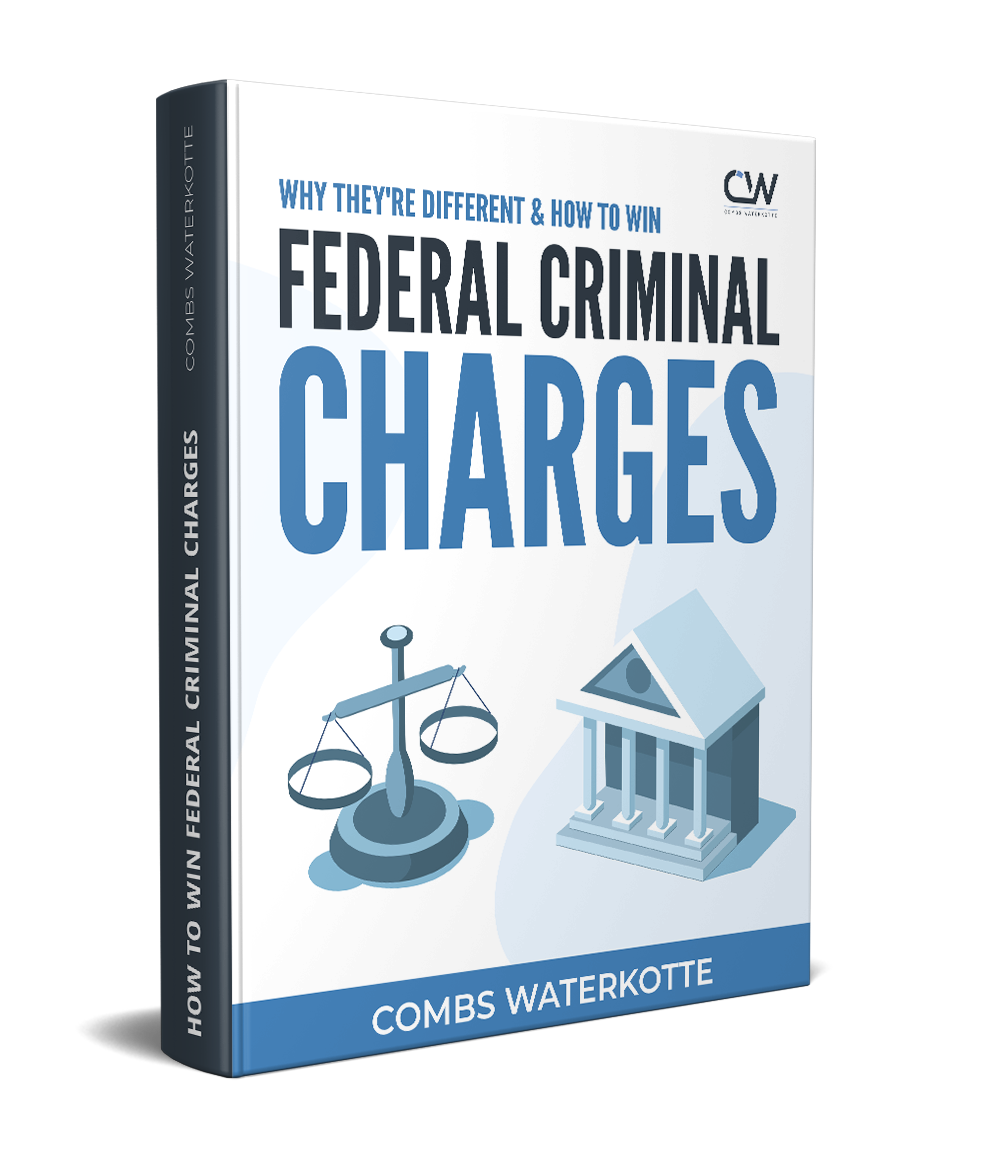
Facing Federal Criminal Charges? Why They’re Different and How to Win
Combs Waterkotte, a leading federal criminal defense law firm, has handled over 10,000 cases successfully. This ebook guides you through the federal criminal defense process, how federal charges are different, and how to win.
Federal Laws Used in Drug Trafficking Cases
The central federal trafficking statute is 21 U.S.C. § 841. It reaches several forms of drug trafficking conduct, including manufacturing, distribution, dispensing, and possession with intent to distribute controlled substances.
Distribution, Manufacturing, and Possession With Intent
The government does not always need a completed sale. A possession with intent to distribute charge can arise when prosecutors claim you knowingly possessed drugs with plans to distribute them, even if no transfer was completed. Distribution does not necessarily require payment or a traditional sale.
Federal drug trafficking charges are not limited to any one substance and may involve fentanyl, methamphetamine, cocaine, heroin, marijuana, or controlled prescription medications. The type of drug can affect the case significantly, but prosecutors still have to connect you to the conduct they are alleging.
When Federal Drug Charges Involve Importation
Allegations that drugs entered the United States can lead to importation of controlled substances charges. The corresponding federal penalty provisions are found in 21 U.S.C. § 960, where penalties can depend on drug type, quantity, and additional facts specified in the statute.
When Prosecutors Allege a Continuing Criminal Enterprise
A continuing criminal enterprise charge under § 848 requires more than participation in an ordinary drug conspiracy. It addresses a continuing series of qualifying drug violations involving an organizer, supervisor, or manager of at least five other people, along with substantial income or resources. A large indictment does not, by itself, establish those requirements.
What Evidence Is Needed to Prove Federal Drug Trafficking in Idaho?
For a typical possession-with-intent charge, the government must prove beyond a reasonable doubt that you knowingly possessed a controlled substance and intended to distribute it. The federal model jury instruction for possession with intent to distribute lays out these basic elements.
Finding drugs directly on you is not the same as finding a suspicious package at a Idaho address you share with other people. Who sent it, who expected it, and who had access to the property? Most importantly, what connects you to knowledge of its contents? Physical location is only part of the story. The defense should examine who actually knew about and controlled the drugs.
To build an intent case, prosecutors may piece together packaging materials, scales, messages, cash, alleged buyer statements, and drug quantity as evidence of an intent to distribute. None of that evidence exists in a vacuum. A prosecutor may call a message incriminating when it is ambiguous, treat legitimate cash as drug proceeds, or rely on a witness whose version of events clashes with the records.
There is an important limit, though: not knowing the drug’s exact identity is not necessarily a defense if you knew you possessed a controlled substance. At the same time, drug type and quantity can affect the statutory sentencing range and must be established through the legally required jury findings or valid plea admissions.
Federal Drug Conspiracy Cases in Idaho
Under 21 U.S.C. § 846, an attempt or conspiracy is subject to the same statutory penalties as the underlying drug offense. Equal statutory exposure does not automatically translate into identical sentences for every person charged.
A federal drug conspiracy allegation is built around two core ideas: an unlawful agreement and your knowing participation in that agreement. Prosecutors do not need to recover drugs from every person they charge. Federal drug conspiracy law under § 846 also does not require a separate overt act beyond the agreement itself, a rule confirmed by the Supreme Court in United States v. Shabani.
Association is not automatically agreement. You can know someone involved in drug trafficking, live with them, or appear repeatedly in their communications without necessarily joining their alleged conspiracy. The defense should pin down what agreement prosecutors claim existed, when they say you became part of it, and what evidence actually ties you to it.
The amount of drugs attributed to you deserves its own careful analysis. Under the Guidelines’ relevant-conduct rules, another person’s conduct is not simply dumped into your Guidelines calculation. It generally must be within the jointly undertaken activity, in furtherance of it, and reasonably foreseeable to you. The entire conspiracy’s drug quantity is not automatically your Guidelines quantity. And when a particular quantity is being used to trigger a statutory minimum sentence, the analysis does not stop with the Guidelines.
What Are the Penalties for Federal Drug Trafficking?
The federal drug trafficking penalty provisions create different sentencing ranges for different drug types and quantities. The table below breaks down several important drug-quantity thresholds before qualifying prior convictions, injury allegations, or other provisions potentially increase the penalties.
| Controlled Substance | Threshold for 5 to 40 Years | Threshold for 10 Years to Life |
|---|---|---|
| Heroin | 100 grams | 1 kilogram |
| Cocaine | 500 grams | 5 kilograms |
| Cocaine base / crack | 28 grams | 280 grams |
| Fentanyl | 40 grams | 400 grams |
| Fentanyl analogue or fentanyl-related substance | 10 grams | 100 grams |
| Methamphetamine, actual | 5 grams | 50 grams |
| Methamphetamine, mixture | 50 grams | 500 grams |
| Marijuana | 100 kilograms or 100 plants | 1,000 kilograms or 1,000 plants |
Each figure in the table represents the quantity at which that statutory penalty tier begins. When the higher quantity threshold is met, the higher statutory range generally applies instead of the lower one. The listed amounts generally concern the total mixture or substance containing the drug, except where the statute specifically uses actual methamphetamine weight or marijuana plant counts. When the statute refers to “actual” methamphetamine, it is measuring the methamphetamine itself rather than the entire mixture.
Do not mistake “below the threshold” for “not serious.” A lower quantity can still expose someone to substantial prison time. Under § 841(b)(1)(C), many Schedule I and II offenses carry up to 20 years even without a quantity-based mandatory minimum, before other enhancements are considered. Different controlled substances and statutory provisions can carry different ranges. Prison is also not the only consequence; substantial fines and terms of supervised release may follow a conviction.
When a Prior Conviction Can Increase a Federal Drug Sentence
For the highest quantity tier under § 841(b)(1)(A), one qualifying prior serious drug felony or serious violent felony can add another five years to the statutory minimum, taking it from 10 years to 15. Two or more can raise it to 25 years. For § 841(b)(1)(B), a qualifying conviction can double the minimum from five years to ten and increase the maximum from 40 years to life.
A felony on your record does not automatically trigger these enhanced penalties. Under 21 U.S.C. § 851, prosecutors generally must file written notice identifying the convictions before trial or a guilty plea to seek the increased punishment. There are two questions to examine closely: does the prior legally qualify, and did the government follow the process required to use it?
Charges Involving Death or Serious Bodily Injury in Idaho
If prosecutors can prove that death or serious bodily injury resulted from use of the drug involved in the offense, the statutory range can increase to 20 years to life. The fact that someone overdosed does not, standing alone, prove the sentencing enhancement. There still has to be legally sufficient proof tying the distributed drug to the death or serious bodily injury.
In Burrage v. United States, the Supreme Court held that but-for causation is required for the death-results enhancement when the drug itself was not independently sufficient to cause death. That can make toxicology results, the presence of other drugs, medical records, and proof of where the substance came from critical to the defense.
When Firearms Increase Federal Drug Trafficking Penalties in Idaho
A gun allegation can add years to a federal drug sentence rather than simply increasing the punishment for the trafficking charge itself. Under 18 U.S.C. § 924(c), using or carrying a firearm during and in relation to drug trafficking, or possessing one in furtherance of it, can carry a consecutive mandatory minimum of five years. Brandishing can push the minimum to seven years, and firing the weapon can raise it to ten. Other firearm circumstances can increase the punishment even further.
A gun’s presence in the same house does not, by itself, establish every element of a § 924(c) offense. We examine ownership, access, location, statements, and the government’s evidence that the firearm furthered the alleged trafficking.
Can a Federal Drug Trafficking Mandatory Minimum Be Avoided?
An applicable federal mandatory minimum does not disappear just because the judge thinks the sentence is too harsh. The key is determining whether one of the recognized legal paths below that minimum applies to your case.
Federal Safety-Valve Eligibility
The federal safety valve allows qualifying defendants convicted of specified drug offenses to be sentenced without the otherwise applicable minimum. The court must find that all of the statutory requirements are satisfied, including:
- A criminal history within the law’s limits
- No qualifying violence, credible threats, or disqualifying firearm or dangerous-weapon involvement tied to the offense
- No death or serious bodily injury resulting from the offense
- No disqualifying leadership or management role and no involvement as a principal in a continuing criminal enterprise
- Truthfully providing the government all required information and evidence by the sentencing deadline
A clean or limited record does not automatically guarantee safety-valve relief in Idaho, and a prior conviction does not automatically rule it out. Your eligibility depends on the details, which means your Idaho federal drug trafficking lawyer has to evaluate the actual record instead of relying on assumptions. Qualifying for safety-valve relief can remove a drug mandatory minimum, but it does not promise a noncustodial sentence or wipe away an independent firearm penalty.
Substantial Assistance and Government Motions
Under 18 U.S.C. § 3553(e), a government motion based on substantial assistance can authorize a sentence below a statutory minimum. A motion addressing the Guidelines does not automatically give the court power to sentence below a mandatory minimum.
Do not treat an informal assurance about cooperation as a promise of a reduced sentence. Before any interview, proffer, or cooperation agreement, your lawyer should examine the written terms, possible risks, and exactly what legal mechanism would be needed to obtain the promised benefit.
There are other ways the sentencing picture can shift. If prosecutors cannot establish the quantity, prior conviction, or charge supporting the minimum, a different statutory range may apply. The number prosecutors put on the table is only the starting point; the defense still needs to test what supports it.
Defenses to Federal Drug Trafficking Charges in Idaho
In some cases, the central fight is whether you knowingly took part in the alleged trafficking. In others, the battle is over whether the government’s evidence was lawfully obtained in the first place. A defense should follow the evidence in your case, not a standard list of motions.
Challenging Searches and Seizures
A search challenge may begin with the initial stop and continue through detention, consent, execution of a warrant, and the eventual seizure of evidence. Federal Rule of Criminal Procedure 41 addresses important procedures involving federal search warrants and the suppression of unlawfully obtained evidence.
The questions can get very specific: was there enough to justify the warrant, did agents exceed its scope, and does the video match what officers later wrote about consent? A successful suppression motion can strip important evidence out of the prosecution’s case. That said, not every mistake requires suppression, and suppressed evidence does not automatically mean the charges disappear.
Challenging Informants and Cooperating Witnesses
A witness who stands to gain from cooperation may have an incentive to make your role sound larger than it was. That does not automatically make the testimony false, but the defense should investigate benefits, prior inconsistent statements, opportunities to observe, and corroboration.
A cooperating witness’s story can evolve. We look at the first version, the post-deal version, and the documents or recordings that show which one holds up.
Disputing Drug Quantity and Attribution
We review lab testing, sample selection, chain-of-custody records, and the math prosecutors used to arrive at the drug quantity they attribute to you. In a methamphetamine case, actual weight and mixture weight can trigger different statutory thresholds. And in conspiracy cases, proving the contents of a seized package does not answer the separate question of whose conduct or quantity can legally be attributed to whom.
A chemical test can prove what a substance was. It cannot, by itself, prove who knew about it, who controlled it, or who agreed to distribute it.
Evaluating Entrapment Where the Evidence Supports It
A valid entrapment defense requires government inducement and a lack of predisposition to engage in the criminal conduct. Simply giving someone the opportunity to commit a crime does not, by itself, establish entrapment. The communications, pressure involved, and sequence of events determine whether this defense fits.
What Happens After a Federal Drug Trafficking Arrest in Idaho?
An indictment is an accusation, not a conviction. A grand jury’s probable-cause determination is different from the proof beyond a reasonable doubt required to convict at trial.
The fight over pretrial release often comes very early in a federal drug case. Under 18 U.S.C. § 3142, certain serious federal drug charges can trigger a rebuttable detention presumption when the offense is punishable by ten years or more and the necessary probable-cause finding has been made. Detention is not automatic, but a release argument needs preparation.
Your lawyer can assess proposed housing, supervision, employment, treatment, and other release conditions while addressing the court’s concerns. Release is only one front. The federal court process also brings evidence review, filing deadlines, negotiations, and decisions about whether to take the case to trial. Those tasks should move forward together.
How Federal Drug Trafficking Sentencing Works in Idaho
The sentence allowed by statute is different from the range produced by the federal Sentencing Guidelines. The U.S. Sentencing Guidelines are advisory, but the court must correctly calculate and consider them. The Guidelines cannot erase a statutory minimum or maximum unless the law provides a valid way around it.
Drug quantity, criminal history, your role, and other findings can affect the calculation. The court also considers the offense, your history and characteristics, and the other factors in § 3553(a).
A strong sentencing defense means combing through the presentence report, challenging unsupported claims, and putting meaningful mitigation and supporting records in front of the court. The presentence report carries weight, but it is not beyond challenge simply because it was prepared for the court.
Federal probation is possible in some cases and unavailable in others, depending on the offense and legal restrictions involved. The absence of a mandatory minimum does not mean probation is available or likely. We explain the actual options before you make decisions based on an assumption about the sentence.
Can the Government Take Property in a Federal Drug Trafficking Case?
A trafficking prosecution can hit more than your freedom; the government may also pursue property it claims is connected to the offense. Under 21 U.S.C. § 853, certain proceeds and property connected to qualifying federal drug offenses can be subject to criminal forfeiture.
That is not a blank check allowing the government to sweep up everything you or your family owns. Questions about ownership, legitimate sources of funds, and the supposed link between the asset and the alleged trafficking can all matter.
Do not toss aside forfeiture paperwork. Keep notices, statements, receipts, titles, and other records that may help establish ownership or a legitimate source of funds. Third-party ownership matters, so tell your lawyer as soon as possible if the property is not solely yours. Claims by third parties have separate procedural requirements and deadlines that should not be ignored.
Why Work With Combs Waterkotte for Federal Drug Trafficking Defense in Idaho?
Complex federal drug cases in Idaho often involve huge volumes of evidence and multiple moving parts, from digital records and lab reports to cooperating witnesses and co-defendants. The defense has to cut through that pile, identify the evidence that truly matters, and be ready to test it in court.
- A team approach: Federal drug trafficking cases can demand serious manpower, and our Idaho clients have access to attorneys, investigators, paralegals, and support staff working toward the same defense strategy.
- Former prosecutors: Understanding how prosecutors build a case can help expose where their theory is strong, where it is weak, and where the defense may be able to push back.
- Prepared to go the distance: An indictment does not mean you should automatically plead guilty. We investigate first, test the government’s case, and prepare for trial when the facts and strategy call for it.
- Client-centered advocacy: We treat you like a person, not a file on a desk. That means clear communication, straight answers, and a defense strategy you actually understand.
- We focus on what can change the outcome: We look at the issues that can actually move the needle, including pretrial detention, drug quantity, suppression motions, sentencing risks, and whether trial makes sense.

Speak With a Federal Drug Trafficking Lawyer in Idaho
Start with the basics: what happened, which federal agency is involved, and whether you have an upcoming hearing, interview, or deadline. Bring the indictment, warrant, target letter, or other paperwork you received. You can come to us with questions, uncertainty, and incomplete information. We will help sort through it.
Our federal criminal defense team represents clients in Idaho, and nationwide. Call (314) 900-HELP or reach out for a free, confidential consultation to start building your defense and understand what comes next.

