

Theft Lawyer in Kansas City, MO. If you’ve been accused of a theft crime, stealing, or larceny in Kansas City, MO, the criminal justice system can move fast. Even a non-violent theft charge can be a serious felony. Without help, the odds are stacked against you.
Combs Waterkotte is prepared to fight for you. With our Kansas City, MO, theft lawyers in your corner, you’re getting help from an experienced firm of leading criminal attorneys. With our firm, we don’t take shortcuts – we won’t stop fighting until you get the justice you deserve.
Up Against Theft Charges in Kansas City, MO? Talk to a Lawyer Right Away
While you’re waiting, the district attorney is working against you. Combs Waterkotte is available for your call — any time of day or night.
Start building your defense now by calling (314) 900-HELP or using our online contact form.
Cases Handled
Over 10,000
Jail Days Saved
Over 1 Million
Google Reviews
500+ Perfect
Legal Experience
100+ Years
Page Overview:
Today, you can read about:
- What constitutes stealing in Kansas City, MO
- 7 steps to take after a theft arrest
- How a theft lawyer can help you protect your freedom
- What makes a larceny charge a felony vs. a misdemeanor
- Additional and/or alternative charges you could face
- Possible approaches your theft lawyer might use in your defense
- What sets the criminal defense attorneys at Combs Waterkotte apart
- How to get started building your defense today
What is Theft in Kansas City, MO?
For a definition of theft in Kansas City, you’ll want to look at § 570.030 RSMo. It outlines different types of larceny in the state:
- Taking something that isn’t yours from its rightful owner — this could be without their knowledge, through trickery, or through threats.
- Attempting to take anhydrous ammonia or liquid nitrogen under the same conditions.
- Selling or keeping goods you know are stolen.
The exact misdemeanor or felony class you’re facing depends on what was allegedly taken and how, which you can read about more detail below. Regardless, you need to get in touch with a Kansas City, MO stealing charges lawyer to discuss what you’re up against.
What Makes Theft Crimes Different From Other Kansas City, MO, Criminal Charges?
Alleged theft cases often are categorized based on two factors: What was stolen and the method used.
The stolen property could be anything from a firearm to an animal, and Missouri sets different penalties for certain specified items. Additionally, the monetary value can change the potential penalty.
Your defense strategy might focus on the supposed method of theft, or on the item itself: In some cases, your criminal defense attorney will show evidence that the allegedly stolen property is of a lesser value than the prosecution is stating. Other times, your defense could hinge on whether or not you had permission to use the item.
Prior stealing convictions can also play a role in Kansas City, MO, theft crime penalties.
Is Shoplifting Considered Theft in Kansas City, MO?
Missouri uses the same law (§ 570.030 RSMo) to define both shoplifting and most other forms of theft.
Shoplifting is distinguished from other forms of theft based on what is stolen and when: It includes items for sale being taken from a store, during its regular business hours. Shoplifting can take various forms. One example is hiding an item inside of a different container, in order to avoid scanning it at checkout.
Some other states have dedicated shoplifting laws. These will assign specific penalties, and sometimes diversion programs, to treat shoplifting differently from other theft.
7 Steps to Take If You’re Accused of Larceny
If you’ve been accused of or arrested for stealing in Kansas City, MO, don’t panic. It’s normal to feel overwhelmed at first, but if you take the right steps, you can lay the foundation for your future defense. Stay silent, request your lawyer, and gather evidence that can support your defense.
Follow these steps to protect your future:
- Exercise Your Right to Remain Silent — The Fifth Amendment gives you the right to remain silent. Politely but firmly tell any investigators that you are invoking this right.
- Contact a Defense Attorney — The Sixth Amendment gives you the right to have an attorney during judicial proceedings. They can give you guidance on how to proceed.
- Obey Release Conditions — If you are given pretrial release, obey any conditions set by the court.
- Be Honest With Your Attorney — Your attorney is on your side, and the more they know, the better.
- Research Your Case — Work with your attorney to get a better understanding of the law and the potential consequences.
- Gather Evidence — Evidence can help your Kansas City, MO, theft lawyer show reasonable doubt.
- Choose a Defensive Tactic — Now that you understand the charges and can review the evidence, it’s time for you and your attorney to pick a defense plan.
Why You Need an Experienced Kansas City, MO, Theft Lawyer
Without an attorney, you’re trying to take on the Kansas City, MO, justice system alone. With an experienced theft lawyer, you’re getting insights and support every step of the way.
Here are places where the right attorney can make all the difference:
| Stage | Without an Attorney | With an Attorney |
|---|---|---|
| Interrogations | Police interrogation tactics are difficult to stand up to. | An attorney can guide you through interrogations and set you up for success. |
| Arraignment | You’ll be given the charges against you with minimal context and asked to make a plea. | You get a personalized explanation of what’s happening and how to proceed. |
| Bail Hearing | If you’re deemed a threat, you could face high bail or a denial of pretrial release. | Your lawyer will argue for pretrial release with reasonable requirements. |
| Legal Research | Missouri legal statutes are often obtuse and hard to understand. | You get an explanation of the law and can ask questions about it. |
| Pretrial Negotiations | You likely won’t have inroads to the prosecutor’s office. | An attorney can leverage relationships in the court to access better deals. |
| Trial | You’ll be under the microscope and put in an unfamiliar position. | You get help from a team that’s experienced in court. |
Get help against these charges now. As Kansas City, MO’s leading criminal defense law firm, Combs Waterkotte is ready for your case. Contact our team now to start building your defense: (314) 900-HELP
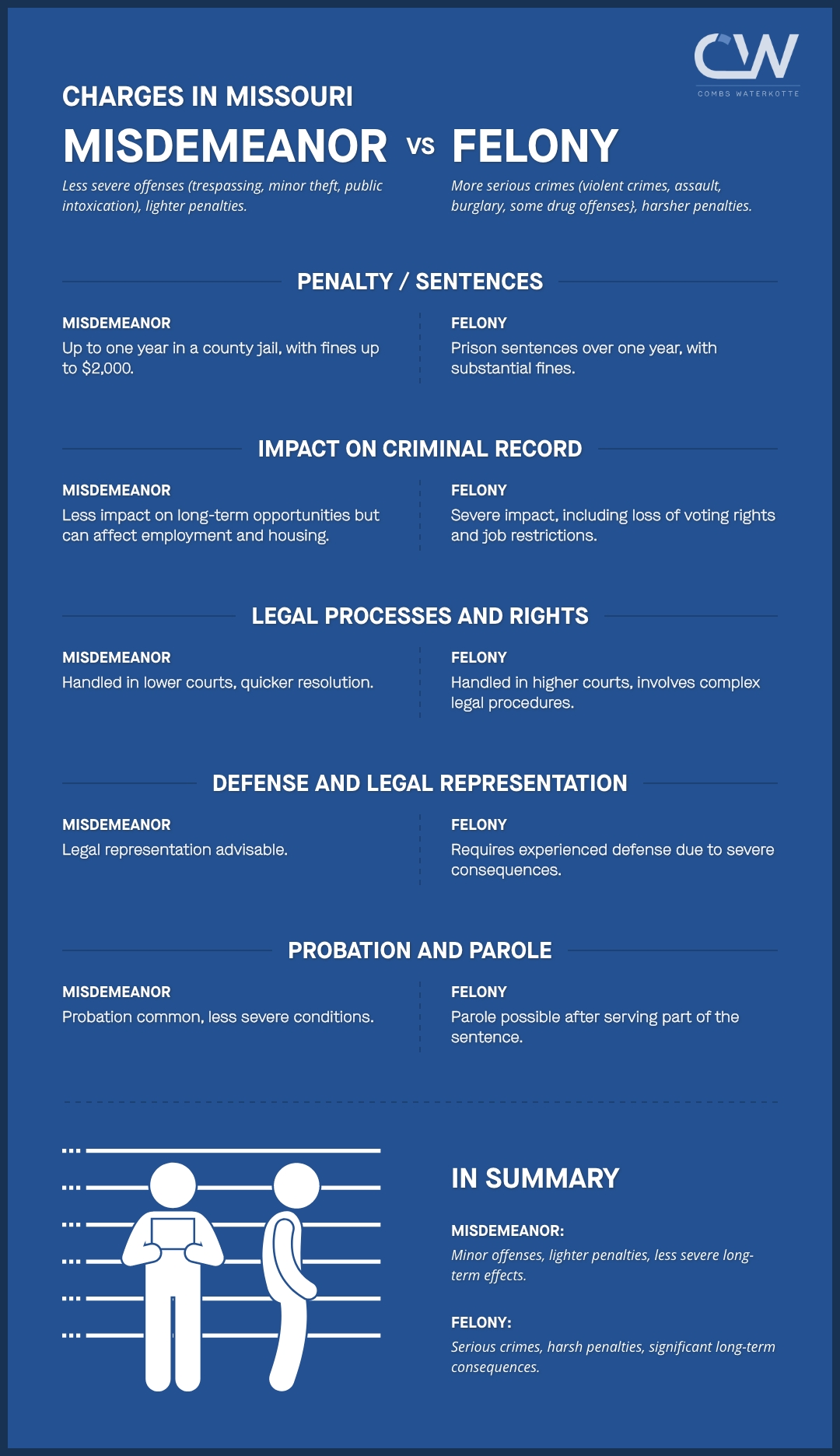
Misdemeanor vs. Felony Theft Charges in Kansas City, MO
If you’ve been accused of theft, what was allegedly stolen can determine what the potential penalty is. In general, the higher the value of the supposedly stolen property, the more serious the accusation. Below is a breakdown of why a theft accusation could fit into a given category:
- Steal anhydrous ammonia, specifically within a storage container.
- General theft and attempted theft of anhydrous ammonia or liquid nitrogen.
- Stealing livestock over $3,000 in value, with a prior livestock theft conviction.
- Stealing livestock over $10,000 in value, with or without a prior conviction.
- Stealing a vehicle, with at least two prior theft-related convictions within 10 years, on separate occasions.
- Stealing money from a financial institution by physically trying to take it from a worker.
- Stealing over $10,000 worth of property as part of an organized retail theft.
- Stealing or stealing from an ATM.
- Stealing $750 or more worth of property, but less than $10,000, as part of a shoplifting ring.
- General theft of property or services worth more than $25,000.
- Stealing something the alleged victim was currently carrying or holding.
- The stolen property was:
- A motor vehicle.
- A will.
- A credit or debit card.
- A firearm.
- An explosive weapon.
- A U.S. flag for public display.
- An original copy of a Missouri legal bill.
- A court document.
- A voter registration book.
- Live fish, raised for sale, with a value of $75 or more.
- Captive wildlife held under permit.
- Drugs.
- Ammonium nitrate.
- Power, phone, or fuel lines.
- Anything to be used in the creation of methamphetamine.
- General theft of property or services worth $750 or more.
- Stealing an animal.
- Stealing a catalytic converter.
- Stealing anything with at least three prior theft-related convictions within 10 years, on separate occasions.
- Stealing mail from someone’s mailbox.
- Stealing property that was not named above, is valued at less than $150, and the alleged offender has no prior theft convictions on their criminal record.
In cases that don’t fit any of the contexts listed above, theft is classified as a class A misdemeanor.
Theft-Related Charges and Their Penalties
Most theft charges in Kansas City, MO, are prosecuted under § 570.030 RSMo, but there are some exceptions. Charges like burglary are often levied alongside stealing/larceny, while identity theft is more likely to be treated as a separate offense.
Burglary
Missouri defines burglary as breaking into a building when you aren’t allowed to be there, and intending to commit a crime. It’s normal for a burglary to be in service of a theft, but not guaranteed.
Robbery
Robbery is a particular kind of theft, where one person uses force or threats to coerce another person into giving away their valuables. In Kansas City, MO, robbery has two specific conditions: Either the supposed victim was threatened/hurt, or the alleged perpetrator used a weapon.
Embezzlement
Embezzlement is when a person misuses funds that were not their own, but they were given control over. This is different from typical theft in that the alleged perpetrator had permission to access the money, but supposedly used it improperly.
Identity Theft
Identity theft is a particular kind of theft that involves stealing someone else’s identity, or manufacturing a fake one. Missouri law also specifies an intent aspect: Identity theft must be done with the intention to commit theft.
Credit Card Fraud
Credit card fraud covers a wide range of actions in Kansas City, MO, including misusing a credit card (often fake or cancelled ones), and lying on credit card applications.
Theft-Related Offenses: Penalties Table
| Charge Type | Statute(s) | Short Description | Penalty Range |
|---|---|---|---|
| Burglary | § 569.160 RSMo and § 569.170 RSMo | Infiltrating a location, with plans to break more laws once on-site. | Class D Felony or Class B Felony |
| Robbery | § 570.023 RSMo and § 570.025 RSMo | Taking money or property directly from another person, using violence, force, or threats. | Class B Felony or Class A Felony |
| Embezzlement | § 570.030 RSMo | Taking or misusing assets which were not yours, but were under your control. | Class B Felony or Class A Felony |
| Identity theft | § 570.223 RSMo | Stealing someone’s identifying information with the intention to steal something. | Class B Misdemeanor to Class B Felony |
| Credit Card Fraud | § 570.130 RSMo and § 570.135 RSMo | Using deception on a credit card application or misusing a card that isn’t yours, or has been revoked. | Class A Misdemeanor or Class E Felony |
Combs Waterkotte’s stealing charges lawyers offer expert criminal defense for all of the above allegations. If you’re facing any of these related charges, you can learn more in our ultimate guide to theft crimes in Missouri.
Possible Defenses to Stealing Accusations in Kansas City, MO
Theft crime defenses can rely on broad strategies, like an alibi, or property-specific strategies, like perceived ownership. The examples listed below are some of the strong defensive options that our lawyers will consider for your case:
- Claim of Right — Claim of right could be argued if there is evidence to show that you were allowed to take/use the property, even if it wasn’t yours.
- Actual Ownership — Taking an item is only theft if you didn’t own it. If you did, this can be your defense.
- Perceived Ownership — If you honestly believed you owned an item, this can sometimes excuse theft. Proving this relies on strong supporting evidence.
- Lack of Intent — It’s possible that you took something that didn’t belong to you by accident; in that case, you did not have any intent to steal.
- Necessity — Sometimes theft is committed to prevent greater harm; for example, stealing medical supplies to help someone who’s been injured.
- Alibi — An alibi shows that the alleged offender was elsewhere at the time of the offense and could not have committed it.
- Mistaken Identity — Thefts can happen fast and be traumatic for the victim. It’s possible that they identified the wrong person as the offender.
- Lack of Evidence — Sometimes, the state fails to make its case in a convincing manner. Your defense lawyer can show off the flaws in the case.
- Evidentiary Issues — If key evidence was obtained illegally or did not follow chain of custody rules, it can be challenged and thrown out.
Your larceny defense lawyer from Combs Waterkotte will help you pick the best defensive strategy for your case.
What Sets Combs Waterkotte’s Theft Defense Lawyers Apart
Our firm is ready to take your case. It doesn’t matter what you’re accused of, what the evidence is, or where you’re at in the justice process. You need an experienced Kansas City, MO, theft lawyer, and we are ready for your call.
This is why you should choose us to defend your case:
- Our team includes a former prosecutor who can give insights on how the state builds its case against you.
- We take a client-first approach and have someone available 24/7 via phone.
- We’re known for building trial-ready defenses, and won’t back down when challenged.
- We have scores of positive reviews from past clients.
- You get help building your case from a former law enforcement officer.
When you call Combs Waterkotte, you’re in good hands from day one. Our team is dedicated to our clients and prepared to fight for your freedom.

Our Kansas City, MO, Theft Lawyers Are Available 24/7
Allegations of larceny are important to take seriously. If you’re found guilty, it could permanently change the course of your life for the worse. When you call Combs Waterkotte, we’re committed to protecting you from negative outcomes.
Connect with a theft lawyer in Kansas City, MO, now by calling (314) 900-HELP or fill out our online form to schedule a confidential consult.

