

DWI With Drugs Lawyer Kansas City, MO
Hire the leading DWI with drugs defense law firm in Kansas City, MO to protect your freedom, driver’s license, record, and future. Whether you have been charged or are under investigation, we can help.
TO COMBS WATERKOTTE,YOU ARE WHY WE EXIST.


DWI With Drugs Lawyer Kansas City, MO
You don’t have to use an illegal drug to face a DWI with drugs charge. Prescription medications, over-the-counter products, marijuana, other controlled substances, and drugs mixed with alcohol can all have consequences on your license and criminal record. If you live in Kansas City, Missouri and got a DWI for driving high, you need representation.
Combs Waterkotte’s Kansas City DWI lawyers look beyond a positive test to determine whether the evidence shows you were actually impaired while driving. We challenge unlawful stops, questionable police conclusions, and testing mistakes to build a defense that keeps you out of jail and protects your driver’s license. Call (314) 900-HELP now to start building your defense.

I owe my life to Combs Waterkotte. If not for them, I would be spending the rest of my life behind bars. There is no amount of words that can explain what they did for me and my family. Its the highest recommendation that I can give.
Alexander B.
Felonies
Verify on

If I could give Steve and his team 10 stars I would in a heartbeat. Was facing more then one felony charge and after these guys found the arresting officer violated my 4th Amendment Rights and those charges were dismissed. My family and I can't thank you enough.
Dean J
Felonies
Verify on
I was hands down guilty. ON VIDEO !!! In a smaller town, and a job dealing with the public, this was devastating. I made one phone call and spoke for maybe 15 minutes. I DIDN'T appear in court. I am extremely impressed. QUIETLY relieved of the matter!
Y.I.V.
Theft
Verify on
My fiance had a felony drug charge and Combs Waterkotte got it dismissed! There were no fines, court cost, nothing. Chris is loyal, professional, knowledgeable, and a man of his word. We are forever grateful for you.
Kimberly T.
Drug Crimes
Verify on
If I was found guilty, it would have been over 100 years in prison. They promised me that they would fight like hell and get me out of it. After everything was done, I just felt free. Like this wasn’t gonna end with me rotting away in a prison cell. I felt like I could start my life and have a fresh start.
Caleb
Assault 1st, Armed Criminal Action
Verify on
I was facing, probably 18 years… I actually got 5 years probation and 40 hours of community service. Without Combs Waterkotte’s help, I don’t think my family could have made it without me. It was just a written book to where it's a perfect ending.
Chris
Unlawful Use of a Weapon, Armed Criminal Action
Verify on
I went through what was supposed to be one of the top law firms in St. Louis. They said I wouldn't have no chance. I end up firing the other lawyer and everything and going with Chris. I felt like Combs Waterkotte actually did something for me and wasn't I wasn't just another number on somebody's desk.
Willy
DWI/DUI
Verify onI owe my life to Combs Waterkotte. If not for them, I would be spending the rest of my life behind bars. There is no amount of words that can explain what they did for me and my family. Its the highest recommendation that I can give.
Alexander B.
Felonies
If I could give Steve and his team 10 stars I would in a heartbeat. Was facing more then one felony charge and after these guys found the arresting officer violated my 4th Amendment Rights and those charges were dismissed. My family and I can't thank you enough.
Dean J
Felonies
I was hands down guilty. ON VIDEO !!! In a smaller town, and a job dealing with the public, this was devastating. I made one phone call and spoke for maybe 15 minutes. I DIDN'T appear in court. I am extremely impressed. QUIETLY relieved of the matter!
Y.I.V.
Theft
My fiance had a felony drug charge and Combs Waterkotte got it dismissed! There were no fines, court cost, nothing. Chris is loyal, professional, knowledgeable, and a man of his word. We are forever grateful for you.
Kimberly T.
Drug Crimes
If I was found guilty, it would have been over 100 years in prison. They promised me that they would fight like hell and get me out of it. After everything was done, I just felt free. Like this wasn’t gonna end with me rotting away in a prison cell. I felt like I could start my life and have a fresh start.
Caleb
Assault 1st, Armed Criminal Action
I was facing, probably 18 years… I actually got 5 years probation and 40 hours of community service. Without Combs Waterkotte’s help, I don’t think my family could have made it without me. It was just a written book to where it's a perfect ending.
Chris
Unlawful Use of a Weapon, Armed Criminal Action
I went through what was supposed to be one of the top law firms in St. Louis. They said I wouldn't have no chance. I end up firing the other lawyer and everything and going with Chris. I felt like Combs Waterkotte actually did something for me and wasn't I wasn't just another number on somebody's desk.
Willy
DWI/DUI
How DWI With Drugs Differs From Alcohol-Related DWI in Missouri
Both alcohol and drug-related DWI charges fall under Chapter 577 of the Missouri Revised Statutes. Missouri doesn’t have a separate offense called “drugged driving.” The law is the same, but proving drug impairment often requires different evidence than proving alcohol impairment.

Protect your driver’s license and criminal record. Call (314) 900-HELP or contact Combs Waterkotte online to take care of your Kansas City, Missouri DWI.
Drug Levels Are Different from the 0.08% BAC Limit
A blood alcohol content (BAC) result can support a separate excessive-BAC charge in an alcohol case. Missouri has no comparable statewide concentration limit for marijuana, opioids, stimulants, sedatives, or other drugs. Simply detecting a substance or metabolite isn’t enough; prosecutors must be able to prove you were high while you operated the vehicle.
The National Highway Traffic Safety Administration’s drug-impaired-driving review explains that researchers haven’t established the same link between drug levels and impairment that exists for alcohol. Some metabolites remain detectable long after drug effects wear off. Determining whether someone drove while intoxicated depends on the test, the collection time, active versus inactive compounds, dosage, tolerance, and drug interactions.
Legal Medication Can Still Lead to a DWI
Having a valid prescription doesn’t lawfully excuse impaired driving. Sleep aids, anxiety medications, painkillers, muscle relaxants, and antihistamines can cause drowsiness, slow reactions, or affect thinking and coordination. But your prescription and documented dosing history still have a bearing on your case. They can help explain a toxicology result without indicating that you were impaired behind the wheel.
Finding pills, weed, paraphernalia, or another substance in a car doesn’t automatically settle a DWI case. Possession and impaired driving are separate issues. The state can prove DWI without recovering drugs. At the same time, finding drugs doesn’t prove that you took them or drove while impaired.
Why Combs Waterkotte is the best Law firm for your case.
Real results for people just like you.

Missouri’s DWI With Drugs Statute Explained
RSMo §577.010 states that DWI occurs when someone operates a vehicle while in an intoxicated condition. Missouri’s statutory DWI definitions describe an “intoxicated condition” as being under the influence of alcohol, a controlled substance, another drug, or any combination of either. It sounds straightforward, but in practice, it’s complex.
Proving Operation and Intoxication
The state must prove that you physically drove or operated your vehicle while you were high. Owning the car, being nearby, or having used a drug aren’t enough on their own. We examine the requirements of the Missouri DWI statute using witness accounts, videos, vehicle position, statements, driving observations, medical records, and toxicology analysis.
Police may point to lane violations, slow responses, unusual speech, pupil size, pulse, balance, muscle tone, odors, or statements about medication. But those details require context. Any one of those observations can be explained legitimately by:
- Fatigue
- Anxiety
- Injuries
- Illness
- Lighting conditions
- Road conditions
- The stress of a traffic stop
Chemical Testing and Implied Consent
Missouri’s implied-consent law allows officers (under specified circumstances) to request up to two chemical tests of breath, blood, saliva, or urine. Because breath tests generally measure alcohol, drug investigations often involve blood or urine testing. Approved methods and qualified personnel are legally required, but we can still challenge how a test was performed even if it was administered lawfully.
Under the law, you may request an independent test at your own expense. An alleged refusal of chemical testing can be used as evidence against you and bring a separate license revocation called a statutory summary suspension. If you ask to speak with an attorney after police request testing, Missouri law gives you twenty minutes to try to make contact with one.

Defense Strategies for DWI With Drugs Charges in Kansas City
An officer’s suspicion isn’t proof that you drove while impaired. We build your defense around the traffic stop, the officer’s observations and evaluation, the sample and lab testing, your medical history, and the drugs involved. We may use any one of the following defense strategies.
Challenge the Stop, Operation, and Arrest
We review dash cam and body cam footage, dispatch records, traffic conditions, and witness accounts to determine whether police had a lawful reason to stop you and probable cause to arrest you. We also question the proof of who drove and whether the vehicle was operated, particularly if someone else drove, the car never moved, or officers arrived after driving ended. An unlawful stop, search, interrogation, or blood draw may allow us to have evidence suppressed.
Dispute the Officer’s Impairment Conclusions
Standardized field sobriety tests were developed primarily around alcohol impairment (rather than drug impairment). We review the officer’s instructions, demonstrations, scoring, and the recording of your performance.
Footwear, the testing surface, weather, lighting, injuries, balance problems, and anxiety may affect the test results. We also check whether the drug recognition expert (DRE) had valid credentials, followed and documented each evaluation step, considered medical explanations, and reached conclusions consistent with toxicology.
Challenge the Toxicology Evidence
We check when and how a sample was collected, whether police had a warrant or consent, and how it was stored and transported. The collection tube, preservatives, seals, and chain of custody of evidence are critical in these cases. We review screening, confirmation, calibration, quality controls, and reporting limits. Missouri’s blood-test procedures and rules governing chemical-test evidence guide this review, but even a valid result needs a reliable interpretation.
A urine test may reveal earlier drug use without showing when you used the drug or whether its effects persisted. Blood testing can offer a closer picture, but delays, metabolism, tolerance, prescribed use, and drug combinations complicate test interpretations. A forensic toxicologist may help us identify conclusions the report doesn’t support.
Consider Other Explanations and Challenge Additional Allegations
Your medical and pharmacy records, prescribing instructions, and sleep history may explain what police observed. Injuries, diabetes, neurological conditions, or involuntary ingestion may also help account for symptoms or test results.
A legal prescription alone won’t defeat the charge, but the full record may create reasonable doubt about intoxication. We separately challenge allegations involving possession, paraphernalia, a child passenger, a crash, injuries, or prior offenses.
Possible Penalties for DWI With Drugs in Missouri
A drug-related DWI carries the same classifications as an alcohol-related DWI. Missouri’s authorized imprisonment ranges apply along with the enhancement rules in RSMo §577.010. A typical first-offense DWI is a Class B misdemeanor, but your history and the circumstances can lead to a more serious charge. The possible jail and prison terms are outlined in the table below.
| Charge | Classification | Jail or Prison Term |
|---|---|---|
| Basic DWI | Class B misdemeanor | Up to 6 months |
| Prior offender or passenger under 17 | Class A misdemeanor | Up to 1 year |
| Persistent offender | Class E felony | Up to 4 years |
| Aggravated offender or negligent physical injury | Class D felony | Up to 7 years |
| Chronic offender or negligent serious physical injury | Class C felony | 3 to 10 years |
| Habitual offender or negligent death | Class B felony | 5 to 15 years |
| Two or more deaths or qualifying repeat death case | Class A felony | 10 to 30 years or life |
Prior offenses can turn a misdemeanor into a felony DWI, but Missouri’s offender categories aren’t always determined by simply counting convictions. The DWI law also limits suspended sentences and probation and sets minimum jail or prison terms in certain repeat-offender, injury, and death cases. Where allowed, courts may order probation, community service, treatment, monitoring, restitution, and costs.
Driver’s License Consequences
The Missouri Department of Revenue’s DWI guidance states that a first drug-related DWI conviction brings a 90-day license suspension. A second intoxication-related conviction normally means a one-year revocation under the points system. A second offense within five years may lead to a five-year denial, while three or more can mean a ten-year denial. With multiple DWIs, the impact on your license can be substantial.
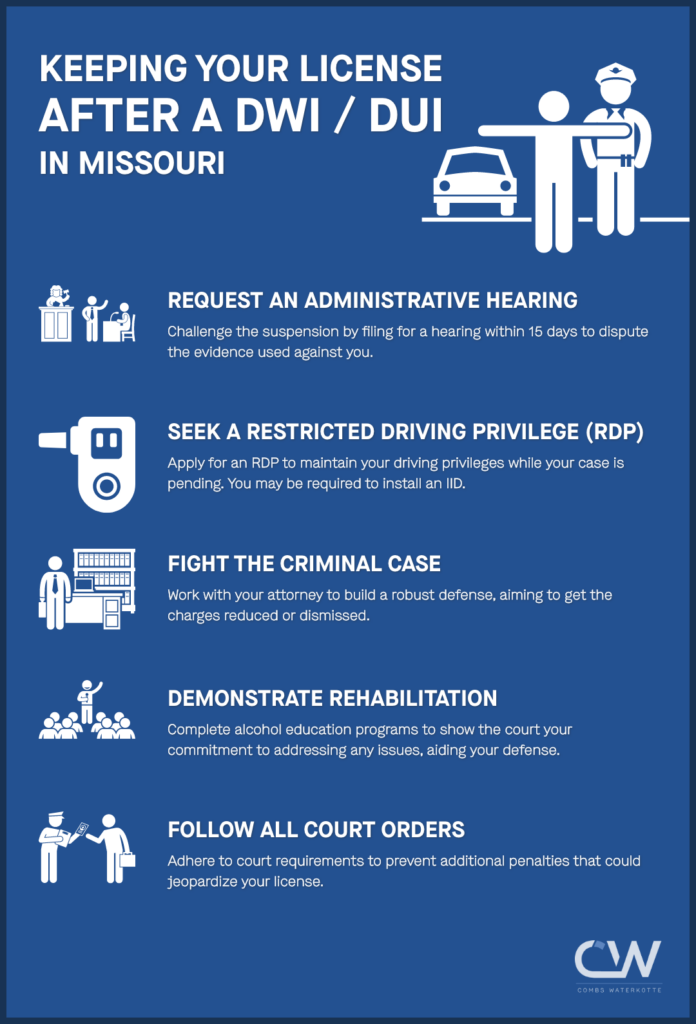
Refusing a chemical test can lead to a separate one-year revocation, even without a DWI conviction. Drug-only cases usually don’t involve the administrative action tied to alcohol cases, but conviction points and refusal penalties still apply. Reinstatement may require SATOP, proof of financial responsibility, fees, and other steps. Have your lawyer review every license notice right away.
Why Choose Combs Waterkotte for a Kansas City DWI With Drugs Case?

Drug-related DWI cases require careful review of police evaluations, toxicology, prior-offender allegations, and license issues. Combs Waterkotte has handled more than 15,000 criminal cases and brings decades of combined experience to this work. We understand the difference between finding a drug in your system and proving impairment.


Our attorneys explain the criminal and licensing risks and build a strategy around your circumstances. We pursue dismissal or a charge reduction when the evidence supports it. When prosecutors won’t offer a fair resolution, we’re trial-ready.
How Combs Waterkotte Will Take On Your DWI With Drugs Charges
When you hire us, we move quickly to preserve recordings and samples and address license deadlines. We compare the prosecution’s claims with your account, the law, and the science. Our work includes:
- Protecting your license: Review notices, refusal allegations, deadlines, reinstatement requirements, and any available driving privileges
- Preserving the evidence: Secure video, dispatch audio, reports, vehicle data, photos, and medical or pharmacy records
- Reviewing the drug evaluation: Check field tests, DRE credentials, compliance with evaluation procedures, alternative explanations, and your recorded performance
- Examining the lab evidence: Obtain chain-of-custody records, raw data, testing methods, quality controls, uncertainty information, and expert review
- Preparing for every outcome: Challenge key legal issues while preparing for dismissal, a charge reduction, an agreement, or trial

Throughout the case, we keep you informed and help address concerns about work, treatment, travel, and family. That early work helps us show when a positive test doesn’t support the charge.
Contact a Kansas City DWI With Drugs Lawyer Today
A positive drug test doesn’t resolve the questions that actually matter most in a DWI case: who drove, whether the stop was lawful, whether the sample was reliable, and whether you were impaired. A good attorney can raise these questions and provide answers advantageous to your case.
To fight back against your Kansas City, Missouri DWI charges, call (314) 900-HELP or contact Combs Waterkotte online. We’ll review the charges and license issues, preserve important evidence, and get to work on a defense designed to keep you on the road and out of jail.
Resources
For more information on criminal defense in Kansas City or anywhere else in Missouri, call the Combs Waterkotte criminal defense attorneys right away at (314) 900-HELP or contact us online for a confidential consultation.
What DWI/DUI Defense Lawyers Actually Do in Missouri
What to Do If You Are Pulled Over for DWI in Missouri
Hidden Costs of a DWI Conviction in Missouri
Can You Drive After Being Charged With a DWI/DUI?
Step-by-Step Walkthrough of a Missouri DWI/DUI Traffic Stop
Can You Get Probation for DWI/DUI?
How Likely is Jail Time for a First Time DUI/DWI Offense in Missouri?

Free book
Don’t “Blow” Your DWI/DUI Case: Key Mistakes to Avoid
Combs Waterkotte, Missouri and Illinois’s leading DWI/DUI law firm, has handled over 10,000 cases successfully. This ebook guides you through the DWI/DUI defense process and helps you avoid key mistakes.

