

Class A Felonies Lawyer Kansas City, MO
Hire the leading criminal defense law firm in Kansas City, MO to protect your freedom, rights, and future. Whether you have been charged with a felony or you’re under investigation, we can help.
TO COMBS WATERKOTTE,YOU ARE WHY WE EXIST.


Class A Felonies Lawyer Kansas City, MO
A conviction for Class A felonies in Missouri can result in life imprisonment or even the death penalty. The proven attorneys at Combs Waterkotte have decades of experience protecting clients from the full power of the government. If you’re facing felony charges, we can fight for your right to a fair process as your case proceeds.

I owe my life to Combs Waterkotte. If not for them, I would be spending the rest of my life behind bars. There is no amount of words that can explain what they did for me and my family. Its the highest recommendation that I can give.
Alexander B.
Felonies
Verify on

If I could give Steve and his team 10 stars I would in a heartbeat. Was facing more then one felony charge and after these guys found the arresting officer violated my 4th Amendment Rights and those charges were dismissed. My family and I can't thank you enough.
Dean J
Felonies
Verify on
I was hands down guilty. ON VIDEO !!! In a smaller town, and a job dealing with the public, this was devastating. I made one phone call and spoke for maybe 15 minutes. I DIDN'T appear in court. I am extremely impressed. QUIETLY relieved of the matter!
Y.I.V.
Theft
Verify on
My fiance had a felony drug charge and Combs Waterkotte got it dismissed! There were no fines, court cost, nothing. Chris is loyal, professional, knowledgeable, and a man of his word. We are forever grateful for you.
Kimberly T.
Drug Crimes
Verify on
If I was found guilty, it would have been over 100 years in prison. They promised me that they would fight like hell and get me out of it. After everything was done, I just felt free. Like this wasn’t gonna end with me rotting away in a prison cell. I felt like I could start my life and have a fresh start.
Caleb
Assault 1st, Armed Criminal Action
Verify on
I was facing, probably 18 years… I actually got 5 years probation and 40 hours of community service. Without Combs Waterkotte’s help, I don’t think my family could have made it without me. It was just a written book to where it's a perfect ending.
Chris
Unlawful Use of a Weapon, Armed Criminal Action
Verify on
I went through what was supposed to be one of the top law firms in St. Louis. They said I wouldn't have no chance. I end up firing the other lawyer and everything and going with Chris. I felt like Combs Waterkotte actually did something for me and wasn't I wasn't just another number on somebody's desk.
Willy
DWI/DUI
Verify onI owe my life to Combs Waterkotte. If not for them, I would be spending the rest of my life behind bars. There is no amount of words that can explain what they did for me and my family. Its the highest recommendation that I can give.
Alexander B.
Felonies
If I could give Steve and his team 10 stars I would in a heartbeat. Was facing more then one felony charge and after these guys found the arresting officer violated my 4th Amendment Rights and those charges were dismissed. My family and I can't thank you enough.
Dean J
Felonies
I was hands down guilty. ON VIDEO !!! In a smaller town, and a job dealing with the public, this was devastating. I made one phone call and spoke for maybe 15 minutes. I DIDN'T appear in court. I am extremely impressed. QUIETLY relieved of the matter!
Y.I.V.
Theft
My fiance had a felony drug charge and Combs Waterkotte got it dismissed! There were no fines, court cost, nothing. Chris is loyal, professional, knowledgeable, and a man of his word. We are forever grateful for you.
Kimberly T.
Drug Crimes
If I was found guilty, it would have been over 100 years in prison. They promised me that they would fight like hell and get me out of it. After everything was done, I just felt free. Like this wasn’t gonna end with me rotting away in a prison cell. I felt like I could start my life and have a fresh start.
Caleb
Assault 1st, Armed Criminal Action
I was facing, probably 18 years… I actually got 5 years probation and 40 hours of community service. Without Combs Waterkotte’s help, I don’t think my family could have made it without me. It was just a written book to where it's a perfect ending.
Chris
Unlawful Use of a Weapon, Armed Criminal Action
I went through what was supposed to be one of the top law firms in St. Louis. They said I wouldn't have no chance. I end up firing the other lawyer and everything and going with Chris. I felt like Combs Waterkotte actually did something for me and wasn't I wasn't just another number on somebody's desk.
Willy
DWI/DUI
Felony Classifications in Missouri
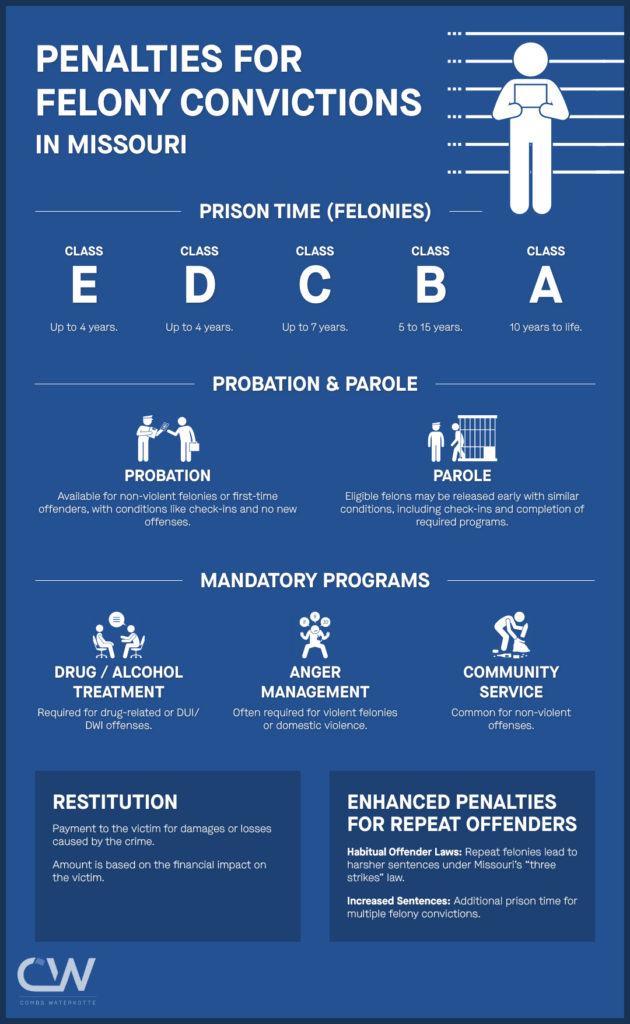
Missouri classifies criminal offenses as either misdemeanors or felonies. Misdemeanors include any offense where the accused could face up to one year of jail time upon conviction. Felonies include all offenses for which the sentence can include at least one year of imprisonment.
Felonies are further divided into five classes identified by the letters A through E. Class E felonies are the least severe felony offenses, while Class A felonies are the most severe.

“Before I met [Combs Waterkotte], I was sitting in jail, and I felt like that was going to be my home for the next one hundred years… [They] promised me that [they] would fight like hell and get me out of it… [From] looking at over a hundred years in prison, I am now serving two-and-a-half years of SIS probation, and it will never be on my record. So I would highly recommend Combs and Waterkotte for anybody who’s looking for the best lawyer you can get.”
-Caleb | Combs Waterkotte Client
The sentencing ranges for felony convictions vary widely. The sentence options for a Class E felony include probation in lieu of imprisonment or a term of imprisonment up to four years.
By contrast, someone convicted of a Class A felony is ineligible for probation and must be sentenced to at least 10 years in prison. The maximum sentence could range from a term of 30 years to the remainder of the offender’s natural life.
Why Combs Waterkotte is the best Law firm for your case.
Real results for people just like you.

Class A Felonies in the Missouri Revised Statutes
Many of the most serious offenses in the Missouri Revised Statutes are categorized as Class A felonies. Someone convicted of repeat offenses could also be sentenced as a Class A felon simply based on their prior record.
The following offenses are classified as Class A felonies in Missouri.
Violent Crimes
State law defines many violent crimes as Class A felonies. Generally, violent crimes involve the use of force or threats to accomplish the prohibited outcome. Violent crimes classified as Class A felonies include:
- First-degree murder
- Second-degree murder
- First-degree kidnapping (in most circumstances)
First-degree assault and first-degree domestic assault may be charged as either Class A or Class B felonies. These offenses are normally charged as Class B felonies but may be elevated to Class A when the alleged victim suffers great bodily harm or is a “special victim.”
“Great bodily harm” refers to an injury that has a high probability of death. It also includes injuries that result in permanent or protracted functional loss of a body part or organ.
Special victims, meanwhile, include the following:
- On-duty police officers, EMTs, firefighters, corrections officers, and probation officers
- Elderly adults
- Disabled individuals
- Vulnerable people in the care or custody of the state’s Department of Mental Health
- Highway, utility, cable, and mass-transit workers performing their job duties
Notably, these enhancements are separate. As such, you don’t need to cause great bodily harm to a special victim to face A-level penalties — an unsuccessful attempt to harm a police officer, elderly person, or other special victim could give prosecutors the legal grounds to elevate the offense.

Sex Offenses
In Missouri, the most serious sex offenses are Class A felonies, including:
- First-degree rape
- First-degree sodomy
- First-degree statutory rape
- First-degree statutory sodomy
- First-degree child molestation
Sentencing for these sex crimes generally includes a prison term of 10 to 30 years. However, persistent sexual offenders must be sentenced to life without parole, while predatory sexual offenders must be sentenced to life with the possibility of parole.
Property Crimes
First-degree robbery and some forms of first-degree arson may be charged as Class A felonies. Interestingly, the law makes it explicit that stealing anhydrous ammonia in storage tanks, tank trucks, or tank trailers is a Class A felony.
Drug Offenses
Major drug offenses, such as first-degree drug trafficking, may be charged as Class A. However, the offense level depends on the type and amount of the substance involved.
If the trafficking involved small amounts of marijuana, it would typically be charged at a lower level. In contrast, even a tiny amount of LSD or fentanyl could trigger A-level penalties.
Repeat-Offender Enhancements
Missouri has several repeat-offender enhancements that can elevate a Class B or Class C felony to a Class A felony. These enhancements can be applied to any of the following:
- Persistent offender with two or more prior felonies or at least one prior dangerous felony
- Dangerous offender with a prior Class A, Class B, or dangerous felony
- Prior assault offender with a prior assault within five years of the current offense
- Persistent assault offender with two or more assaults within 10 years of the current offense
- Persistent drug offender with two or more prior felony drug offenses
Persistent, dangerous, and prior assault offenders are sentenced at one level higher than their current felony charge. For instance, a Class B felony would be sentenced as if it were a Class A felony.
Persistent assault offenders and persistent drug offenders are sentenced at two levels higher than the current felony charge. Under this rule, either a Class C or Class B felony could be sentenced as if it were a Class A felony.
Defenses Against Class A Felonies in Kansas City, MO
The defenses available against a Class A felony charge depend on the specific offense in question. The strategy your criminal defense lawyer develops for your case may incorporate any of the following defenses.
Self-Defense and Defense of Others
Missouri’s self-defense statute allows you to use force, including deadly force, when necessary to protect yourself or others from the imminent use of unlawful force.
This law is based on the potential victim’s reasonable belief at the time of the incident. If you reasonably believed that the other person was about to commit an assault or homicide, you may use the amount of force necessary to stop them.
Consent
Consent is a common defense to sex offenses. Generally, sex acts are criminal when the other person hasn’t consented or cannot give consent. For example, someone who is intoxicated or underage cannot consent. Similarly, someone who is forced into a sex act hasn’t consented.
Conversely, you may have a defense against charges of rape or sodomy if the other person consented through their words or actions. This defense may even apply if you made a reasonable mistake in interpreting their words or actions.
Lack of Intent
Intent is a necessary element of most Class A felonies. Moreover, the intent required is usually high.
Specifically, A-level felonies typically must be committed “purposefully” or “knowingly.” That means mistakes or accidents will usually fail to satisfy all elements of the offense. For example, you would likely have a viable defense against first-degree drug-trafficking charges if you were unaware that a friend had hidden drugs in your car.
Possible Penalties Upon Conviction for a Class A Felony in Kansas City, MO
Class A felony sentences generally include a lengthy term of imprisonment. While there’s no mandatory fine for these crimes because of the prison term, offenders may be required to pay restitution to victims for any medical or financial losses they cause them to suffer.
The sentence for a Class A felony has the following basic structure:
| Base Class A prison sentence | 10–30 years imprisonment |
| Class A prison sentence, first-degree murder | Death or life imprisonment without parole |
| Class A prison sentence, juvenile first-degree murder | 30–40 years or life imprisonment |
| Minimum term served before parole eligibility (current) | All but five years |
| Minimum term served before parole eligibility (2028) | 70% of sentence |
Why You Should Hire Combs Waterkotte to Take the Lead on Your Class A Felony Case
Class A felony cases involve serious crimes. Prosecutors and police officers zealously, though sometimes recklessly, rush to apprehend and prosecute those suspected of these offenses. This rush to judgment can result in sloppy investigations and unjust accusations.
Even when an offense may have occurred, public pressure can lead prosecutors to overcharge suspects. Overcharging can pressure those accused to accept a plea deal for a more severe punishment than they deserve.


We’ll take the time to listen to your version of events and gather compelling evidence to push back against your charges.
How We Can Defend You From Class A Felony Charges in Kansas City, MO
Class A felony charges are frequently brought as a result of complex situations. Our skilled attorneys will use every tool at their disposal to seek a fair resolution to your case.
Depending on the nature of the alleged offense, we might interview witnesses and hire experts to analyze forensic evidence. We can also search for additional witnesses and evidence that the police may have overlooked.


Once we have a more detailed picture of what happened, we’ll negotiate with prosecutors to address your charges. If you’ve been wrongfully accused, we’ll move for a dismissal of your case. Otherwise, we’ll seek a fair plea deal that may include a lighter sentencing recommendation or a reduction in your charges to a lower offense level.
If we’re unable to negotiate an acceptable deal with the prosecution, we won’t hesitate to fight your charges in court, where we’ll present your defenses to a jury and argue forcefully for an acquittal.
Contact Combs Waterkotte to Discuss Your Situation With a Trusted Criminal Defense Attorney in Kansas City, MO

Class A felonies are the most serious charges you can face in Missouri. Fortunately, our attorneys have abundant experience taking on these cases. Contact us online or at (314) 900-HELP today to learn more about the defense strategies we may be able to pursue to overcome your charges.
Resources
For more information on criminal defense in Kansas City or anywhere else in Missouri, call the Combs Waterkotte criminal defense attorneys right away at (314) 900-HELP or contact us online for a confidential consultation.
What Are the Sentencing Guidelines for Class A Felonies in Missouri?
What Are My Rights When Charged With a Crime in Kansas City?
Why You Should ALWAYS Remain Silent
How Much Does It Cost To Expunge A Felony In Missouri?
What Does a Kansas City, MO, Criminal Defense Attorney Actually Do?
Free book
How a Criminal Defense Attorney Can Protect Your Rights and Future
Combs Waterkotte has over 80 years of experience and over 10,000 cases handled. This ebook helps guide you through the criminal defense process and how an experienced, skilled defense attorney can keep your freedoms intact.

