

Multiple DWIs Lawyer Kansas City, MO
Hire the leading DWI Defense Law Firm in Kansas City, MO to protect your freedom, driver’s license, and future. If you’ve been charged or arrested for your second or subsequent DWI, we can help.
TO COMBS WATERKOTTE,YOU ARE WHY WE EXIST.


Multiple DWIs Lawyer Kansas City, MO
An intoxicated driving offense can be charged as high as a Class A felony for repeat offenders. As such, a conviction for multiple DWIs can mean decades of imprisonment.
The attorneys at Combs Waterkotte have handled more than 15,000 criminal cases, including many involving accusations of driving while intoxicated (DWI). If you’ve been accused of repeated DWI offenses, we know how to challenge the government’s case effectively.

I owe my life to Combs Waterkotte. If not for them, I would be spending the rest of my life behind bars. There is no amount of words that can explain what they did for me and my family. Its the highest recommendation that I can give.
Alexander B.
Felonies
Verify on

If I could give Steve and his team 10 stars I would in a heartbeat. Was facing more then one felony charge and after these guys found the arresting officer violated my 4th Amendment Rights and those charges were dismissed. My family and I can't thank you enough.
Dean J
Felonies
Verify on
I was hands down guilty. ON VIDEO !!! In a smaller town, and a job dealing with the public, this was devastating. I made one phone call and spoke for maybe 15 minutes. I DIDN'T appear in court. I am extremely impressed. QUIETLY relieved of the matter!
Y.I.V.
Theft
Verify on
My fiance had a felony drug charge and Combs Waterkotte got it dismissed! There were no fines, court cost, nothing. Chris is loyal, professional, knowledgeable, and a man of his word. We are forever grateful for you.
Kimberly T.
Drug Crimes
Verify on
If I was found guilty, it would have been over 100 years in prison. They promised me that they would fight like hell and get me out of it. After everything was done, I just felt free. Like this wasn’t gonna end with me rotting away in a prison cell. I felt like I could start my life and have a fresh start.
Caleb
Assault 1st, Armed Criminal Action
Verify on
I was facing, probably 18 years… I actually got 5 years probation and 40 hours of community service. Without Combs Waterkotte’s help, I don’t think my family could have made it without me. It was just a written book to where it's a perfect ending.
Chris
Unlawful Use of a Weapon, Armed Criminal Action
Verify on
I went through what was supposed to be one of the top law firms in St. Louis. They said I wouldn't have no chance. I end up firing the other lawyer and everything and going with Chris. I felt like Combs Waterkotte actually did something for me and wasn't I wasn't just another number on somebody's desk.
Willy
DWI/DUI
Verify onI owe my life to Combs Waterkotte. If not for them, I would be spending the rest of my life behind bars. There is no amount of words that can explain what they did for me and my family. Its the highest recommendation that I can give.
Alexander B.
Felonies
If I could give Steve and his team 10 stars I would in a heartbeat. Was facing more then one felony charge and after these guys found the arresting officer violated my 4th Amendment Rights and those charges were dismissed. My family and I can't thank you enough.
Dean J
Felonies
I was hands down guilty. ON VIDEO !!! In a smaller town, and a job dealing with the public, this was devastating. I made one phone call and spoke for maybe 15 minutes. I DIDN'T appear in court. I am extremely impressed. QUIETLY relieved of the matter!
Y.I.V.
Theft
My fiance had a felony drug charge and Combs Waterkotte got it dismissed! There were no fines, court cost, nothing. Chris is loyal, professional, knowledgeable, and a man of his word. We are forever grateful for you.
Kimberly T.
Drug Crimes
If I was found guilty, it would have been over 100 years in prison. They promised me that they would fight like hell and get me out of it. After everything was done, I just felt free. Like this wasn’t gonna end with me rotting away in a prison cell. I felt like I could start my life and have a fresh start.
Caleb
Assault 1st, Armed Criminal Action
I was facing, probably 18 years… I actually got 5 years probation and 40 hours of community service. Without Combs Waterkotte’s help, I don’t think my family could have made it without me. It was just a written book to where it's a perfect ending.
Chris
Unlawful Use of a Weapon, Armed Criminal Action
I went through what was supposed to be one of the top law firms in St. Louis. They said I wouldn't have no chance. I end up firing the other lawyer and everything and going with Chris. I felt like Combs Waterkotte actually did something for me and wasn't I wasn't just another number on somebody's desk.
Willy
DWI/DUI
Why Does Missouri Treat Multiple DWIs Differently?
Drunk and drugged driving are major safety concerns, particularly in large cities like St. Louis and Kansas City. Impaired driving crashes caused about 18% of the state’s traffic fatalities from 2020 through 2024.

“I was charged with my second DWI and was very scared… [Combs Waterkotte] was able to get my charge reduced and my license was not suspended for one day. I would strongly recommend [them] to anyone charged with a DWI.”
-Joe | Combs Waterkotte Client
Studies show that repeat offenders are a leading factor in the drunk-driving problem. Between one-third and three-fourths of those arrested for DWI have a prior DWI conviction.
To address this situation, Missouri’s legislature approved harsh penalties for repeat DWI convictions. Additionally, repeat offenders may be ineligible for probation and other case resolutions that don’t require incarceration.
Why Combs Waterkotte is the best Law firm for your case.
Real results for people just like you.

Multiple DWIs in the Missouri Revised Statutes
The Missouri Revised Statutes outline the following repeat offense levels:
- Prior offender with one prior DWI conviction within five years of the current case
- Persistent offender with two or more DWIs, or one DWI involving injury or death
- Aggravated offender with three or more DWIs, or two DWIs involving injury or death
- Chronic offender with four or more DWIs, three or more with at least one involving injury or death, or two or more involving injury or death
- Habitual offender with five or more DWIs, four or more with at least one involving injury or death, or three or more with at least two involving injury or death
Missouri prosecutors can count all prior offenses, including those committed in other states, on military bases, or on federal lands, such as national parks.
The potential penalties for a new DWI charge will increase depending on your repeat offense level. DWI charges can take the following forms.
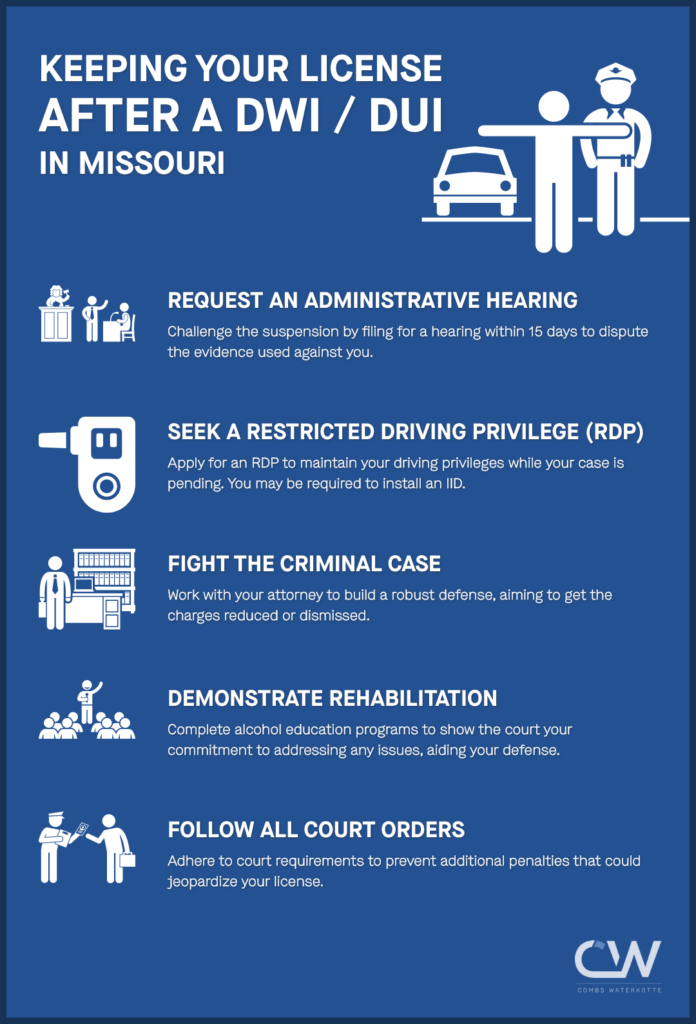
Driving While Intoxicated
Missouri law prohibits driving while intoxicated, which is broadly defined as operating a motor vehicle while in an intoxicated condition. The law, in turn, defines “intoxicated condition” as under the influence of drugs, alcohol, or a combination of the two.
Missouri’s statutes don’t define the term “influence.” However, the courts have interpreted it to mean any physical or mental impairment of a driver’s ability to operate a motor vehicle.
Drugs and alcohol can have myriad effects, including:
- Altering perceptions of speed and distance
- Impairing judgment
- Slowing reflexes
- Dulling attention or causing drowsiness
Due to these effects, some drivers react to drugs or alcohol by taking greater risks, thereby increasing their odds of causing a car accident.
“Operate” also has a particularly legalistic meaning. “Operating” includes driving; however, it also refers to any physical control of the vehicle with the intent to operate it.
Therefore, you can commit a DWI even if you’re sitting in a vehicle with the ignition off, provided the keys are accessible. Whether the keys are in your pocket, in your purse, or on the dashboard, the police could claim that you had physical control and the intent to drive.
The police determine intoxication through observation and testing. An officer will observe your driving before pulling you over, as well as your physical condition and mental state while talking with you during the stop. They might interpret symptoms like bloodshot eyes, dilated pupils, slurred speech, and confusion as signs of impairment.
If an officer suspects intoxication, they may investigate further by asking you to perform a field sobriety test, which will consist of physical and cognitive challenges designed to identify signs of impairment.
For instance, the officer who stopped you may ask you to stand on one leg to test your balance and coordination, or they may assess your speech and memory by having you recite the alphabet.
Police officers in Kansas City, MO, can record field sobriety tests. Their recordings, typically captured using body- or dash-mounted cameras, are admissible in court to prove driver intoxication.
Driving With Excessive Blood Alcohol Content
Missouri also prohibits motorists from driving with a blood alcohol content (BAC) at or over the legal limit of 0.08%. This crime is referred to as a “per se offense” because you’re presumed to be too intoxicated to drive when you have a high BAC, even if you don’t show signs of mental or physical impairment.
To secure a conviction for driving with excessive BAC, prosecutors only need to show that you were operating a vehicle and failed a blood, breath, or urine test. They don’t need testimony from police officers or results of field sobriety tests indicating confusion, poor balance, or slow reactions.
Although prosecutors aren’t required to prove impairment, an excessive BAC conviction is still considered a DWI when calculating repeat offender level.
For example, if you had one intoxicated driving conviction and two excessive BAC convictions, you could be classified as an aggravated offender. As a result, the judge would impose increased penalties upon your next conviction.
Possible Defenses in Cases Involving Multiple DWIs in Kansas City, MO
The criminal defense strategies available when facing a DWI charge after a prior conviction usually take two forms. First, your lawyer can fight the new charge. If you win the case, your prior DWI history will be irrelevant.
Alternatively (or additionally), your lawyer might challenge how the prosecution has tried to count your previous DWI convictions. By reducing the prior case count, they can negotiate for less harsh penalties if you’re convicted.
The following are some of the defenses your lawyer might employ.
Invalid Test Results
The testing equipment, the administering officer, or procedural missteps can all taint the results of a chemical test. For example, uncalibrated equipment can produce invalid test results. If your lawyer can raise reasonable doubts about the test results, you could secure an acquittal.
No Probable Cause for the Traffic Stop
Under the Constitution’s Fourth Amendment, police officers must have probable cause to stop your vehicle. “Probable cause” means the officer has a reasonable suspicion that you violated the law. If the officer who pulled you over conducted an illegal stop, the judge can dismiss your charges.
Alternate Explanation for Failed Field Sobriety Test
If the prosecution relies on a failed field sobriety test, your lawyer may be able to undercut their case by providing an alternate reason for your inability to perform the tasks as directed.
For instance, you may have stumbled because of a preexisting leg injury or failed to recite the alphabet because of a cognitive condition. If your explanation is reasonable, a jury might see fit to drop your charges.
No Operation
Prosecutors must prove that you were operating a vehicle to get a conviction for DWI. As noted, you can “operate” a vehicle when the ignition is off if you have the ability and intent to drive. However, when either of these elements is missing, your lawyer can dispute the charges.
Suppose that the police found you sleeping in your parked car. However, you dropped your keys outside the car before you got in. Your lawyer could point to this fact to prove that you couldn’t have operated the vehicle.
Improperly Counted Prior Convictions
In some cases, prosecutors may miscount prior convictions, placing you at a higher repeat-offender level than you deserve. For example, prosecutors might misinterpret the charges in a case you faced while serving in the military as a DWI.
In such a scenario, your attorney can gather relevant documents and argue that a certain case shouldn’t count toward your offense level.
Penalties for Multiple DWIs in Missouri
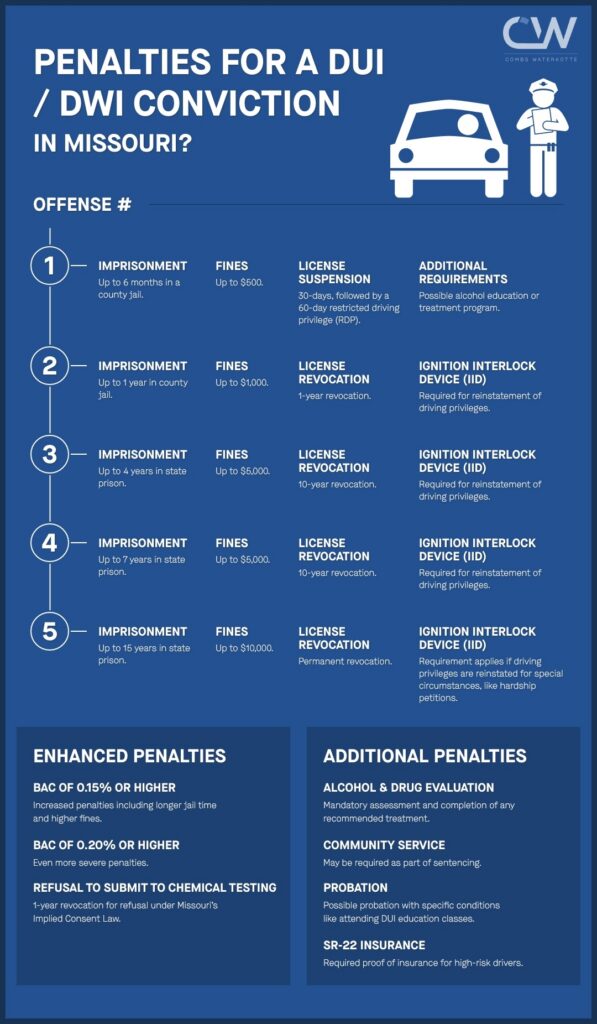
First-offense and second-offense DWIs are usually punished as misdemeanors, as long as no injuries or fatalities occurred. However, repeat DWI offenders face felony exposure, which comes with the following penalties:
| Offense | Charge Level |
|---|---|
| Persistent offender DWI or excessive BAC | Class E felony; up to four years |
| Aggravated offender DWI or excessive BAC | Class D felony; up to seven years |
| Chronic offender DWI or excessive BAC | Class C felony; up to 10 years |
| Habitual offender DWI or excessive BAC | Class B felony; up to 15 years |
Why Hire Combs Waterkotte to Handle Your Multiple DWIs in Kansas City, MO?

Jackson County is one of the few counties in Missouri that doesn’t have a DWI court. For this reason, you must be prepared to mount a vigorous defense to your charges; otherwise, you may face significant jail time.


Our attorneys have over 100 years of experience fighting for those accused of serious criminal offenses. We know the types of evidence and legal arguments that can yield a positive outcome in your DWI case.
How We Can Defend You After You Receive Multiple DWIs in Missouri
First and most importantly, we’ll listen to your side of the story. Based on your explanation, our team will gather the evidence needed to support your legal defense. We’ll then negotiate with prosecutors to seek a fair resolution to your case, including a dismissal or plea bargain.

Legal Video:

Legal Video:
If prosecutors are unwilling to offer an acceptable plea deal, we’ll challenge your charges in court, presenting evidence and testimony to the jury and arguing for an acquittal.
Contact Combs Waterkotte to Discuss Your Defense in a Case Involving Multiple DWIs
Missouri has taken a firm stance against repeat DWI offenses. The capable attorneys at Combs Waterkotte have the skills and resources to help you avoid the worst consequences of a conviction. Contact us online or at (314) 900-HELP to learn more about the defenses we can raise against your DWI charges.
Resources
For more information on criminal defense in Kansas City or anywhere else in Missouri, call the Combs Waterkotte criminal defense attorneys right away at (314) 900-HELP or contact us online for a confidential consultation.
What Do Police Look for During a DWI/DUI Stop?
Can a DWI/DUI Be Reduced in Missouri?
What DWI/DUI Defense Lawyers Actually Do in Missouri
How does a DWI or DUI affect your driver’s license?
Step-by-Step Walkthrough of a Missouri DWI/DUI Traffic Stop
Explaining DWI/DUI Cases in Missouri
Charged with a DWIDUI in Missouri? Here’s What You Need to Know
Should I Blow if I Get Pulled Over for a DWI/DUI in Missouri?

Free book
Don’t “Blow” Your DWI/DUI Case: Key Mistakes to Avoid
Combs Waterkotte, Missouri and Illinois’s leading DWI/DUI law firm, has handled over 10,000 cases successfully. This ebook guides you through the DWI/DUI defense process and helps you avoid key mistakes.

