

Fentanyl Charges Lawyer Kansas City, MO
Hire the leading fentanyl charges defense law firm in Kansas City, MO to protect your freedom, rights, and future. Whether you have been charged or are under investigation, we can help.
TO COMBS WATERKOTTE,YOU ARE WHY WE EXIST.


Fentanyl Charges Lawyer Kansas City, MO
A fentanyl charge in Kansas City can become a major felony case, even at quantities measured in milligrams. Missouri law punishes unauthorized possession as a felony and allows far harsher charges if prosecutors allege delivery, an overdose, sales in a protected location, or trafficking.
The severity and complexity of a fentanyl charge means that if you’ve been accused or arrested, you should seek legal help immediately. Combs Waterkotte builds strong criminal defenses for people facing serious Kansas City drug charges. We examine the search, weight, delivery evidence, and any claimed injuries or deaths to challenge your charges. Reach out by calling (314) 900-HELP today.

I owe my life to Combs Waterkotte. If not for them, I would be spending the rest of my life behind bars. There is no amount of words that can explain what they did for me and my family. Its the highest recommendation that I can give.
Alexander B.
Felonies
Verify on

If I could give Steve and his team 10 stars I would in a heartbeat. Was facing more then one felony charge and after these guys found the arresting officer violated my 4th Amendment Rights and those charges were dismissed. My family and I can't thank you enough.
Dean J
Felonies
Verify on
I was hands down guilty. ON VIDEO !!! In a smaller town, and a job dealing with the public, this was devastating. I made one phone call and spoke for maybe 15 minutes. I DIDN'T appear in court. I am extremely impressed. QUIETLY relieved of the matter!
Y.I.V.
Theft
Verify on
My fiance had a felony drug charge and Combs Waterkotte got it dismissed! There were no fines, court cost, nothing. Chris is loyal, professional, knowledgeable, and a man of his word. We are forever grateful for you.
Kimberly T.
Drug Crimes
Verify on
If I was found guilty, it would have been over 100 years in prison. They promised me that they would fight like hell and get me out of it. After everything was done, I just felt free. Like this wasn’t gonna end with me rotting away in a prison cell. I felt like I could start my life and have a fresh start.
Caleb
Assault 1st, Armed Criminal Action
Verify on
I was facing, probably 18 years… I actually got 5 years probation and 40 hours of community service. Without Combs Waterkotte’s help, I don’t think my family could have made it without me. It was just a written book to where it's a perfect ending.
Chris
Unlawful Use of a Weapon, Armed Criminal Action
Verify on
I went through what was supposed to be one of the top law firms in St. Louis. They said I wouldn't have no chance. I end up firing the other lawyer and everything and going with Chris. I felt like Combs Waterkotte actually did something for me and wasn't I wasn't just another number on somebody's desk.
Willy
DWI/DUI
Verify onI owe my life to Combs Waterkotte. If not for them, I would be spending the rest of my life behind bars. There is no amount of words that can explain what they did for me and my family. Its the highest recommendation that I can give.
Alexander B.
Felonies
If I could give Steve and his team 10 stars I would in a heartbeat. Was facing more then one felony charge and after these guys found the arresting officer violated my 4th Amendment Rights and those charges were dismissed. My family and I can't thank you enough.
Dean J
Felonies
I was hands down guilty. ON VIDEO !!! In a smaller town, and a job dealing with the public, this was devastating. I made one phone call and spoke for maybe 15 minutes. I DIDN'T appear in court. I am extremely impressed. QUIETLY relieved of the matter!
Y.I.V.
Theft
My fiance had a felony drug charge and Combs Waterkotte got it dismissed! There were no fines, court cost, nothing. Chris is loyal, professional, knowledgeable, and a man of his word. We are forever grateful for you.
Kimberly T.
Drug Crimes
If I was found guilty, it would have been over 100 years in prison. They promised me that they would fight like hell and get me out of it. After everything was done, I just felt free. Like this wasn’t gonna end with me rotting away in a prison cell. I felt like I could start my life and have a fresh start.
Caleb
Assault 1st, Armed Criminal Action
I was facing, probably 18 years… I actually got 5 years probation and 40 hours of community service. Without Combs Waterkotte’s help, I don’t think my family could have made it without me. It was just a written book to where it's a perfect ending.
Chris
Unlawful Use of a Weapon, Armed Criminal Action
I went through what was supposed to be one of the top law firms in St. Louis. They said I wouldn't have no chance. I end up firing the other lawyer and everything and going with Chris. I felt like Combs Waterkotte actually did something for me and wasn't I wasn't just another number on somebody's desk.
Willy
DWI/DUI
Fentanyl Charges in Kansas City, Missouri
Missouri prosecutes fentanyl through several controlled-substance statutes rather than one all-purpose, fentanyl-related offense. Possession, delivery, protected-location distribution, delivery causing an injury or death, and trafficking allegations all require different facts and carry different penalty ranges.
Missouri’s controlled-substance laws treat unauthorized fentanyl possession as a felony (even below trafficking thresholds). A valid prescription or any other legal authority can make possession lawful, but sharing, or selling prescribed fentanyl can still result in a delivery charge.

Kansas City, Missouri prosecutors take fentanyl offenses very seriously. To start building your defense against your fentanyl-related charges, call (314) 900-HELP or contact us online now.
Fentanyl’s trafficking thresholds make these cases especially sensitive to measurements. More than three milligrams can trigger a trafficking charge, while fourteen milligrams or more brings high-level felony charges. (By comparison, Missouri begins heroin trafficking charges above 30 grams and cocaine trafficking charges above 150 grams.)
The statute covers fentanyl and its derivatives, as well as qualifying compounds, mixtures, or substances containing even a detectable amount of fentanyl (including isomers and analogues). This means chemical identification, sampling, weight, mixture and lab testing reliability central to a defense.
Overdose allegations add additional complications. Prosecutors have to prove both an unlawful delivery and the resulting injury or death. A serious-injury charge also requires proof that the accused knew the delivered substance was mixed with another controlled substance.
Why Combs Waterkotte is the best Law firm for your case.
Real results for people just like you.

Fentanyl Offenses Under Missouri Law
Chapter 579 of the Missouri Revised Statutes defines the conduct that controls most Kansas City fentanyl cases. While several fentanyl-related offenses are on the books in Missouri, the following are some of the most common charges we help defend against.
First- and Second-Degree Fentanyl Trafficking
First-degree drug trafficking under RSMo §579.065 covers knowingly distributing, manufacturing, or attempting to sell or make more than three milligrams of fentanyl. It is a Class B felony above three milligrams and a Class A felony at fourteen milligrams or more.
Second-degree drug trafficking under RSMo §579.068 covers knowingly possessing, controlling, purchasing, or attempting to purchase more than three milligrams of fentanyl (or a substance containing it). It is a Class C felony above three milligrams and a Class B felony at fourteen milligrams or more.
Delivery, Intent to Deliver, and Protected Locations
Missouri’s drug delivery law covers:
- Distribution or delivery
- An attempted transfer
- Possession with intent to distribute
- Knowingly allowing a minor to purchase or transport drugs
Ordinary fentanyl delivery is a Class C felony, and conduct involving a minor raises the charge to a Class B felony.
The state may also charge distribution in a protected location as a Class A felony. Prosecutors must be able to establish the transfer and the accused’s knowledge that it occurred within a protected area (like a school, park, or public or government-assisted housing property).
Delivery Causing Serious Injury or Death
The delivery-causing-serious-injury statute applies when a person delivers a Schedule I or II controlled substance, knows the substance is mixed with another controlled substance, and someone suffers a serious physical injury from its use. The offense is a Class C felony, even the injured individual takes the substance willingly.
RSMo §579.022 defines the separate offense of delivery causing death. In these cases, prosecutors have to prove that someone delivered fentanyl and that a death resulted from its ingestion. Causing an accidental fentanyl death is a Class A felony.
Possession of Fentanyl
RSMo §579.015 prohibits knowing possession of a controlled substance unless the law authorizes the possession. Missouri’s drug possession statute classifies unauthorized fentanyl possession as a Class D felony, even when the amount is just intended for personal use.
Possession allegations typically come in two forms:
- Actual possession, which usually involves fentanyl found on a person’s body or in an item the person carries
- Constructive possession, which applies when the state claims someone knew about fentanyl found elsewhere (like a shared car, bedroom, bag, or medicine cabinet)
Defense Strategies for Fentanyl Charges in Kansas City
A good defense against a Kansas City, Missouri fentanyl crime must account for the exact charge and the evidence supporting it. At Combs Waterkotte, we look for constitutional issues, evidence of knowledge, proof of delivery, lab testing results, drug weight, and causation and build a defense around these facts. Here are some common defense strategies we use to challenge fentanyl allegations.
Challenge the Search and Seizure
Fentanyl cases may begin with an arrest, search warrant, traffic stop, or an intercepted package. Whatever the circumstances, we can examine factors like reasonable suspicion, probable cause, canine use, and searches of phones or containers. If police violate your constitutional rights, a Fourth Amendment defense can support suppression of critical evidence and severely limit the prosecution’s case.
Dispute Knowledge, Control, or Lack of Authorization
In fentanyl cases, the state must prove knowing possession. Fentanyl found in a shared car, residence,or bag, does not necessarily belong to everyone nearby. We can analyze access, prescriptions, labels, fingerprints, DNA, and statements to determine whether the evidence shows knowing, unauthorized control.
Contest Delivery or Intent to Deliver
Prosecutors may assume intent from packaging, cash, scales, messages, or certain quantities. However, we can test alternative explanations, the completeness of communications, surveillance gaps, and informant incentives. For an alleged hand-to-hand transfer, we’ll demand reliable proof of who delivered what to whom.
Attack the Lab Result and Milligram Weight
Field tests cannot reliably establish the chemical structure or weight of fentanyl. And when three and fourteen milligrams determine felony tiers, small measurement errors can carry enormous consequences. So, we scrutinize sampling, contamination, calibration, analyst methods, evidence seals, and chain of custody errors to push back against the charges.
Challenge Overdose Source and Causation
An injury or death demands clear evidence to establish who supplied the substance or what actually caused the harm. We compare toxicology, medical records, timelines, interactions with other drugs, witness accounts, and physical evidence. In a serious-injury case, we also look for proof that the accused knew the substance contained fentanyl.
Possible Penalties for Fentanyl Offenses in Missouri
Missouri’s felony prison ranges are laid out in RSMo §558.011. The charged statute (e.g., possession, delivery, serious injury, etc.) and proven facts determine the classification. The table below summarizes common fentanyl-related charges in Kansas City, Missouri and the felony penalty associated with each charge:
| Offense | Classification | Authorized Prison Term |
|---|---|---|
| Unauthorized possession of fentanyl | Class D felony | Up to 7 years |
| Delivery or intent to deliver fentanyl | Class C felony | 3 to 10 years |
| Delivery of fentanyl to a minor | Class B felony | 5 to 15 years |
| Delivery of fentanyl causing serious physical injury | Class C felony | 3 to 10 years |
| Delivery of fentanyl causing death | Class A felony | 10 to 30 years or life |
| Distribution of fentanyl in a protected location | Class A felony | 10 to 30 years or life |
| First-degree fentanyl trafficking (3 to 14 mg) | Class B felony | 5 to 15 years |
| First-degree fentanyl trafficking (14 mg or more) | Class A felony | 10 to 30 years or life |
| Second-degree fentanyl trafficking (3 to 14 mg) | Class C felony | 3 to 10 years |
| Second-degree fentanyl trafficking (14 mg or more) | Class B felony | 5 to 15 years |
Given the serious, long-term prison sentences involved with a fentanyl conviction, getting legal help as early as possible is critical to your defense. Combs Waterkotte’s Kansas City office is here to help if you’ve been arrested or charged.
Why Choose Combs Waterkotte for a Kansas City Fentanyl Case?

Fentanyl prosecutions may involve narcotics officers, forensic chemists, toxicologists, medical records, surveillance, and other complicated investigatorial elements. Combs Waterkotte has both the experience and the resources to test every aspect of the case against you and expose conclusions that don’t match the underlying evidence.


Combs Waterkotte brings decades of combined experience to suppression litigation, expert review, negotiations, and trial preparation, having handled more than 15,000 criminal cases. Our clients receive prompt and direct communication, informed options, and a strategy built around the evidence and the outcomes that matter most to them.
We pursue charge dismissals or reductions when the record supports it. We negotiate from a position of preparation and we remain trial-ready when prosecutors don’t offer a fair resolution.
How Combs Waterkotte Will Take On Your Fentanyl Charges
When you choose our firm to handle your fentanyl charges, we start by learning what happened and identifying your most urgent concerns. Our team then obtains discovery evidence, reconstructs the investigation, reviews reports and recordings, and traces the seized evidence. We attack the prosecution from all angles by:
- Examining police conduct: We’ll challenge unlawful stops, searches, seizures, warrants, and interrogations
- Separating presence from possession: We’ll identify shared access, lawful authority, and evidence of another person’s control
- Exploring forensic proof: We review lab methods, milligram weight, toxicology, packaging, and chain of custody
- Testing charge enhancements: We demand proof of delivery, intent, location, mixture knowledge, weight, or causation
- Preparing for every outcome: We’ll pursue suppression, dismissal, reduction, a fair agreement, or trial acquittal


All the while, we’ll explain your choices and possible risks at every stage. Whether your case comes down to a suppression hearing, a laboratory issue, a toxicology opinion, an informant’s testimony, or a jury trial, we’ll develop key defenses to stay prepared for any possibility.
Contact a Fentanyl Charges Lawyer in Kansas City, MO
A fentanyl charge is very serious, but a good criminal defense attorney can help. Prompt defense work can preserve critical evidence, locate witnesses, and protect your options. To start building your defense, call Combs Waterkotte at (314) 900-HELP or contact us online today. We can evaluate the allegations against you, explain all of your legal options, and begin developing a focused defense to limit the impact of your fentanyl charges on your life, freedom, and future.
Resources
For more information on criminal defense in Kansas City or anywhere else in Missouri, call the Combs Waterkotte criminal defense attorneys right away at (314) 900-HELP or contact us online for a confidential consultation.
Can Criminal Charges Be Dropped?
What Does a Kansas City, MO, Criminal Defense Attorney Actually Do?
Free book
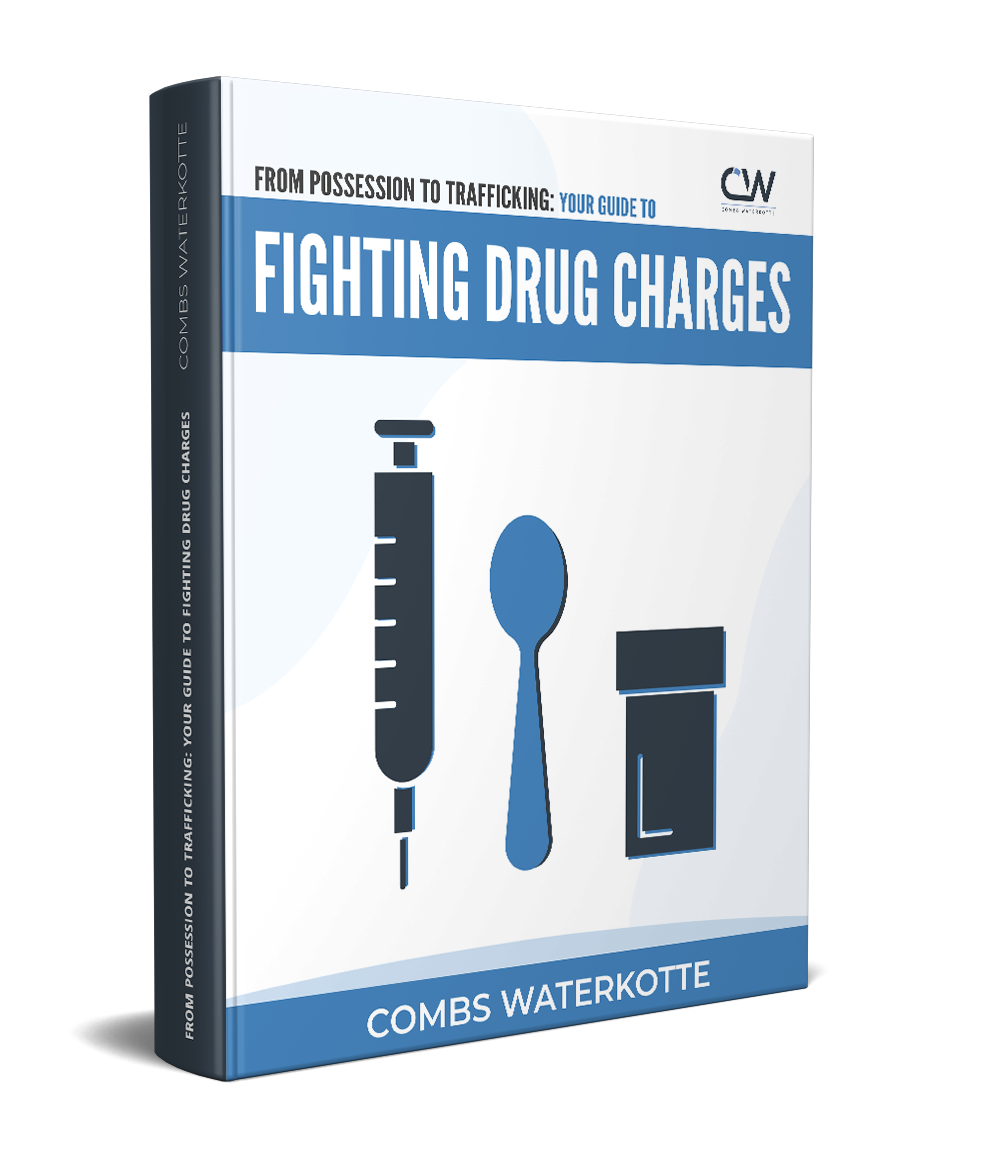
From Possession to Trafficking: Your Guide to Fighting Drug Charges
Combs Waterkotte is a leading drug crimes defense firm in Missouri, known for handling high-stakes cases and delivering real results. With over 10,000 cases handled and more than one million days of jail time avoided, we know how to fight—and win—against serious drug charges. This guide is built from that experience.

