

Maryland Federal Fraud Defense Lawyer. A federal fraud investigation may be underway long before anyone calls it a criminal case. One company receives a subpoena. Someone else is asked about a payment. Funds are frozen, records are collected, and former employees are interviewed. When prosecutors finally reveal their theory, they may have already spent months assembling ordinary business documents into an accusation of intentional fraud.
That theory can look tidy because the government decides which records sit next to each other. The defense has to restore what was left out: the rest of the email thread, the work that was actually performed, the advice someone relied on, the pressure surrounding a business decision, and the difference between a venture that failed and a plan that was fraudulent from the beginning.
Cases Handled
Over 10,000
Jail Days Saved
Over 1 Million
Google Reviews
500+ Perfect
Legal Experience
100+ Years
Combs Waterkotte represents individuals and organizations in Maryland, including executives, professionals, business owners, and health care providers, in federal fraud investigations and prosecutions across the United States. Our federal criminal defense lawyers can intervene before indictment, take over communication with agents and prosecutors, examine the government’s evidence against the full record, and prepare the case for motions, negotiation, trial, or sentencing.
Call (314) 900-HELP for a free, confidential case review, or contact Combs Waterkotte online.
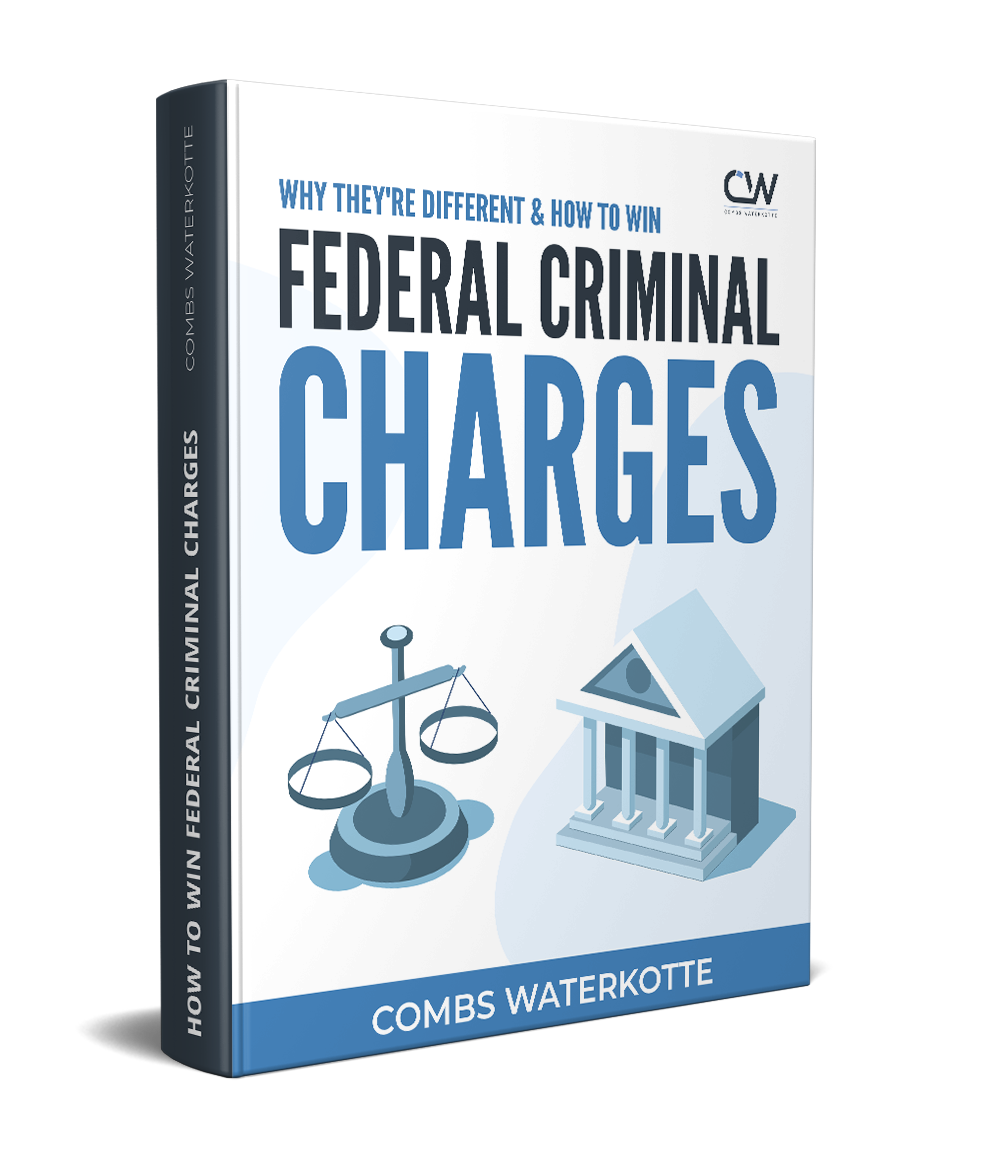
Free book
Facing Federal Criminal Charges? Why They’re Different and How to Win
Combs Waterkotte, a leading federal criminal defense law firm, has handled over 10,000 cases successfully. This ebook guides you through the federal criminal defense process, how federal charges are different, and how to win.
This guide covers:
- how an accusation of fraud can trigger federal jurisdiction;
- the fraud statutes and related charges commonly included in federal indictments;
- how a federal fraud matter can progress from subpoenas and interviews to trial or sentencing; and
- how Combs Waterkotte challenges intent, evidence, witnesses, searches, and loss calculations.
Legal Videos
Can Federal Charges Be Reduced Or Dismissed?
Can Federal Charges Be Reduced Or Dismissed? Chris Combs and Andrew Russek, lawyers with Combs Waterkotte, a leading federal criminal defense firm, talk about proffers, probation, and federal …
Should I Hire A Lawyer Experienced In Federal Defense?
Should I Hire A Lawyer Experienced In Federal Defense? Chris Combs and Andrew Russek from the leading federal criminal defense firm Combs Waterkotte discuss the importance of hiring a lawyer with …
What Penalties Apply To Federal Sex Crime Convictions?
What Penalties Apply To Federal Sex Crime Convictions? Andrew Russek and Chris Combs from Combs Waterkotte federal criminal defense firm discuss potential penalties related to federal sex crime …
Do Federal Sex Crimes Require Sex Offender Registration?
Do Federal Sex Crimes Require Sex Offender Registration? Andrew Russek, a lawyer with leading federal criminal defense firm Combs Waterkotte, discusses the sex offender registry and federal sex …
What Makes A Sex Crime Federal Rather Than State?
What Makes A Sex Crime Federal Rather Than State? Andrew Russek and Chris Combs of Combs Waterkotte discuss factors that play into a sex crime being classified as federal, rather than …
What Are Federal Sex Crime Charges?
What Are Federal Sex Crime Charges? Chris Combs and Andrew Russek of Combs Waterkotte discuss the most common federal sex crime charges. Interview Transcript Scott Michael Dunn: Well, let's …
Can Federal Charges Be Reduced Or Dismissed?
Can Federal Charges Be Reduced Or Dismissed? Chris Combs and Andrew Russek, lawyers with Combs Waterkotte, a leading federal criminal defense firm, talk about proffers, probation, and federal …
Should I Hire A Lawyer Experienced In Federal Defense?
Should I Hire A Lawyer Experienced In Federal Defense? Chris Combs and Andrew Russek from the leading federal criminal defense firm Combs Waterkotte discuss the importance of hiring a lawyer with …
What Penalties Apply To Federal Sex Crime Convictions?
What Penalties Apply To Federal Sex Crime Convictions? Andrew Russek and Chris Combs from Combs Waterkotte federal criminal defense firm discuss potential penalties related to federal sex crime …
Do Federal Sex Crimes Require Sex Offender Registration?
Do Federal Sex Crimes Require Sex Offender Registration? Andrew Russek, a lawyer with leading federal criminal defense firm Combs Waterkotte, discusses the sex offender registry and federal sex …
What Makes A Sex Crime Federal Rather Than State?
What Makes A Sex Crime Federal Rather Than State? Andrew Russek and Chris Combs of Combs Waterkotte discuss factors that play into a sex crime being classified as federal, rather than …
What Are Federal Sex Crime Charges?
What Are Federal Sex Crime Charges? Chris Combs and Andrew Russek of Combs Waterkotte discuss the most common federal sex crime charges. Interview Transcript Scott Michael Dunn: Well, let's …
How Can a Fraud Allegation in Maryland Become a Federal Case?
Federal fraud prosecutions begin with jurisdiction. The government must connect the alleged conduct to a federal statute, then prove the link that allows the case to proceed in federal court. Depending on the charge, that link may be a communication system, federally backed money, a covered institution, or a scheme crossing state lines.
A case can attract federal attention through allegations involving:
- emails, text messages, phone calls, electronic payments, online platforms, or other interstate communications;
- letters, checks, packages, or documents carried by the mail or a private carrier;
- funds or property controlled by a federally insured financial institution;
- money connected to Medicare, Medicaid, federal aid, disaster assistance, procurement, or federally insured loans;
- securities, commodities, regulated markets, or investor communications;
- records or representations the government claims were false when submitted to a federal agency; or
- conduct spanning several states, countries, companies, accounts, or alleged participants.
A company operating in Maryland may use interstate systems every day without thinking about federal jurisdiction. One email, card transaction, bank transfer, or shipped package can give prosecutors the connection required by a statute. That connection opens the courthouse door; it does not prove fraudulent intent or any other element of the offense.
Types of Federal Fraud Charges in Maryland
Federal charging decisions focus on the method of the alleged scheme, not merely the label people use for it. An internet fraud claim may become wire fraud. A billing dispute may produce health care fraud, false statement, or conspiracy counts. Combs Waterkotte represents people and organizations in Maryland in these and other federal white-collar cases.
- Wire fraud under 18 U.S.C. 1343: Federal charges based on the alleged use of digital communications, electronic payments, or other interstate wires to execute a fraudulent scheme.
- Mail fraud under 18 U.S.C. 1341: Cases involving the U.S. mail or private carriers used in connection with an alleged scheme, including invoices, checks, applications, contracts, and account documents.
- Bank fraud under 18 U.S.C. 1344: Allegations that a person intentionally targeted a financial institution or sought money under its control through a false or fraudulent representation.
- Loan and credit application fraud under 18 U.S.C. 1014: Charges alleging that false information was knowingly supplied to influence a bank, lender, or federally connected credit decision.
- Health care fraud under 18 U.S.C. 1347: Federal investigations of claims, treatments, prescriptions, referral arrangements, or reimbursement practices that the government describes as fraudulent.
- Securities and commodities fraud under 18 U.S.C. 1348: Cases involving investor disclosures, trading activity, offering materials, valuations, market information, or the sale of covered securities and commodities.
- Government contract, grant, and benefit fraud: Cases involving federal contracts, grants, relief programs, benefits, procurement, eligibility representations, or invoices submitted for government money.
- Federal tax fraud and tax crimes: Accusations that a taxpayer or business knowingly concealed income, misstated deductions, failed to remit payroll taxes, or otherwise acted willfully.
- Access device fraud and computer fraud: Federal allegations based on the use of credit cards, account identifiers, digital credentials, devices, or computer access to obtain information, money, or property.
- Honest services fraud under 18 U.S.C. 1346: Charges claiming that a person accepted or offered bribes or kickbacks and thereby deprived another party of the right to honest services.
Dozens of counts do not necessarily mean dozens of unrelated events. Prosecutors often divide one alleged scheme into separate communications and transactions. Defense strategy must examine what each count requires, which evidence supports it, and whether the broad accusation survives when its pieces are tested individually.
A federal prosecution does not follow the same path as a state case. Its agencies, prosecutors, courts, discovery practices, and sentencing framework are different. Our guide explains what makes federal criminal cases distinct.
What Does the Government Have to Prove in Federal Fraud Cases in Maryland?
The government’s burden changes with the offense. A wire fraud charge has different elements from health care fraud, bank fraud, or false statements. Even so, federal fraud prosecutions tied to Maryland often turn on the same core issues:
- Can prosecutors prove the existence of the scheme described in the indictment, including its objective and operation?
- Did the accused knowingly participate in that scheme?
- Did the accused act with an intent to defraud rather than through mistake, negligence, confusion, or good faith?
- Was a statement, omission, promise, or representation false or misleading in a way that mattered?
- Did the alleged conduct use or affect the mail, interstate wires, a financial institution, a federal program, or another required federal connection?
Signs You May Be Under Federal Fraud Investigation in Maryland
You do not need to see your name on an indictment before hiring counsel. Early signs may appear through other people or institutions first.
- A federal target letter, grand jury subpoena, or formal demand for testimony or documents arrived.
- Federal agents contacted you at home, at work, by phone, or through another person.
- You learned that investigators demanded records from an institution, professional, or company that does business with you.
- A search resulted in the government taking devices or records that may contain years of personal and commercial information.
- A bank account was restrained, frozen, or named in a forfeiture notice.
- Questions in an audit began emphasizing personal knowledge, certifications, emails, and the reasons behind particular decisions.
- Agents began questioning people around you, including colleagues, employees, customers, patients, investors, or family members.
- Agents or prosecutors asked you to explain records in what they described as an informal conversation.
An invitation to “clear something up” in Maryland should not be mistaken for a harmless chat. Investigators may already possess emails, financial records, and witness accounts. Answering from memory can create discrepancies, and an intentionally false response can become its own federal offense.
How Combs Waterkotte Challenges Federal Fraud Charges in Maryland
Federal fraud defense in Maryland begins with the statute, the indictment or investigation, and the complete record. Some cases call for a direct attack on the alleged scheme; others are weakened by challenging individual counts, witnesses, transactions, or calculations.
The Conduct Was Not Driven by Fraudulent Intent
Fraud requires more than an error, a failed prediction, or a questionable business choice. Evidence that the accused sought professional advice, communicated openly, delivered value, or acted in good faith may show that deception was never the objective.
Prosecutors Presented an Incomplete Record
An accusation built from selected documents deserves to be tested against everything the government left out. Full message threads, earlier drafts, later corrections, contemporaneous records, and informed witnesses can explain entries that appear suspicious in isolation.
Ambiguity Is Not Fraud
A statement can be incomplete, uncertain, or open to more than one reasonable interpretation without being intentionally false. Forecasts and estimates may also prove wrong despite being honestly made. Where materiality is an element, prosecutors must show that the alleged misrepresentation mattered to the relevant decision.
Association Does Not Prove Knowing Participation
Federal cases often involve many people, but contact with an alleged participant does not prove agreement. The government must show that the accused understood the fraudulent plan and chose to take part, not merely that the accused worked nearby or completed a routine task.
A Cooperating Witness Is Shifting Blame
A witness may tell the government a story that protects a career, company, or plea agreement. Cross-examination and documentary evidence can reveal what the witness received, what changed over time, and where the account conflicts with the record.
The Alleged Conduct Does Not Fit the Federal Statute
Every federal fraud statute has boundaries. The government may need to prove a particular mailing, interstate wire, financial institution, federal program, or protected interest. If that connection is missing or does not match the charged conduct, the defense can challenge jurisdiction.
The Search or Interrogation Violated Constitutional Rights
An overbroad warrant, unsupported search, unlawful seizure, or improperly obtained statement may support a motion to suppress. Digital searches deserve particular attention because one device can hold years of personal, business, and privileged information. Learn more about Fourth Amendment defense issues.
The Government’s Loss Figure Overstates the Case
A large number in a charging document is a claim, not a final calculation. Defense review may separate actual harm from intended loss, identify legitimate value and repayments, challenge the number of victims, and dispute transactions outside the accused’s conduct.
The Federal Fraud Case Process
Not every case follows the same route, and some involving Maryland end before formal charges. A federal fraud matter commonly moves through these stages:
- Investigation: Agents gather records, interview witnesses, use subpoenas, execute warrants, and work with federal prosecutors. Counsel may be able to communicate with the government and present information before charging decisions are final.
- Grand jury proceedings: A federal grand jury can compel documents and testimony while prosecutors present their evidence outside the presence of the defense. A finding of probable cause may result in an indictment.
- Initial appearance and release decision: Following an arrest or arranged surrender, a judge considers representation and decides whether the accused will be detained or released subject to conditions.
- Arraignment and discovery: After the initial proceedings, the defense receives the government’s evidence and begins comparing the indictment with the documents, financial analyses, interviews, and digital records.
- Motions and expert review: Defense counsel may file motions to suppress or exclude evidence, seek additional discovery, attack defects in the indictment, and challenge the government’s experts. Accountants, computer specialists, or industry professionals can help examine complex proof.
- Negotiation or trial preparation: The government and defense may explore a resolution, but preparation cannot pause. Counsel must evaluate plea terms and sentencing exposure while developing the factual themes and courtroom strategy needed for trial.
- Trial, sentencing, and appeal: At trial, the burden remains on the government to prove each charged element beyond a reasonable doubt. A plea or guilty verdict moves the case to sentencing, while appeal may be available for certain preserved errors and rulings.
Sentencing Exposure in Federal Fraud Cases
Federal fraud charges arising in Maryland may carry long maximum prison terms. Sentencing requires a separate analysis, including the applicable counts, prior record, advisory Federal Sentencing Guidelines, findings made by the judge, and the statutory factors governing a sufficient sentence.
| Federal Statute | Statutory Sentencing Range |
|---|---|
| Mail fraud, 18 U.S.C. 1341 | Up to 20 years in prison for a standard offense. The maximum can reach 30 years when the violation affects a financial institution or falls within specified emergency or disaster benefit provisions. |
| Wire fraud, 18 U.S.C. 1343 | The statute generally authorizes up to 20 years in prison. The maximum may increase to 30 years when the offense affects a financial institution or involves certain emergency benefits. |
| Bank fraud, 18 U.S.C. 1344 | A bank fraud conviction can carry up to 30 years in prison, along with a fine of as much as $1,000,000. |
| Health care fraud, 18 U.S.C. 1347 | The standard maximum is 10 years. Serious bodily injury can increase the maximum to 20 years, while a violation resulting in death can carry life imprisonment. |
| Securities and commodities fraud, 18 U.S.C. 1348 | Up to 25 years in prison, along with potential fines, restitution, and forfeiture. |
| False statements, 18 U.S.C. 1001 | A false statement conviction generally carries up to five years in prison, subject to the statute’s different treatment of specified proceedings and offenses. |
| Aggravated identity theft, 18 U.S.C. 1028A | A two-year prison term that generally runs consecutively to the sentence for the underlying felony. |
| Fraud attempt or conspiracy, 18 U.S.C. 1349 | The statutory maximum follows the fraud crime the defendant allegedly attempted or agreed to commit. |
For federal fraud matters connected to Maryland, Guideline Section 2B1.1 commonly provides the starting point. The government’s loss figure may increase the offense level, while additional adjustments can involve victims, role, sophisticated means, trust, obstruction, acceptance of responsibility, and jointly attributed conduct.
Sentencing is not limited to a loss table. Restitution, forfeiture, and guideline loss raise distinct legal questions, and the totals may not match. The defense can also present the person’s background, health, family obligations, positive conduct, and reasons a lower sentence satisfies federal law.
Our related guides explain what happens at federal sentencing and whether a federal court can impose probation.
Steps to Take After Federal Agents Contact You in Maryland
An unexpected fraud inquiry can feel so wrong that answering seems harmless. The safer response is to pause, preserve the record, and understand the investigation before speaking.
- Do not treat a voluntary interview as a routine conversation. You may tell investigators that you will not answer questions until you have legal representation.
- Do not fill gaps in memory with assumptions. An inaccurate answer can damage credibility, and an intentional falsehood can produce an additional charge even when no fraud occurred.
- Preserve the evidence exactly as it exists. Save electronic communications, financial records, contracts, notices, devices, and business data without changing them.
- Do not compare stories with potential witnesses. Let counsel handle necessary contact so ordinary outreach is not portrayed as an attempt to influence a witness.
- Do not answer the allegation through a mass email. A mass email creates new evidence and may reach people cooperating with investigators.
- Preserve all papers and messages received from investigators. Keep copies of every letter, subpoena, warrant, receipt, inventory, agent card, email, and delivery envelope.
- Have counsel review deadlines and demands. Counsel can help preserve required materials, negotiate the scope, identify privileged information, and avoid an incomplete or overly broad production.
- Get federal defense counsel involved promptly in Maryland. A lawyer may be able to clarify your status, review government demands, and present information before prosecutors make final charging decisions.
What Combs Waterkotte Brings to Federal Fraud Cases in Maryland
Federal fraud defense for clients in Maryland is document work, courtroom work, and human work at the same time. The legal team must understand the transaction, find the records that change its meaning, and stay focused on the person whose freedom and career are attached to the file.
- More than 100 years of combined legal experience: Our attorneys handle serious criminal matters in state and federal court.
- More than 10,000 cases handled and over one million jail days saved: That volume helps our lawyers recognize recurring weaknesses, overlooked facts, and opportunities to improve the client’s position.
- More than 500 perfect Google reviews: Clients have trusted Combs Waterkotte during investigations and prosecutions carrying life-changing stakes.
- Early intervention: Before charges are filed, the firm can manage government contact, examine subpoenas, investigate the evidence, and determine whether information should be presented to prosecutors.
- A full defense team: Complex cases may require lawyers, investigators, paralegals, law clerks, accountants, computer specialists, and other professionals working from one defense plan.
- Trial preparation from the beginning: Every count is evaluated with trial in mind, even while the team pursues dismissal, pre-indictment advocacy, or a negotiated outcome. That readiness creates leverage throughout the case.
- Client-centered communication: Clients need more than periodic updates. Our client-centered approach provides direct communication, useful explanations, and 24/7 availability when events change quickly.
Combs Waterkotte also handles federal cases involving:
Get Help With Federal Fraud Charges in Maryland
A federal fraud case in Maryland may still be in the investigation stage, or an indictment may already allege fraud and related financial offenses. Either way, the government is building forward. Your defense should be doing the same.
Call (314) 900-HELP or request a free, confidential consultation with Combs Waterkotte online.

