

Federal Fraud Defense Lawyer in Fort Wayne, IN. A federal fraud investigation may be underway long before anyone calls it a criminal case. One company receives a subpoena. Someone else is asked about a payment. Funds are frozen, records are collected, and former employees are interviewed. When prosecutors finally reveal their theory, they may have already spent months assembling ordinary business documents into an accusation of intentional fraud.
Records do not explain themselves. When prosecutors choose the date range, the documents, and the order in which those documents appear, a messy commercial dispute can look calculated. Defense work puts the omitted facts back into the timeline and tests whether the evidence truly shows fraud or merely a venture that did not succeed.
Cases Handled
Over 10,000
Jail Days Saved
Over 1 Million
Google Reviews
500+ Perfect
Legal Experience
100+ Years
Combs Waterkotte defends clients in Fort Wayne, IN and throughout the country against federal fraud allegations. Our clients include individuals, businesses, executives, licensed professionals, and health care providers. The firm’s federal criminal defense lawyers can communicate with agents and prosecutors, investigate before indictment, examine the evidence in context, file motions, negotiate, and prepare for trial or sentencing.
Discuss the investigation with Combs Waterkotte during a free, confidential case review. Call (314) 900-HELP or reach out online.
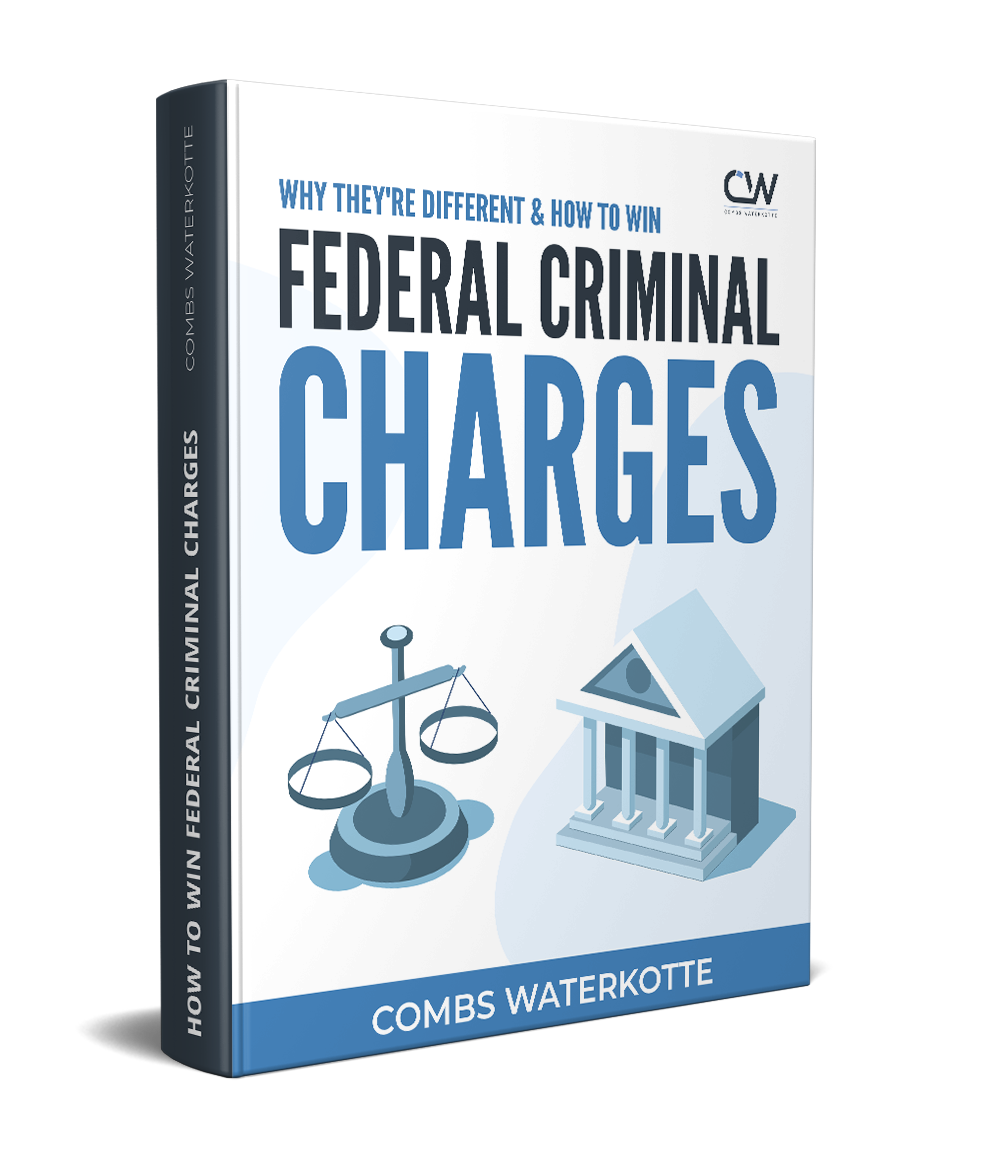
Free book
Facing Federal Criminal Charges? Why They’re Different and How to Win
Combs Waterkotte, a leading federal criminal defense law firm, has handled over 10,000 cases successfully. This ebook guides you through the federal criminal defense process, how federal charges are different, and how to win.
This page explains:
- how an accusation of fraud can trigger federal jurisdiction;
- which federal fraud offenses prosecutors may charge together;
- the major stages of a federal investigation and prosecution; and
- how the defense may challenge the government’s theory, the collection of evidence, cooperating witnesses, and the loss figure.
Legal Videos
Can Federal Charges Be Reduced Or Dismissed?
Can Federal Charges Be Reduced Or Dismissed? Chris Combs and Andrew Russek, lawyers with Combs Waterkotte, a leading federal criminal defense firm, talk about proffers, probation, and federal …
Should I Hire A Lawyer Experienced In Federal Defense?
Should I Hire A Lawyer Experienced In Federal Defense? Chris Combs and Andrew Russek from the leading federal criminal defense firm Combs Waterkotte discuss the importance of hiring a lawyer with …
What Penalties Apply To Federal Sex Crime Convictions?
What Penalties Apply To Federal Sex Crime Convictions? Andrew Russek and Chris Combs from Combs Waterkotte federal criminal defense firm discuss potential penalties related to federal sex crime …
Do Federal Sex Crimes Require Sex Offender Registration?
Do Federal Sex Crimes Require Sex Offender Registration? Andrew Russek, a lawyer with leading federal criminal defense firm Combs Waterkotte, discusses the sex offender registry and federal sex …
What Makes A Sex Crime Federal Rather Than State?
What Makes A Sex Crime Federal Rather Than State? Andrew Russek and Chris Combs of Combs Waterkotte discuss factors that play into a sex crime being classified as federal, rather than …
What Are Federal Sex Crime Charges?
What Are Federal Sex Crime Charges? Chris Combs and Andrew Russek of Combs Waterkotte discuss the most common federal sex crime charges. Interview Transcript Scott Michael Dunn: Well, let's …
Can Federal Charges Be Reduced Or Dismissed?
Can Federal Charges Be Reduced Or Dismissed? Chris Combs and Andrew Russek, lawyers with Combs Waterkotte, a leading federal criminal defense firm, talk about proffers, probation, and federal …
Should I Hire A Lawyer Experienced In Federal Defense?
Should I Hire A Lawyer Experienced In Federal Defense? Chris Combs and Andrew Russek from the leading federal criminal defense firm Combs Waterkotte discuss the importance of hiring a lawyer with …
What Penalties Apply To Federal Sex Crime Convictions?
What Penalties Apply To Federal Sex Crime Convictions? Andrew Russek and Chris Combs from Combs Waterkotte federal criminal defense firm discuss potential penalties related to federal sex crime …
Do Federal Sex Crimes Require Sex Offender Registration?
Do Federal Sex Crimes Require Sex Offender Registration? Andrew Russek, a lawyer with leading federal criminal defense firm Combs Waterkotte, discusses the sex offender registry and federal sex …
What Makes A Sex Crime Federal Rather Than State?
What Makes A Sex Crime Federal Rather Than State? Andrew Russek and Chris Combs of Combs Waterkotte discuss factors that play into a sex crime being classified as federal, rather than …
What Are Federal Sex Crime Charges?
What Are Federal Sex Crime Charges? Chris Combs and Andrew Russek of Combs Waterkotte discuss the most common federal sex crime charges. Interview Transcript Scott Michael Dunn: Well, let's …
What Gives Federal Courts Jurisdiction Over Fraud in Fort Wayne, IN?
Federal fraud prosecutions begin with jurisdiction. The government must connect the alleged conduct to a federal statute, then prove the link that allows the case to proceed in federal court. Depending on the charge, that link may be a communication system, federally backed money, a covered institution, or a scheme crossing state lines.
A case can attract federal attention through allegations involving:
- interstate wires such as emails, texts, phone calls, online platforms, and electronic payments;
- mailings sent through the U.S. Postal Service or an interstate delivery company;
- a bank, lender, credit union, or other covered financial institution;
- claims involving federal programs, contracts, grants, benefits, or emergency funding;
- trading, investment disclosures, securities, commodities, or federally regulated markets;
- records or representations the government claims were false when submitted to a federal agency; or
- transactions that move through several jurisdictions, companies, bank accounts, or people.
A company operating in Fort Wayne, IN may use interstate systems every day without thinking about federal jurisdiction. One email, card transaction, bank transfer, or shipped package can give prosecutors the connection required by a statute. That connection opens the courthouse door; it does not prove fraudulent intent or any other element of the offense.
Federal Fraud Charges Our Fort Wayne, IN Lawyers Defend
Federal charging decisions focus on the method of the alleged scheme, not merely the label people use for it. An internet fraud claim may become wire fraud. A billing dispute may produce health care fraud, false statement, or conspiracy counts. Combs Waterkotte represents people and organizations in Fort Wayne, IN in these and other federal white-collar cases.
- Wire fraud under 18 U.S.C. 1343: Federal charges based on the alleged use of digital communications, electronic payments, or other interstate wires to execute a fraudulent scheme.
- Mail fraud under 18 U.S.C. 1341: Cases involving the U.S. mail or private carriers used in connection with an alleged scheme, including invoices, checks, applications, contracts, and account documents.
- Bank fraud under 18 U.S.C. 1344: Prosecutions based on an alleged plan to defraud a bank or acquire funds held by a financial institution through materially false information.
- Loan and credit application fraud under 18 U.S.C. 1014: Investigations involving statements in loan, credit, refinancing, or related applications that prosecutors claim were material and intentionally false.
- Health care fraud under 18 U.S.C. 1347: Allegations that a provider, owner, employee, or organization used false information to obtain money from Medicare, Medicaid, or another health care benefit program.
- Securities and commodities fraud under 18 U.S.C. 1348: Charges claiming that investors or market participants were misled through disclosures, trading conduct, offering documents, or material omissions.
- Government contract, grant, and benefit fraud: Allegations involving procurement documents, certifications, invoices, eligibility information, disaster relief, federally funded programs, or money belonging to the United States.
- Federal tax fraud and tax crimes: Federal investigations focused on returns, records, income, deductions, employment taxes, or transactions the government believes were designed to evade tax.
- Access device fraud and computer fraud: Federal allegations based on the use of credit cards, account identifiers, digital credentials, devices, or computer access to obtain information, money, or property.
- Honest services fraud under 18 U.S.C. 1346: Charges claiming that a person accepted or offered bribes or kickbacks and thereby deprived another party of the right to honest services.
Federal fraud cases can multiply quickly because each communication or transaction may support another count. A single alleged plan may therefore produce charges tied to separate payments, messages, applications, or deliveries. The defense has to pull the indictment apart without losing sight of the larger theory.
The federal system operates under different procedures, charging practices, judges, sentencing rules, and local court requirements. Learn more about the differences between federal and state criminal cases.
Elements of Federal Fraud Charges in Fort Wayne, IN
The elements depend on the statute. Mail fraud is not identical to bank fraud. Health care fraud differs from a false statement charge. Still, many federal fraud cases involving Fort Wayne, IN revolve around several recurring questions:
- Was there an actual scheme within the meaning of the charged statute, rather than a failed deal, broken promise, or ordinary dispute?
- Did the accused knowingly participate in that scheme?
- Can prosecutors prove beyond a reasonable doubt that the accused meant to deceive, rather than made a mistake or relied on information believed to be accurate?
- Can the government prove that a statement, promise, or omission was misleading and material, not merely ambiguous, incomplete, or immaterial?
- Is there proof of the jurisdictional element that makes the alleged conduct a federal offense rather than a state or civil matter?
How to Recognize a Federal Fraud Investigation in Fort Wayne, IN
You do not need to see your name on an indictment before hiring counsel. Early signs may appear through other people or institutions first.
- A federal target letter, grand jury subpoena, or formal demand for testimony or documents arrived.
- Federal agents contacted you at home, at work, by phone, or through another person.
- A subpoena was delivered to a bank, accountant, employer, clinic, vendor, customer, or business associate connected to you.
- Agents executed a search warrant or seized phones, computers, files, or business records.
- A bank notified you that funds were blocked or linked to a federal seizure proceeding.
- A matter that began as civil or administrative started examining intent, responsibility, and potentially false statements.
- Investigators contacted people who may know about your work, finances, relationships, or involvement in the alleged conduct.
- You were invited to a meeting, interview, or proffer to give your side of a payment, application, claim, or transaction.
An invitation to “clear something up” in Fort Wayne, IN should not be mistaken for a harmless chat. Investigators may already possess emails, financial records, and witness accounts. Answering from memory can create discrepancies, and an intentionally false response can become its own federal offense.
Federal Fraud Defense Strategies for Fort Wayne, IN Cases
A useful defense for clients in Fort Wayne, IN grows from the charged statute and the actual evidence. It may challenge the government’s entire theory or narrow a case count by count.
There Was No Intent to Defraud
The accused may have acted in good faith, relied on professional advice, followed company practice, disclosed the relevant facts, or believed the information was accurate. Evidence of real work, legitimate value, corrective action, and open communication can undermine a claim that the transaction was designed to cheat someone.
Selected Records Distort the Full Story
A single text or ledger entry can look damaging when separated from the records around it. The defense may recover the full conversation, compare drafts with final documents, rebuild the timeline, and speak with people who know why the transaction occurred. Context can turn an apparent red flag into an ordinary business event.
The Statement Was Not Materially False
The document may have been accurate, ambiguous, based on a reasonable interpretation, or completed by someone else. A prediction or estimate may have been presented honestly even though events turned out differently. Some statutes require proof that the alleged falsehood was material to the decision or transaction at issue.
Association Does Not Prove Knowing Participation
Working for the same company, processing a payment, or appearing in a message thread does not establish knowing participation. Large investigations can sweep in employees and professionals whose work touched a transaction but who never agreed to defraud anyone.
A Government Witness Has Reasons to Accuse Someone Else
A witness may tell the government a story that protects a career, company, or plea agreement. Cross-examination and documentary evidence can reveal what the witness received, what changed over time, and where the account conflicts with the record.
Federal Jurisdiction Is Open to Challenge
The prosecution must prove the jurisdictional element of the charged statute. Depending on the offense, that may involve the mail, interstate wires, a covered financial institution, a federal program, or another federally protected interest. Assumptions about that connection should be tested rather than conceded.
The Government Collected Evidence Through an Unlawful Search
A federal investigation does not eliminate constitutional limits. The defense can examine the warrant affidavit, the places searched, the data seized, and the circumstances of any interview. An unlawful search or statement may lead to suppression. More information is available in our guide to Fourth Amendment defenses.
The Alleged Financial Harm Is Miscalculated
Loss calculations often combine assumptions about causation, intent, victim impact, and the scope of the alleged scheme. The defense can test each assumption and determine whether credits, collateral, returned funds, or another participant’s conduct improperly increased the total.
The Federal Fraud Case Process
Some matters arising in Fort Wayne, IN are resolved during the investigation; others continue through grand jury proceedings, court appearances, motions, and trial. A typical federal fraud case may include the following steps:
- Investigation: Federal agencies collect documents, question witnesses, issue subpoenas, conduct searches, and coordinate with prosecutors. Defense counsel may contact the government, preserve favorable evidence, and provide context before a charging decision is made.
- Grand jury proceedings: The government may continue collecting evidence through grand jury subpoenas and witness testimony. If jurors conclude there is probable cause, formal charges can be returned in an indictment.
- Initial appearance and release decision: The first court appearance typically addresses the right to counsel, the charges, and pretrial release. The government may seek detention or request restrictions on travel, finances, or communication.
- Arraignment and discovery: After the initial proceedings, the defense receives the government’s evidence and begins comparing the indictment with the documents, financial analyses, interviews, and digital records.
- Motions and expert review: Pretrial litigation can address unlawful searches, improperly obtained statements, charging defects, missing discovery, expert opinions, and evidence the government wants to present. Financial or technical experts may also test transactions and loss figures.
- Negotiation or trial preparation: The parties may discuss charging changes, plea terms, proffers, or sentencing positions. At the same time, the defense prepares witnesses, exhibits, cross-examination, and trial themes.
- Trial, sentencing, and appeal: The final stages may include trial, a sentencing hearing, and appellate review. The prosecution carries the trial burden; at sentencing, the defense can challenge guideline calculations and present the broader circumstances of the person and case.
Potential Penalties for Federal Fraud Charges
Federal fraud statutes carry serious maximum penalties, but the statutory maximum is not a prediction of the sentence for a person charged in Fort Wayne, IN. The charged counts, criminal history, advisory Federal Sentencing Guidelines, facts found by the court, and the factors in federal sentencing law all affect the outcome.
| Federal Charge | Potential Statutory Penalty |
|---|---|
| Mail fraud, 18 U.S.C. 1341 | Mail fraud is generally punishable by as much as 20 years in prison. Certain financial institution and emergency or disaster benefit cases can raise the maximum to 30 years. |
| Wire fraud, 18 U.S.C. 1343 | Wire fraud is ordinarily punishable by as much as 20 years, with a possible 30-year ceiling under the statute’s specified financial institution or emergency-benefit provisions. |
| Bank fraud, 18 U.S.C. 1344 | The statutory maximum includes 30 years of imprisonment and a fine as high as $1 million. |
| Health care fraud, 18 U.S.C. 1347 | Up to 10 years in prison for the standard offense, up to 20 years if serious bodily injury results, and up to life if death results. |
| Securities and commodities fraud, 18 U.S.C. 1348 | A conviction can carry a prison term of as much as 25 years, in addition to possible fines, restitution, and forfeiture. |
| False statements, 18 U.S.C. 1001 | A false statement conviction generally carries up to five years in prison, subject to the statute’s different treatment of specified proceedings and offenses. |
| Aggravated identity theft, 18 U.S.C. 1028A | The statute generally requires an additional two years of imprisonment to be served consecutively to the sentence imposed for the predicate felony. |
| Fraud attempt or conspiracy, 18 U.S.C. 1349 | The same penalties prescribed for the fraud offense that was attempted or was the object of the conspiracy. |
In cases tied to Fort Wayne, IN, federal sentencing may begin with Section 2B1.1. The calculation can change based on loss and several other issues, including role, victims, sophisticated conduct, abuse of trust, obstruction, acceptance of responsibility, and transactions attributed from other people.
Sentencing is not limited to a loss table. Restitution, forfeiture, and guideline loss raise distinct legal questions, and the totals may not match. The defense can also present the person’s background, health, family obligations, positive conduct, and reasons a lower sentence satisfies federal law.
Read more about how federal sentencing works and when probation may be available for a federal offense.
What to Do if Federal Agents Contact You About Fraud in Fort Wayne, IN
When an accusation makes no sense, the natural response is to explain everything immediately. In a federal investigation, that impulse can create new evidence before you know what the agents already possess.
- Pause before meeting with agents. You can decline to answer questions and state that an attorney will respond.
- Avoid both false statements and uncertain speculation. An inaccurate answer can damage credibility, and an intentional falsehood can produce an additional charge even when no fraud occurred.
- Preserve the evidence exactly as it exists. Implement careful preservation for paper records, accounts, messages, backups, and devices.
- Do not compare stories with potential witnesses. Let counsel handle necessary contact so ordinary outreach is not portrayed as an attempt to influence a witness.
- Do not answer the allegation through a mass email. Internal communications should be planned carefully because employees or recipients may already have been interviewed.
- Save the complete government communication. Keep copies of every letter, subpoena, warrant, receipt, inventory, agent card, email, and delivery envelope.
- Let counsel examine the demand before records are produced. Counsel can help preserve required materials, negotiate the scope, identify privileged information, and avoid an incomplete or overly broad production.
- Get federal defense counsel involved promptly in Fort Wayne, IN. A lawyer may be able to clarify your status, review government demands, and present information before prosecutors make final charging decisions.
Why Hire Combs Waterkotte for a Federal Fraud Case in Fort Wayne, IN?
Defending a federal fraud case in Fort Wayne, IN requires more than reading an indictment. Counsel must understand how the transaction worked, locate the records that restore context, prepare for federal court, and remember that a person’s liberty, career, and reputation sit behind every document.
- More than 100 years of combined legal experience: Our team has spent decades defending high-stakes cases in both federal and state courts.
- More than 10,000 cases handled and over one million jail days saved: That experience helps our team recognize where a government theory is overbroad, where an investigation has skipped steps, and where leverage may exist.
- More than 500 perfect Google reviews: Hundreds of clients have described their experience with the firm while facing cases that threatened their freedom, family, and careers.
- Early intervention: We can communicate with agents and prosecutors, assess target or subject status, review subpoenas, and pursue pre-indictment advocacy when the timing allows.
- A full defense team: Federal fraud defense often crosses legal, accounting, technological, and industry questions. Our team can coordinate the internal and outside resources the case requires.
- Trial preparation from the beginning: Every count is evaluated with trial in mind, even while the team pursues dismissal, pre-indictment advocacy, or a negotiated outcome. That readiness creates leverage throughout the case.
- Client-centered communication: Clients have access to the people handling the matter and receive straightforward guidance about what is happening and what comes next. The firm is available around the clock for urgent developments.
Other federal cases we take on include:
Contact a Federal Fraud Defense Attorney in Fort Wayne, IN
Whether agents are still gathering evidence in Fort Wayne, IN or prosecutors have already obtained an indictment, the federal case will continue moving. Defense investigation, record preservation, and strategic preparation should begin now.
Call (314) 900-HELP to discuss the case during a free, confidential consultation, or contact Combs Waterkotte online.

