

Murder Lawyer Kansas City, MO
Hire the leading Criminal Defense Law Firm in Kansas City, MO to protect your freedom, rights, and future. Whether you have been charged with a crime or arrested, we can help.
TO COMBS WATERKOTTE,YOU ARE WHY WE EXIST.


Murder Lawyer Kansas City, MO
Murder is the most serious crime in Missouri’s criminal statutes, punishable by life imprisonment without parole or even the death penalty.
The attorneys at Combs Waterkotte have over 100 years of combined experience defending clients against homicide charges, including in high-profile cases. If you’re facing accusations of murder, we have the legal knowledge and skills to provide a robust, tailored defense.

I owe my life to Combs Waterkotte. If not for them, I would be spending the rest of my life behind bars. There is no amount of words that can explain what they did for me and my family. Its the highest recommendation that I can give.
Alexander B.
Felonies
Verify on

If I could give Steve and his team 10 stars I would in a heartbeat. Was facing more then one felony charge and after these guys found the arresting officer violated my 4th Amendment Rights and those charges were dismissed. My family and I can't thank you enough.
Dean J
Felonies
Verify on
I was hands down guilty. ON VIDEO !!! In a smaller town, and a job dealing with the public, this was devastating. I made one phone call and spoke for maybe 15 minutes. I DIDN'T appear in court. I am extremely impressed. QUIETLY relieved of the matter!
Y.I.V.
Theft
Verify on
My fiance had a felony drug charge and Combs Waterkotte got it dismissed! There were no fines, court cost, nothing. Chris is loyal, professional, knowledgeable, and a man of his word. We are forever grateful for you.
Kimberly T.
Drug Crimes
Verify on
If I was found guilty, it would have been over 100 years in prison. They promised me that they would fight like hell and get me out of it. After everything was done, I just felt free. Like this wasn’t gonna end with me rotting away in a prison cell. I felt like I could start my life and have a fresh start.
Caleb
Assault 1st, Armed Criminal Action
Verify on
I was facing, probably 18 years… I actually got 5 years probation and 40 hours of community service. Without Combs Waterkotte’s help, I don’t think my family could have made it without me. It was just a written book to where it's a perfect ending.
Chris
Unlawful Use of a Weapon, Armed Criminal Action
Verify on
I went through what was supposed to be one of the top law firms in St. Louis. They said I wouldn't have no chance. I end up firing the other lawyer and everything and going with Chris. I felt like Combs Waterkotte actually did something for me and wasn't I wasn't just another number on somebody's desk.
Willy
DWI/DUI
Verify onI owe my life to Combs Waterkotte. If not for them, I would be spending the rest of my life behind bars. There is no amount of words that can explain what they did for me and my family. Its the highest recommendation that I can give.
Alexander B.
Felonies
If I could give Steve and his team 10 stars I would in a heartbeat. Was facing more then one felony charge and after these guys found the arresting officer violated my 4th Amendment Rights and those charges were dismissed. My family and I can't thank you enough.
Dean J
Felonies
I was hands down guilty. ON VIDEO !!! In a smaller town, and a job dealing with the public, this was devastating. I made one phone call and spoke for maybe 15 minutes. I DIDN'T appear in court. I am extremely impressed. QUIETLY relieved of the matter!
Y.I.V.
Theft
My fiance had a felony drug charge and Combs Waterkotte got it dismissed! There were no fines, court cost, nothing. Chris is loyal, professional, knowledgeable, and a man of his word. We are forever grateful for you.
Kimberly T.
Drug Crimes
If I was found guilty, it would have been over 100 years in prison. They promised me that they would fight like hell and get me out of it. After everything was done, I just felt free. Like this wasn’t gonna end with me rotting away in a prison cell. I felt like I could start my life and have a fresh start.
Caleb
Assault 1st, Armed Criminal Action
I was facing, probably 18 years… I actually got 5 years probation and 40 hours of community service. Without Combs Waterkotte’s help, I don’t think my family could have made it without me. It was just a written book to where it's a perfect ending.
Chris
Unlawful Use of a Weapon, Armed Criminal Action
I went through what was supposed to be one of the top law firms in St. Louis. They said I wouldn't have no chance. I end up firing the other lawyer and everything and going with Chris. I felt like Combs Waterkotte actually did something for me and wasn't I wasn't just another number on somebody's desk.
Willy
DWI/DUI
Types of Homicide in Missouri
The term “homicide” simply means that someone died due to another person’s actions. Many homicides are non-criminal. For example, prosecutors won’t necessarily file criminal charges when someone dies in an automobile crash or workplace accident resulting from negligence. They need more to bring criminal charges.
Criminal negligence or recklessness can justify involuntary manslaughter charges in Missouri. This charge is filed when prosecutors believe that the death was unintentional, but that the alleged perpetrator’s actions were sufficiently culpable to warrant criminal punishment.

“Before I met [Combs Waterkotte], I was sitting in jail, and I felt like that was going to be my home for the next one hundred years… [They] promised me that [they] would fight like hell and get me out of it… [From] looking at over a hundred years in prison, I am now serving two-and-a-half years of SIS probation, and it will never be on my record. So I would highly recommend Combs and Waterkotte for anybody who’s looking for the best lawyer you can get.”
-Caleb | Combs Waterkotte Client
For example, suppose that someone threw a rock off a bridge and killed a swimmer. Even though the act of throwing the rock was deliberate, the death was unintended. Even so, the action was reckless enough that prosecutors may file first-degree involuntary manslaughter charges.
However, if the evidence suggests that the accused acted with intention, prosecutors could pursue more serious charges, such as voluntary manslaughter or murder. Voluntary manslaughter occurs when someone intentionally causes a death but proves that they acted in response to a sufficient provocation.
Murder charges are the most serious homicide charges under Missouri law. They’re typically filed when someone causes another person’s death intentionally and without justification. They also apply when someone dies during the commission of a felony.
Why Combs Waterkotte is the best Law firm for your case.
Real results for people just like you.

Murder in the Missouri Revised Statutes
The Missouri Revised Statutes include the following two murder charges.
First-Degree Murder
A first-degree murder charge can be filed when someone knowingly causes another person’s death after deliberation.
The term “deliberation” is roughly equivalent to “premeditation” or “malice aforethought.” It means the accused thought about the killing before carrying it out. Any amount of thought, including mere seconds or fractions of seconds, counts as deliberation.
Deliberation is often defined by what it isn’t. That is, deliberation isn’t reactive, impulsive, or accidental; rather, it represents a conscious decision. Moreover, it’s generally unprovoked, since provoked killings are usually classified as manslaughter.
While planning can show deliberation, they aren’t the same. Prosecutors would argue that someone can only plan a killing by deliberating about it. However, a deliberate killing can also happen without planning.
For example, someone might be charged with this offense after a fatal bar fight. They didn’t plan to kill anyone when they went to the bar. However, the prosecution can argue that they deliberated when they decided not to fight with their fists but instead walked to their car and retrieved a baseball bat.
Prosecutors can also pursue a first-degree charge if the victim’s death resulted from the accused’s failure to act. Again, they must have evidence that the accused deliberated. They must also prove that the accused had a legal duty to act.
For instance, someone who starves an elderly, bedridden relative to death to receive an inheritance might face first-degree charges.
Second-Degree Murder
Second-degree murder charges can arise in two circumstances. First, someone may commit this offense when they cause another person’s death either knowingly or with the purpose of causing serious physical injury.
Unlike the first-degree charge, the second-degree offense doesn’t require deliberation. It only requires proof that the defendant intended to kill or seriously injure the victim. As such, you can think of second-degree murder as a catch-all for unprovoked intentional killings that don’t involve the level of forethought needed to prove a first-degree charge.
Second, this offense covers “felony murder.” Under this legal doctrine, any death — even an unintentional one — that occurs during the commission of a felony is considered murder.
A classic example is when a bank customer dies of a heart attack during a bank robbery. The prosecution could argue that a murder charge is appropriate because the act of robbing the bank produced the shock and fear that resulted in the customer’s death.
Possible Defenses to Murder Charges in Kansas City, MO
Depending on the circumstances of the killing, the criminal defense strategies available in homicide cases can include the following.
Alibi
In some cases, the police arrest the wrong person for a killing. A witness might have mistakenly identified you as the perpetrator. Alternatively, the police might misinterpret the evidence or jump to conclusions.
In either case, alibi evidence may clear your name. Other witnesses might place you somewhere other than the crime scene at the time of death, or security footage might show that you couldn’t have committed the crime. It’s also possible that any forensic evidence, such as DNA left at the crime scene, might not be a match.
Lack of Intent
Murder requires knowledge and intent. An act occurs “knowingly” when the perpetrator is practically certain to cause the death.
As with the term “deliberately,” accidents can’t be committed “knowingly.” If the death occurred unintentionally, you likely lacked the intent to cause it.
Self-Defense and Defense of Others
Missouri law allows you to use physical force, including deadly force, to protect yourself or others. To use self-defense, you must reasonably believe that force is needed to defend yourself or someone else from the imminent use of unlawful force.
If you use force, you can only use the amount necessary. Therefore, you may need to show that you reasonably believed deadly force was both necessary and justified based on the other person’s actions.
Defense of Property
Additionally, you can use physical force to protect property when you reasonably believe that the other person is committing or attempting to commit theft, property damage, or tampering. You can raise this defense even if your belief was mistaken. However, your attorney will need to prove that the mistake was reasonable.
Penalties Upon Conviction for Murder in Missouri

First-degree murder is the only offense in Missouri eligible for the death penalty. Cases where the death penalty is possible have two separate proceedings: determining guilt or innocence, and a penalty phase to decide whether the defendant will be sentenced to death or life in prison without parole. Some factors a jury might assess when deciding whether to impose the death penalty include:
Aggravating Factors
- Prior record of homicide or assault
- Offense occurred during another homicide or felony
- Offense was committed for something of value
- Defendant exposed multiple people to danger
- Method was particularly vile, such as torture
Mitigating Factors
- No significant criminal history
- Defendant was an accomplice, not the perpetrator
- Offense was committed while mentally disturbed
- Defendant acted under extreme duress
- Defendant didn’t understand criminality of acts
Why You Should Choose Combs Waterkotte for Your Kansas City Murder Defense
Homicide cases are the highest priority for law enforcement and prosecutors. Moreover, these cases tend to attract media attention. For these reasons, the authorities may hurry their investigation so they can arrest a suspect quickly.


A rushed or sloppy investigation can result in errors. The police may misunderstand what happened or even arrest the wrong person.
Our job is to tell your side of the story. Whether you were wrongfully accused or have a legal justification for your actions, we’ll make sure your voice is heard by the police, the prosecution, and the judge and jury.
How We Can Defend You Against Murder Charges in Kansas City, MO
We’ll start by having an honest and non-judgmental conversation about what took place. We’ll use this discussion as an opportunity to identify possible legal defenses against your charges.
Our team will then gather evidence to support your defense. We may interview eyewitnesses and identify additional witnesses that the police overlooked. We’ll also gather physical evidence, such as surveillance and cell phone videos, that may disprove the prosecution’s case.

If needed, we can also hire expert witnesses to review the prosecution’s forensic evidence. Fingerprints, DNA, and other forms of evidence may have been tainted during collection or misused by the prosecution to reach an unsupported conclusion. Our experts can explain the problems with the prosecution’s evidence to the jury.
At every stage of your case, we’ll push for a fair resolution, such as a dismissal or reduction in your charges. For example, if we can prove self-defense, the prosecution may have to dismiss your charges. If we show that you were provoked or that the death was accidental, your charges may be downgraded to manslaughter.
If we can’t negotiate a fair plea deal, we’ll fight your charges in court, using every tool available to advocate for an acquittal.
Contact Combs Waterkotte to Start Planning Your Defense in Your Kansas City Murder Case
Murder charges can have severe consequences, including the death penalty. When your life and freedom are on the line, you can’t afford not to have reliable legal representation. Contact us online or at (314) 900-HELP today to discuss the accusations against you and the defenses we can raise on your behalf.
Resources
For more information on criminal defense in Kansas City or anywhere else in Missouri, call the Combs Waterkotte criminal defense attorneys right away at (314) 900-HELP or contact us online for a confidential consultation.
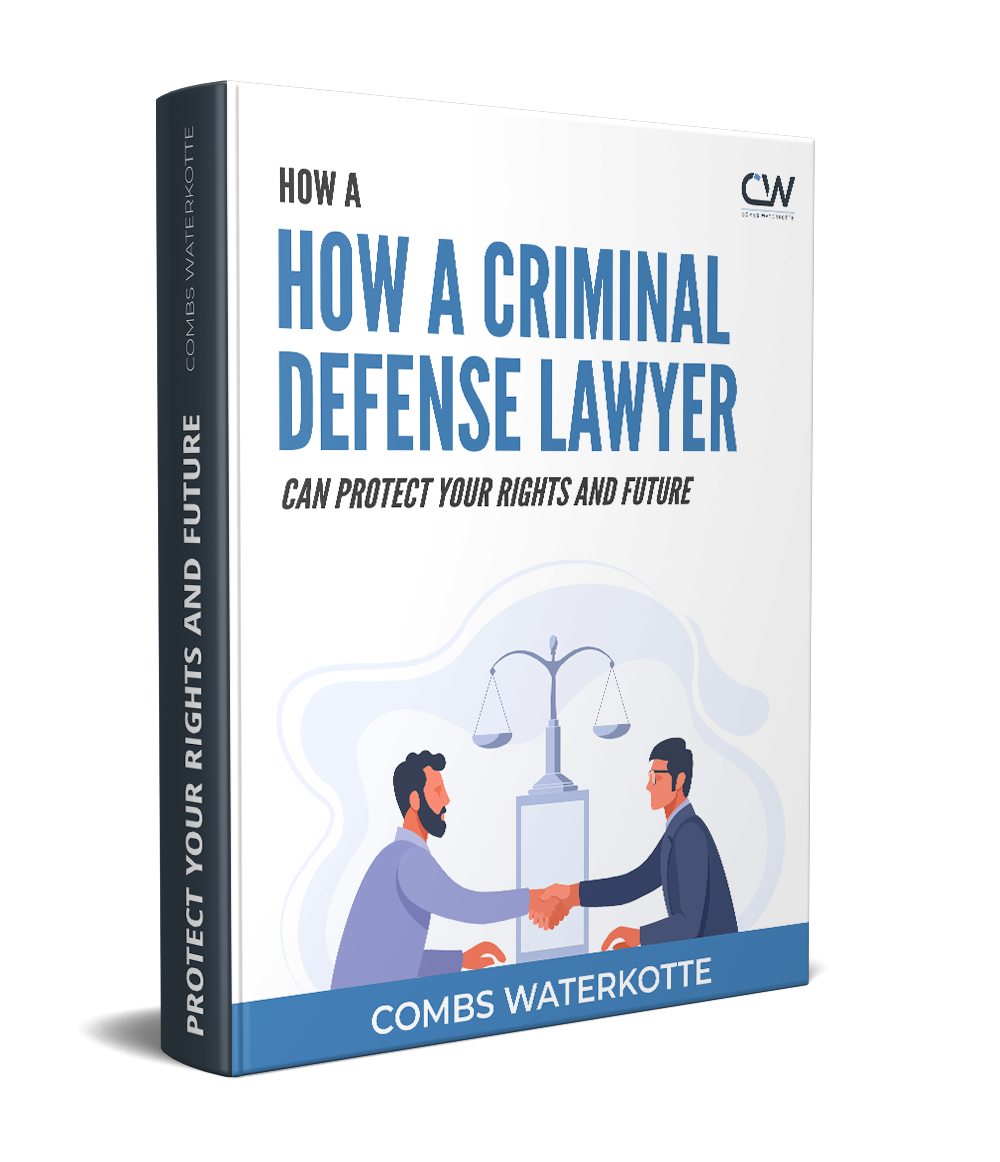
Free book
How a Criminal Defense Attorney Can Protect Your Rights and Future
Combs Waterkotte has over 80 years of experience and over 10,000 cases handled. This ebook helps guide you through the criminal defense process and how an experienced, skilled defense attorney can keep your freedoms intact.

