

First Degree Domestic Violence Lawyer Kansas City, MO
Hire the leading first degree domestic violence defense law firm in Kansas City, MO to protect your freedom, reputation, family, and future. Whether you have been charged or are under investigation, we can help.
TO COMBS WATERKOTTE,YOU ARE WHY WE EXIST.


First Degree Domestic Violence Lawyer Kansas City, MO
A first degree domestic violence charge can have a profound effect on your life before your case ever reaches trial. An arrest may bring restraining orders, problems involving your children or housing, and the possibility of years in prison. If you’re facing first degree domestic violence charges in Kansas City, you need an attorney immediately.
Combs Waterkotte’s criminal defense attorneys are ready to defend you and build a powerful case against your allegations. We preserve messages and recordings, review medical evidence and witness accounts, and protect your constitutional rights while pursuing a dismissal, a reduced charge, or an acquittal. Call (314) 900-HELP to get started today.

I owe my life to Combs Waterkotte. If not for them, I would be spending the rest of my life behind bars. There is no amount of words that can explain what they did for me and my family. Its the highest recommendation that I can give.
Alexander B.
Felonies
Verify on

If I could give Steve and his team 10 stars I would in a heartbeat. Was facing more then one felony charge and after these guys found the arresting officer violated my 4th Amendment Rights and those charges were dismissed. My family and I can't thank you enough.
Dean J
Felonies
Verify on
I was hands down guilty. ON VIDEO !!! In a smaller town, and a job dealing with the public, this was devastating. I made one phone call and spoke for maybe 15 minutes. I DIDN'T appear in court. I am extremely impressed. QUIETLY relieved of the matter!
Y.I.V.
Theft
Verify on
My fiance had a felony drug charge and Combs Waterkotte got it dismissed! There were no fines, court cost, nothing. Chris is loyal, professional, knowledgeable, and a man of his word. We are forever grateful for you.
Kimberly T.
Drug Crimes
Verify on
If I was found guilty, it would have been over 100 years in prison. They promised me that they would fight like hell and get me out of it. After everything was done, I just felt free. Like this wasn’t gonna end with me rotting away in a prison cell. I felt like I could start my life and have a fresh start.
Caleb
Assault 1st, Armed Criminal Action
Verify on
I was facing, probably 18 years… I actually got 5 years probation and 40 hours of community service. Without Combs Waterkotte’s help, I don’t think my family could have made it without me. It was just a written book to where it's a perfect ending.
Chris
Unlawful Use of a Weapon, Armed Criminal Action
Verify on
I went through what was supposed to be one of the top law firms in St. Louis. They said I wouldn't have no chance. I end up firing the other lawyer and everything and going with Chris. I felt like Combs Waterkotte actually did something for me and wasn't I wasn't just another number on somebody's desk.
Willy
DWI/DUI
Verify onI owe my life to Combs Waterkotte. If not for them, I would be spending the rest of my life behind bars. There is no amount of words that can explain what they did for me and my family. Its the highest recommendation that I can give.
Alexander B.
Felonies
If I could give Steve and his team 10 stars I would in a heartbeat. Was facing more then one felony charge and after these guys found the arresting officer violated my 4th Amendment Rights and those charges were dismissed. My family and I can't thank you enough.
Dean J
Felonies
I was hands down guilty. ON VIDEO !!! In a smaller town, and a job dealing with the public, this was devastating. I made one phone call and spoke for maybe 15 minutes. I DIDN'T appear in court. I am extremely impressed. QUIETLY relieved of the matter!
Y.I.V.
Theft
My fiance had a felony drug charge and Combs Waterkotte got it dismissed! There were no fines, court cost, nothing. Chris is loyal, professional, knowledgeable, and a man of his word. We are forever grateful for you.
Kimberly T.
Drug Crimes
If I was found guilty, it would have been over 100 years in prison. They promised me that they would fight like hell and get me out of it. After everything was done, I just felt free. Like this wasn’t gonna end with me rotting away in a prison cell. I felt like I could start my life and have a fresh start.
Caleb
Assault 1st, Armed Criminal Action
I was facing, probably 18 years… I actually got 5 years probation and 40 hours of community service. Without Combs Waterkotte’s help, I don’t think my family could have made it without me. It was just a written book to where it's a perfect ending.
Chris
Unlawful Use of a Weapon, Armed Criminal Action
I went through what was supposed to be one of the top law firms in St. Louis. They said I wouldn't have no chance. I end up firing the other lawyer and everything and going with Chris. I felt like Combs Waterkotte actually did something for me and wasn't I wasn't just another number on somebody's desk.
Willy
DWI/DUI
Kansas City, Missouri First Degree Domestic Violence Charges
First degree domestic violence is legally defined in Chapter 565 of the Missouri Revised Statutes. While the term “domestic violence” covers a broad range of conduct, the actual criminal charge is called “domestic assault.”

Combs Waterkotte is ready to start building your defense against your first degree domestic violence charges. Just contact us online or call (314) 900-HELP.
The relationship between the people involved is what separates the offense from general assault. Your mental state, the intended harm, and any actual injuries that occur determine the degree of the charge you face.
First Degree vs. Lower Degrees
First degree domestic assault involves an attempt to kill or knowingly causing or trying to cause a serious physical injury. Second degree domestic assault covers other conduct, including certain assaults involving weapons, strangulation, or reckless injuries. Third degree domestic assault and fourth degree domestic assault cover other injuries, threats, offensive contact, and conduct that puts someone at risk.
You don’t necessarily have to use a weapon or cause an injury to face a first degree domestic violence charge. Prosecutors may still try to allege an attempt to kill if, for instance, someone stepped in before an injury occurred.
However, even when police describe an incident as extreme, the evidence may actually support a lower charge. An injury alone doesn’t prove what you knew, that you caused it, or that your use of force was unlawful.

Criminal Charges and Orders of Protection
The prosecutor (not the alleged victim) decides whether to pursue a domestic violence criminal case. Contrary to popular belief, the other person involved can’t simply “drop the charges.”
Separately, Missouri’s domestic abuse and protective-order laws can restrict things like:
- Contact with the alleged victim
- Where you’re allowed to live
- Custody of your children
- Whether you’re allowed to own a firearm
Though they’re separate, evidence from one proceeding may be used in the other. Your criminal case can affect whether or not you receive an order of protection, and evidence in a civil order of protection hearing can impact your criminal case.
Why Combs Waterkotte is the best Law firm for your case.
Real results for people just like you.

Missouri’s First Degree Domestic Assault Statute Explained
RSMo §565.072 currently sets out two ways a person can commit first degree domestic assault:
- Attempting to kill a domestic victim
- Knowingly causing or attempting to cause serious physical injury to a domestic victim
Attempt to Kill or Knowingly Cause Serious Physical Injury
Angry words, preparation, or a frightening statement aren’t enough on their own to prove an attempt to kill. Prosecutors have to show a criminal purpose and actions toward carrying it out. They may point to what was said, the force used, or weapon handling. When defending clients in these cases, we examine the full encounter for evidence of an accident, reckless behavior, or a different intent other than intent to kill.
Under Missouri’s criminal-code definitions, acting “knowingly” means being aware that your conduct is practically certain to cause a particular result. A “serious physical injury” is defined as one that creates a substantial risk of death, causes serious disfigurement, or causes a prolonged loss or impairment of a body part’s function.
Who Counts as a Domestic Victim?
Missouri’s definition of a domestic victim includes family and household members, as well as children in the family or household. The definition of a family or household member includes:
- Spouses
- Former spouses
- Relatives (by blood or marriage)
- People who live (or once lived) together
It also covers people in a continuing romantic relationship and people who share a child, whether or not they were ever married or lived together. Dating partners don’t need to share a home to face domestic violence charges.
How Actual Injury Affects the Felony Classification
First degree domestic assault starts as a Class B felony (even when an attempt to kill or cause an injury is unsuccessful). It becomes a Class A felony, however, if the accused actually causes serious physical injury during the offense.
Medical records are important evidence, but treatment alone doesn’t establish who caused an injury, when it happened, how serious it was, or what the accused knew.
Defense Strategies for First Degree Domestic Violence Charges in Kansas City
Police responding to a domestic dispute often make an arrest before they have the full story. An initial statement can carry a lot of weight, but it isn’t the whole investigation. Our defense work focuses on what the evidence shows actually happened. To protect you, we may employ any of the following criminal defense strategies.
Self-Defense or Defense of Another Person
Missouri law allows for reasonable, proportional force in response to an immediate threat of force. To build a self-defense strategy, we look at who started or escalated the encounter, the threats that were made, and each person’s size and injuries. We also consider weapons, escape routes, and earlier communications. The same evidence may support a defense of another person if you acted to protect a child, relative, or someone else.
Challenge Intent, Knowledge, and Attempt
A split-second action doesn’t always show exactly what someone intended to do. A lack-of-intent defense asks whether prosecutors can prove an attempt to kill or knowledge that serious injury was certain to occur. An accident, an effort to deescalate, an abandoned act, or reckless behavior may undermine the prosecution’s argument.
Contest Injury, Causation, and the Domestic Relationship
In domestic violence cases, we review any and all of the following to see whether an injury meets the pertinent legal definitions:
- Hospital records
- Imaging
- Photos
- Follow-up care
- Expected recovery
- Expert opinions
Preexisting conditions, a fall, another person’s actions, a later event, or treatment complications can also affect what caused an injury. Without proof of a serious physical injury, the state may not be able to prove their charge.
Also, if the relationship doesn’t meet Missouri’s domestic victim definition, the domestic assault count may fail (although a general assault charge could still be brought).
Check Witness Accounts Against the Evidence
Even if the alleged victim takes back a statement, prosecutors may continue the case using 911 calls, body cam footage, photos, medical statements, or other witnesses. We check those accounts against messages, videos, property damage, scene photos, and both parties’ injuries. We also look for constitutional violations in police searches and officer interrogations.
Possible Penalties for First Degree Domestic Assault in Missouri
Missouri’s felony sentencing law, RSMo §558.011, sets the possible prison ranges for a first degree domestic violence conviction. The sentence you could face depends on when the alleged offense occurred, the charge, the facts, your criminal history, and any additional counts.
| Charge | Classification | Possible Prison Term |
|---|---|---|
| First degree domestic assault (no serious physical injury inflicted) | Class B felony | 5 to 15 years |
| First degree domestic assault (serious physical injury inflicted) | Class A felony | 10 to 30 years or life |
Missouri classifies first degree domestic assault as a dangerous felony. Under the dangerous-felony minimum-term statute, a convicted individual must serve at least 85% of their sentence before they’re eligible for parole.
Prison isn’t the only possible consequence of a first degree domestic violence conviction, either. A court may order restitution and costs, restrict contact or weapons, or require treatment. A conviction can also mean collateral consequences on:
- Your firearm rights
- Your immigration status
- Any professional licenses you may have
- Your employment opportunities
- Family court decisions
Separate charges like armed criminal action, child endangerment, unlawful weapon possession, witness tampering, or violating an order of protection can bring additional penalties.

Why Choose Combs Waterkotte for a Kansas City First Degree Domestic Violence Case?

First degree domestic assault cases require an in-depth investigation and careful felony trial preparation. Combs Waterkotte has handled more than 15,000 criminal cases, including hundreds of Missouri domestic violence cases. We bring decades of combined experience to violent crime defense.


We also know how prosecutors try to prove an attempt, how medical evidence affects your charges and possible sentence, and how protective orders or custody issues can complicate your defense.
Our attorneys speak with you directly, explain the risks, and develop a strategy around your circumstances and goals. We pursue a dismissal or charge reduction when the evidence supports it, prepare thoroughly for negotiations, and build a trial-ready defense when prosecutors won’t offer a fair resolution.
How Combs Waterkotte Will Take On Your First Degree Domestic Violence Charges
When you hire our team, we start with the immediate concerns: bond and no-contact conditions, shared property, digital evidence, and witness statements. Then, we obtain discovery, investigate beyond the police report, and get to work on your defense by:
- Protecting you from the start: Explain your release conditions, help you avoid mistakes, and address urgent work, home, and family concerns
- Preserving the evidence: Secure videos, photos, 911 calls, body-camera footage, messages, social media, location data, medical records, and witness information
- Reconstructing what happened: Build a timeline of statements, threats, defensive actions, injuries, the police response, and later accounts
- Challenging the state’s case: Examine identity, the relationship, intent, the alleged attempt, legal justification, injury severity and cause, and witness credibility
- Preparing for the best possible outcome: Pursue a dismissal, lower charge, fair agreement, or trial acquittal based on what the evidence supports


As new evidence becomes available, we reassess the strategy and explain your options before you make any decisions. That preparation helps us negotiate effectively and puts us in a stronger position for hearings or trial.
Contact a Kansas City First Degree Domestic Violence Lawyer Today

An arrest isn’t proof that you committed first degree domestic assault or that your use of force was unlawful. Give your defense the best possible start by following all protective and bond orders, don’t ask anyone to contact the alleged victim for you, and don’t delete messages or post about the incident. Speak with a lawyer before giving investigators a statement.
Contact Combs Waterkotte online or call (314) 900-HELP today. We’ll review the allegations against you, preserve important evidence, and start building a defense to protect your freedom and future.
Resources
For more information on criminal defense in Kansas City or anywhere else in Missouri, call the Combs Waterkotte criminal defense attorneys right away at (314) 900-HELP or contact us online for a confidential consultation.
Common Defenses to Domestic Violence Charges
If The Victim Stops Cooperating, Will My Domestic Violence Case in Missouri Be Dismissed?
What Is the Missouri Domestic Violence 12 Hour Rule?
Do I Need a Lawyer If I’m Accused of Domestic Violence?
Do I Need a Lawyer for a Domestic Violence Case? What to Know & What to Do
Does Emotional Abuse Count as Domestic Violence?
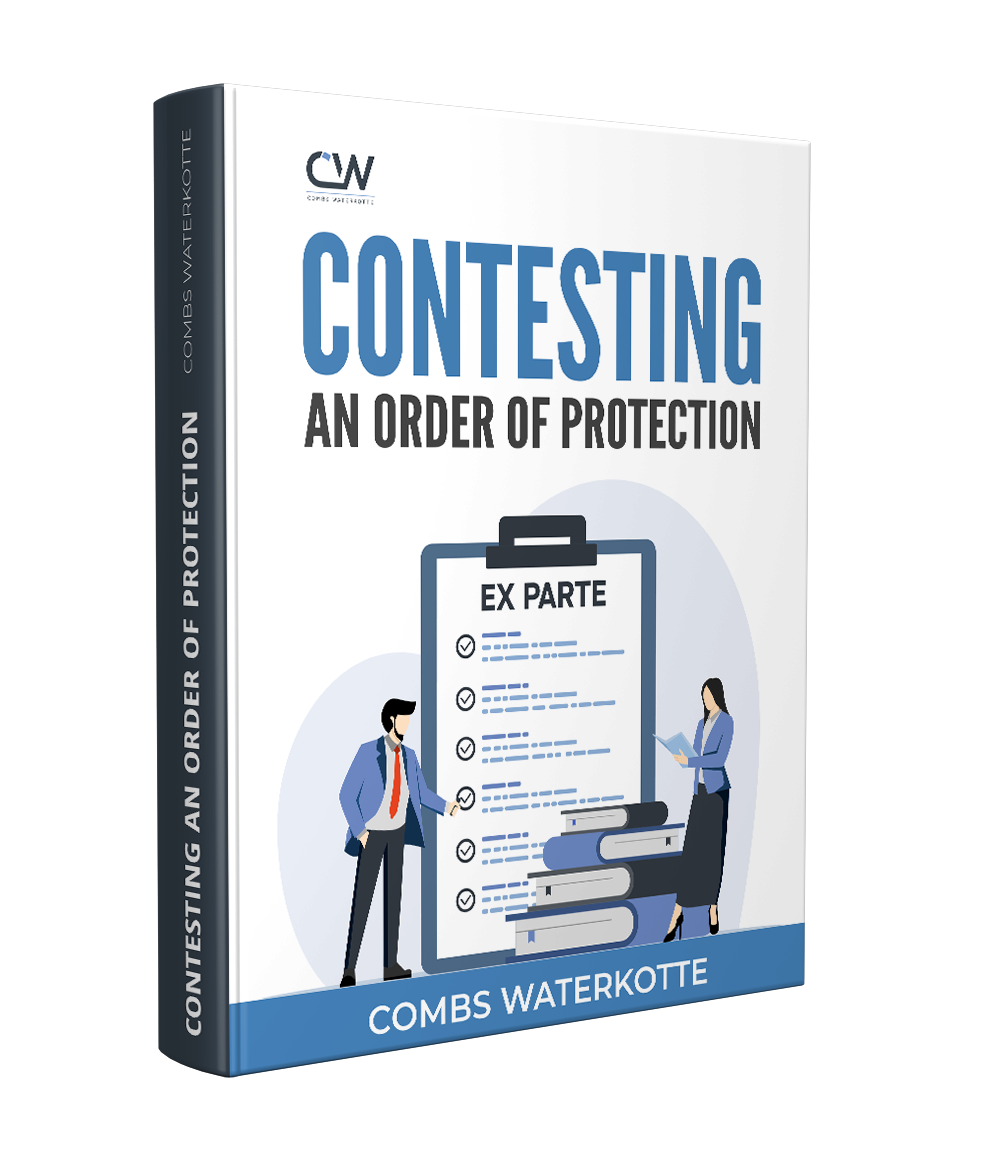
Free book
Telling Your Side of the Story: Contesting an Order of Protection
We specialize in defending individuals served with orders of protection in Missouri. We’ve published this ebook to help you understand the process, build a solid defense, and protect your rights.

