

Second Degree Domestic Violence Lawyer Kansas City, MO
Hire the leading second degree domestic violence defense law firm in Kansas City, MO to protect your freedom, reputation, family, and future. Whether you have been charged or are under investigation, we can help.
TO COMBS WATERKOTTE,YOU ARE WHY WE EXIST.


Second Degree
Domestic Violence Lawyer
Kansas City, MO
A second degree domestic violence charge in Kansas City can put your freedom and reputation at risk from the outset. An arrest may force you out of your home and restrict contact with your family. If you’re facing a second degree domestic violence charge, you need legal counsel right away.
Combs Waterkotte’s criminal defense lawyers are ready to help you fight back. We preserve recordings and messages, review medical records and weapon evidence, and challenge any violations of your rights. Our goal is to build the strongest case for a dismissal, charge reduction, or acquittal. Call us now at (314) 900-HELP for a free, confidential case review.

I owe my life to Combs Waterkotte. If not for them, I would be spending the rest of my life behind bars. There is no amount of words that can explain what they did for me and my family. Its the highest recommendation that I can give.
Alexander B.
Felonies
Verify on

If I could give Steve and his team 10 stars I would in a heartbeat. Was facing more then one felony charge and after these guys found the arresting officer violated my 4th Amendment Rights and those charges were dismissed. My family and I can't thank you enough.
Dean J
Felonies
Verify on
I was hands down guilty. ON VIDEO !!! In a smaller town, and a job dealing with the public, this was devastating. I made one phone call and spoke for maybe 15 minutes. I DIDN'T appear in court. I am extremely impressed. QUIETLY relieved of the matter!
Y.I.V.
Theft
Verify on
My fiance had a felony drug charge and Combs Waterkotte got it dismissed! There were no fines, court cost, nothing. Chris is loyal, professional, knowledgeable, and a man of his word. We are forever grateful for you.
Kimberly T.
Drug Crimes
Verify on
If I was found guilty, it would have been over 100 years in prison. They promised me that they would fight like hell and get me out of it. After everything was done, I just felt free. Like this wasn’t gonna end with me rotting away in a prison cell. I felt like I could start my life and have a fresh start.
Caleb
Assault 1st, Armed Criminal Action
Verify on
I was facing, probably 18 years… I actually got 5 years probation and 40 hours of community service. Without Combs Waterkotte’s help, I don’t think my family could have made it without me. It was just a written book to where it's a perfect ending.
Chris
Unlawful Use of a Weapon, Armed Criminal Action
Verify on
I went through what was supposed to be one of the top law firms in St. Louis. They said I wouldn't have no chance. I end up firing the other lawyer and everything and going with Chris. I felt like Combs Waterkotte actually did something for me and wasn't I wasn't just another number on somebody's desk.
Willy
DWI/DUI
Verify onI owe my life to Combs Waterkotte. If not for them, I would be spending the rest of my life behind bars. There is no amount of words that can explain what they did for me and my family. Its the highest recommendation that I can give.
Alexander B.
Felonies
If I could give Steve and his team 10 stars I would in a heartbeat. Was facing more then one felony charge and after these guys found the arresting officer violated my 4th Amendment Rights and those charges were dismissed. My family and I can't thank you enough.
Dean J
Felonies
I was hands down guilty. ON VIDEO !!! In a smaller town, and a job dealing with the public, this was devastating. I made one phone call and spoke for maybe 15 minutes. I DIDN'T appear in court. I am extremely impressed. QUIETLY relieved of the matter!
Y.I.V.
Theft
My fiance had a felony drug charge and Combs Waterkotte got it dismissed! There were no fines, court cost, nothing. Chris is loyal, professional, knowledgeable, and a man of his word. We are forever grateful for you.
Kimberly T.
Drug Crimes
If I was found guilty, it would have been over 100 years in prison. They promised me that they would fight like hell and get me out of it. After everything was done, I just felt free. Like this wasn’t gonna end with me rotting away in a prison cell. I felt like I could start my life and have a fresh start.
Caleb
Assault 1st, Armed Criminal Action
I was facing, probably 18 years… I actually got 5 years probation and 40 hours of community service. Without Combs Waterkotte’s help, I don’t think my family could have made it without me. It was just a written book to where it's a perfect ending.
Chris
Unlawful Use of a Weapon, Armed Criminal Action
I went through what was supposed to be one of the top law firms in St. Louis. They said I wouldn't have no chance. I end up firing the other lawyer and everything and going with Chris. I felt like Combs Waterkotte actually did something for me and wasn't I wasn't just another number on somebody's desk.
Willy
DWI/DUI
Kansas City, MO Second Degree Domestic Violence Charges Explained
Missouri’s domestic assault laws appear in Chapter 565 of the Missouri Revised Statutes. “Domestic violence” is a broader term that covers a wide range of conduct; the criminal charge is technically called “domestic assault in the second degree.”
What separates domestic assault from a typical assault charge is your relationship to the other person. Your mental state, the extent of the injury, and any alleged weapon use determines the degree of the domestic assault charge you face.

A second degree domestic violence conviction can derail your entire life. Call (314) 900-HELP or fill out our online form to speak to a Combs Waterkotte attorney in Kansas City today.
Second Degree vs. First, Third, and Fourth Degree
First degree domestic assault involves an attempt to kill or knowingly causing (or attempting to cause) a serious physical injury. Second degree domestic assault covers knowingly causing a physical injury, recklessly causing a serious physical injury, and certain reckless injuries involving a deadly weapon.
Third degree domestic assault and fourth degree domestic assault cover other combinations of injuries, threats, offensive contact, isolation, and conduct that puts someone else at risk.
The injury alone doesn’t necessarily determine which charge you face. A bruise may count as a physical injury, but it doesn’t mean that someone knowingly caused it. Even a severe injury may support a second degree charge rather than a first degree charge if the evidence shows recklessness instead of knowing conduct.
Criminal Charges and Orders of Protection in Domestic Violence Cases
In these cases, the prosecutor is the one who decides whether to pursue a criminal domestic violence case. The alleged victim can’t simply drop the charges.
Also, Missouri’s domestic abuse and protective order laws can:
- Limit contact with the alleged victim
- Affect where you’re allowed to live
- Legal custody of your children
- Your firearm rights
Evidence from your criminal case may have an impact on your civil protective order case (and vice versa). Be sure to follow all bond conditions and protective orders, even if the alleged victim contacts you first. Your lawyer can help arrange any necessary communication without violating the law.
Why Combs Waterkotte is the best Law firm for your case.
Real results for people just like you.

Missouri’s Second Degree Domestic Assault Statute Explained
RSMo §565.073 describes three ways someone can commit second degree domestic assault. For each, prosecutors must prove beyond a reasonable doubt that the accused committed domestic violence and that the other person meets the law’s official definition of a domestic victim.
Knowingly Causing Injury (Including Choking or Strangulation)
The first part of the statute covers knowingly causing a physical injury to a domestic victim. It specifically mentions deadly weapons, dangerous instruments, choking, and strangulation, but other methods can also apply.
The conduct must also be done “knowingly.” Under Missouri law, acting “knowingly” means being aware that your conduct is practically certain to cause an injury.
Reckless Serious Injury or a Deadly Weapon Injury
The other two parts cover recklessly causing a serious physical injury or recklessly causing a physical injury with a deadly weapon. Under Missouri’s criminal code definitions, recklessness means consciously disregarding a substantial, unjustifiable risk.
Legally, a physical injury can involve anything from slight impairment to a temporary loss of use. A serious physical injury, on the other hand, must create a substantial risk of death, cause serious disfigurement, or cause a prolonged loss or impairment of a body function.
The law treats “deadly weapons” and “dangerous instruments” differently. Firearms and certain other listed weapons meet the deadly-weapon definition. An ordinary object can qualify as a dangerous instrument if the way it’s used makes it capable of causing a death or serious physical injury. This distinction can make a difference when prosecutors allege armed criminal action.
Who Counts as a Domestic Violence Victim Under Missouri Law?
RMo §565.002 defines a domestic victim as a family or household member, including children in the family or house. The related family or household member definition includes:
- Spouses
- Former spouses
- Relatives by blood or marriage
- People who live together
- People who previously lived together
- People in a relationship who have a child together
Defense Strategies for Second Degree Domestic Violence Charges in Kansas City
Police responding to a domestic dispute may make an arrest after hearing just one side of the story. They may not have reviewed available video, messages, or medical history that could explain the reality of what happened. Our defense strategies look beyond the first account and check the allegations against the evidence.
Self-Defense or Defense of Another Person
Missouri law may justify reasonable, proportional force in response to an immediate threat of force. To build a self-defense strategy, we examine who started or escalated the encounter, any threats, each person’s movements and size, and both parties’ injuries.
The same evidence may support defense of another person if you acted to protect a child, relative, or someone else. These defenses are often a key component to achieving a favorable result in a Kansas City domestic violence case.
Challenge the Required Mental State
An injury doesn’t automatically mean someone acted knowingly or recklessly. A lack-of-intent defense considers whether you knew an injury was certain or consciously disregarded a specific injury risk. An accidental collision, a reflex, or an unforeseeable fall may directly refute the state’s argument.
Contest Injury, Causation, Weapon Claims, and Credibility
In domestic assault situations, we review medical records, photos, imaging, follow-up care, preexisting conditions, and expert opinions to see whether an injury meets the legal threshold. A fall, someone else’s actions, or a later event may also explain what caused it. In strangulation cases, we examine symptoms, timing, photos, and records, because marks alone don’t prove or disprove the charge.
We may also check whether an alleged weapon meets legal criteria and whether it was used as claimed. If at any point during the investigation the police violated your rights during a search or questioning, we may be able to keep that evidence out of court.
Possible Penalties for Second Degree Domestic Assault in Missouri
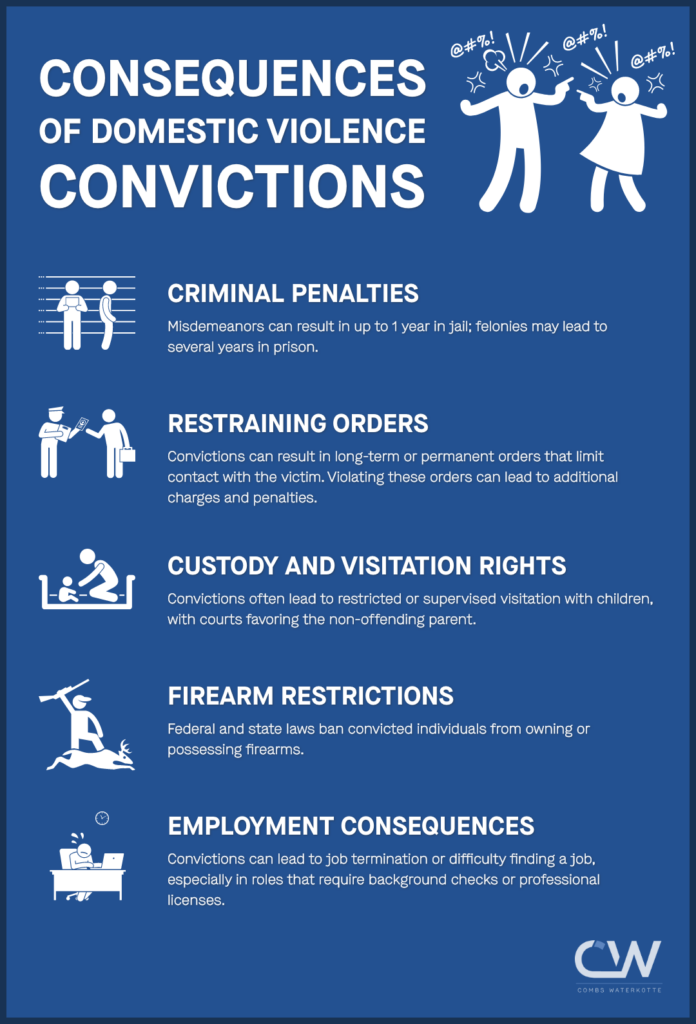
Second degree domestic assault is always charged as a Class D felony in Kansas City. Missouri’s general felony sentencing law allows up to seven years in prison, and state law also permits a fine of up to $10,000. A prior domestic assault conviction doesn’t automatically raise the felony class, but your criminal history can still affect the charges, negotiations, probation, and sentence.
| Conduct | Classification | Possible Penalties |
|---|---|---|
| Knowingly causing physical injury to a domestic victim by any means | Class D felony | Up to 7 years; fine up to $10,000 |
| Reckless serious physical injury, or reckless physical injury with a deadly weapon | Class D felony | Up to 7 years; fine up to $10,000 |
A conviction can bring more than prison time. A felony conviction can have consequences on your firearm rights, immigration status, employment opportunities, and housing options. The court may order restitution payments, court costs, treatment, and no-contact conditions. You’ll also have to pay for any court-ordered batterer intervention program.
Why Choose Combs Waterkotte for a Kansas City Second Degree Domestic Violence Case?

Second degree domestic assault cases require an attorney who can act quickly and knows how to defend a felony charge. Combs Waterkotte has handled more than 15,000 criminal cases and brings over 100 years of combined experience to domestic violence cases. As former prosecutors, we know how the state builds these cases, and we know how to fight back.


Our attorneys speak with you directly, explain the potential risks, and build a strategy around your specific circumstances. We pursue a dismissal or charge reduction when the evidence supports it, prepare thoroughly for negotiations, and develop a trial-ready defense when prosecutors won’t offer a fair resolution. You’ll receive candid advice and confidential representation based on your particular situation.
How Combs Waterkotte Will Take On Your Second Degree Domestic Violence Charges
When you hire us, we start with what needs attention right away. We address bond conditions, no-contact orders, digital evidence, and witnesses whose accounts we may need to get right away. We then begin building your defense:
- Protecting you from the start: We explain release conditions, help you avoid communications that could hurt your case, and address work, home, and family concerns
- Preserving the evidence: We secure videos, photos, 911 calls, body cam footage, messages, location data, medical records, and witness information
- Reconstructing what happened: We build a timeline of statements, movements, threats, defensive actions, and injuries
- Challenging the state’s case: We examine the relationship, identity, knowledge, recklessness, legal justification, injuries (and their causes), weapon claims, and witness credibility
- Preparing for the best possible outcome: We pursue a dismissal, lower charge, fair agreement, or trial acquittal

Read More:

As new evidence comes in, we’ll reassess the strategy and keep you informed every step of the way. Thorough preparation helps us negotiate effectively and puts your defense in a stronger position.
Contact a Kansas City Second Degree Domestic Violence Lawyer Today

If you’ve been charged with second degree domestic violence in Kansas City, Missouri, hiring a lawyer is one of the most important steps you can take. Contact Combs Waterkotte online or call us at (314) 900-HELP today. We’ll review the allegations against you, preserve important evidence, and start building a defense designed to minimize the impact of your charges on your life and career.
Resources
For more information on criminal defense in Kansas City or anywhere else in Missouri, call the Combs Waterkotte criminal defense attorneys right away at (314) 900-HELP or contact us online for a confidential consultation.
A Complete Guide to Missouri Domestic Violence Laws
What Happens During a Domestic Violence Investigation?
If The Victim Stops Cooperating, Will My Domestic Violence Case in Missouri Be Dismissed?
Does Emotional Abuse Count as Domestic Violence?
Everything About Domestic Violence Defense Charges in Missouri
Can a Domestic Violence Conviction Be Expunged in Missouri?
Do I Need a Lawyer for a Domestic Violence Case? What to Know & What to Do

Free book
Telling Your Side of the Story: Contesting an Order of Protection
We specialize in defending individuals served with orders of protection in Missouri. We’ve published this ebook to help you understand the process, build a solid defense, and protect your rights.

