

Second-Degree Murder Lawyer Kansas City, MO
Facing second-degree murder charges in Kansas City, Missouri? Combs Waterkotte can fight to protect your rights, freedom, and future.
TO COMBS WATERKOTTE,YOU ARE WHY WE EXIST.


Second-Degree Murder Lawyer Kansas City, MO
A second-degree murder conviction can carry a heavy sentence: life imprisonment with the possibility of parole. That means you could spend decades in prison before becoming eligible for conditional release.
The capable attorneys at Combs Waterkotte have handled more than 15,000 cases, including victories in high-profile Missouri murder cases. If you’re facing murder charges, we can protect your rights and help you pursue a fair outcome.

I owe my life to Combs Waterkotte. If not for them, I would be spending the rest of my life behind bars. There is no amount of words that can explain what they did for me and my family. Its the highest recommendation that I can give.
Alexander B.
Felonies
Verify on

If I could give Steve and his team 10 stars I would in a heartbeat. Was facing more then one felony charge and after these guys found the arresting officer violated my 4th Amendment Rights and those charges were dismissed. My family and I can't thank you enough.
Dean J
Felonies
Verify on
I was hands down guilty. ON VIDEO !!! In a smaller town, and a job dealing with the public, this was devastating. I made one phone call and spoke for maybe 15 minutes. I DIDN'T appear in court. I am extremely impressed. QUIETLY relieved of the matter!
Y.I.V.
Theft
Verify on
My fiance had a felony drug charge and Combs Waterkotte got it dismissed! There were no fines, court cost, nothing. Chris is loyal, professional, knowledgeable, and a man of his word. We are forever grateful for you.
Kimberly T.
Drug Crimes
Verify on
If I was found guilty, it would have been over 100 years in prison. They promised me that they would fight like hell and get me out of it. After everything was done, I just felt free. Like this wasn’t gonna end with me rotting away in a prison cell. I felt like I could start my life and have a fresh start.
Caleb
Assault 1st, Armed Criminal Action
Verify on
I was facing, probably 18 years… I actually got 5 years probation and 40 hours of community service. Without Combs Waterkotte’s help, I don’t think my family could have made it without me. It was just a written book to where it's a perfect ending.
Chris
Unlawful Use of a Weapon, Armed Criminal Action
Verify on
I went through what was supposed to be one of the top law firms in St. Louis. They said I wouldn't have no chance. I end up firing the other lawyer and everything and going with Chris. I felt like Combs Waterkotte actually did something for me and wasn't I wasn't just another number on somebody's desk.
Willy
DWI/DUI
Verify onI owe my life to Combs Waterkotte. If not for them, I would be spending the rest of my life behind bars. There is no amount of words that can explain what they did for me and my family. Its the highest recommendation that I can give.
Alexander B.
Felonies
If I could give Steve and his team 10 stars I would in a heartbeat. Was facing more then one felony charge and after these guys found the arresting officer violated my 4th Amendment Rights and those charges were dismissed. My family and I can't thank you enough.
Dean J
Felonies
I was hands down guilty. ON VIDEO !!! In a smaller town, and a job dealing with the public, this was devastating. I made one phone call and spoke for maybe 15 minutes. I DIDN'T appear in court. I am extremely impressed. QUIETLY relieved of the matter!
Y.I.V.
Theft
My fiance had a felony drug charge and Combs Waterkotte got it dismissed! There were no fines, court cost, nothing. Chris is loyal, professional, knowledgeable, and a man of his word. We are forever grateful for you.
Kimberly T.
Drug Crimes
If I was found guilty, it would have been over 100 years in prison. They promised me that they would fight like hell and get me out of it. After everything was done, I just felt free. Like this wasn’t gonna end with me rotting away in a prison cell. I felt like I could start my life and have a fresh start.
Caleb
Assault 1st, Armed Criminal Action
I was facing, probably 18 years… I actually got 5 years probation and 40 hours of community service. Without Combs Waterkotte’s help, I don’t think my family could have made it without me. It was just a written book to where it's a perfect ending.
Chris
Unlawful Use of a Weapon, Armed Criminal Action
I went through what was supposed to be one of the top law firms in St. Louis. They said I wouldn't have no chance. I end up firing the other lawyer and everything and going with Chris. I felt like Combs Waterkotte actually did something for me and wasn't I wasn't just another number on somebody's desk.
Willy
DWI/DUI
Degrees of Murder in Missouri Law
Murder was formerly a single crime in Missouri; any culpable homicide that didn’t qualify as murder constituted manslaughter. However, the state later divided murder into two separate offenses.
First-degree murder happens when someone knowingly causes another person’s death after deliberation. It’s considered deliberation, also known as “premeditation” and “malice aforethought,” when the accused engaged in “cool reflection,” no matter how brief, before the alleged killing.
For example, suppose that someone argues with a friend, goes to their car to get a gun, and returns to shoot them. Prosecutors could argue that the decision to walk to the car and the time it took to retrieve the gun implied “cool reflection” on the part of the accused.

“Before I met [Combs Waterkotte], I was sitting in jail, and I felt like that was going to be my home for the next one hundred years… [They] promised me that [they] would fight like hell to get me out of it. And because of the hard work and the dedication that [they] put into my case… I am now serving two-and-a-half years of SIS probation, and it will never be on my record. So I would highly recommend Combs and Waterkotte for anybody who’s looking for the best lawyer you can get.”
-Caleb | Combs Waterkotte Client
Second-degree murder doesn’t require cool reflection. It encompasses killings that occur knowingly, but where the evidence of deliberation is either missing or weak. It also covers killings committed during the commission of another felony, even if unintended.
The second-degree offense sits between premeditated murder and manslaughter. The latter charge can also cover intentional killings when the accused claims that they acted under the influence of sudden passion provoked by an adequate cause.
Prosecutors thread the needle when charging someone with murder in the second degree. They frequently bring these charges when they can’t prove deliberation, and the accused hasn’t claimed that sudden passion motivated their actions.
Why Combs Waterkotte is the best Law firm for your case.
Real results for people just like you.

Second-Degree Murder in the Missouri Revised Statutes
Under the Missouri Revised Statutes, someone commits murder in the second degree under the following circumstances.
Knowingly Causing Another’s Death
This offense can happen when the accused knowingly causes the death of another person. Under Missouri law, someone is said to act knowingly when they’re aware of the basic nature of their actions and that those actions are practically certain to cause a prohibited result.
For example, prosecutors might accuse you of pulling a knife out of your pocket and stabbing your spouse after they admitted to cheating on you. They would contend that you were aware that stabbing someone is practically certain to kill them.
Missouri law allows prosecutors to pursue murder charges even if the person killed wasn’t the intended victim. In other words, the state must prove that you intended to kill someone, but it doesn’t need to prove that you intended to kill the person who died.
This doctrine, formally known as “transferred intent,” might apply when someone gets killed after intervening in an altercation. It can also be invoked when prosecuting someone for a mass shooting.
Causing Death With the Purpose of Causing Serious Physical Injury
A second-degree murder charge can also apply when someone causes another person’s death with the purpose of causing serious physical injury. This might happen when someone only intends to injure someone, but the person dies.
Missouri defines a serious physical injury as any physical condition that causes any of the following:
- A substantial risk of death
- Serious disfigurement
- Protracted impairment in the function of a body part
Someone acts purposely when their conscious goal is to cause the prohibited result. An example is when the accused gets into a fight and decides to beat the other person so severely that they’ll leave the accused alone in the future. If the other person dies due to the beating, the prosecution might pursue charges of murder in the second-degree.
Prosecutors can use this theory to charge someone for an unintentional death. For instance, imagine that someone throws acid at a neighbor with the intention to scar and disfigure them. However, the attack accidentally kills the neighbor. The accused’s intent to cause serious physical injury is potentially enough to warrant a murder charge.

Felony Murder
Felony murder is an old concept that’s been viewed as unfair but necessary. This legal theory allows the state to charge someone with murder when anyone dies while the accused commits, attempts to commit, or flees after committing a felony.
Consider, for example, someone who carjacks a vehicle and accidentally runs over a pedestrian as they flee the scene. If the pedestrian dies, the carjacker can face both vehicle hijacking and felony murder charges, even if the death was clearly unintentional.
Prosecutors can also pursue felony murder for even more tenuous deaths. A common example is when a robbery victim suffers a stress-related heart attack when threatened with a gun. Even if the gun was unloaded, the robber could face charges of both robbery and felony murder.
Possible Defenses to Second-Degree Murder Charges in Kansas City, MO
The criminal defense strategy your attorney employs in your case may incorporate any of the following arguments.
Defense of Self or Others
Missouri law allows you to use force to protect yourself or others. Force is permitted when you reasonably believe that it’s necessary to stop the use or imminent use of unlawful force. You could, therefore, use self-defense to shoot someone attacking you or preparing to attack you with a knife.
It isn’t always lawful to use deadly force. Generally, the amount of force applied must be reasonable in view of the threat. However, you can justifiably kill another person when you reasonably believe that deadly force is necessary to avoid death, serious injury, or a forcible felony.
Defense of Property
As a rule, you can’t use deadly force to protect your property. If someone is stealing your car off the street, you aren’t justified in shooting at them.
That said, Missouri law recognizes the right to use deadly force to protect an occupied home or vehicle. Specifically, you can use deadly force against someone who unlawfully entered, attempted to enter, or remained after entering an occupied dwelling, residence, or vehicle.
You can also use deadly force to protect unoccupied private property. Under this rule, deadly force is justified against someone who unlawfully enters, attempts to enter, or remains after entering private property that you own, lease, or have permission to occupy.
Mental Disease or Defect
When prosecutors present evidence of your intent, your lawyer may respond with proof that you were incapable of knowing and appreciating your actions. This defense, sometimes called the insanity defense, applies when a mental disease or condition prevents you from understanding the quality, nature, or wrongfulness of your behavior.
Importantly, your lawyer doesn’t need to show that you lacked all three types of understanding. Proving one of them can be enough to justify your actions.
Imagine that you’ve been diagnosed with schizophrenia. As a result of your condition, you genuinely believed that stabbing a sick relative would release an evil spirit and restore their health. Your medical history may help you prove that you lacked the intent to commit murder because you didn’t appreciate the nature of your actions.
Sudden Passion for Adequate Cause
Another viable defense to second-degree murder is to “inject the issue” of sudden passion. If successful, you may defeat the murder charges but expose yourself to possible manslaughter charges.
However, voluntary manslaughter is a Class B felony, while murder is a Class A felony. As such, receiving a manslaughter charge could reduce your potential sentence considerably.
Penalties for Second-Degree Murder in Missouri
Murder in the second degree is a Class A felony in Missouri, the highest offense level in the state’s criminal code. The second-degree offense isn’t eligible for the death penalty, which is reserved for first-degree murder.
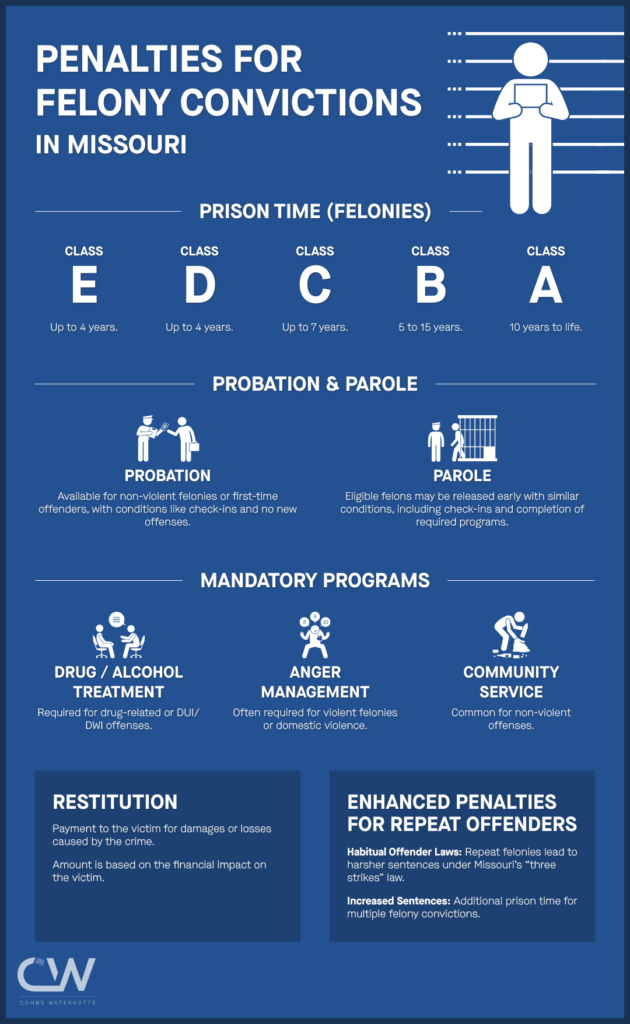
Upon conviction for murder in the second degree, a judge can sentence you to 10 to 30 years or life in prison. However, life sentences for second-degree murder generally allow for the possibility of parole after 30 years.
Why Hire Combs Waterkotte to Handle Your Second-Degree Murder Case in Kansas City?

Our attorneys have over 100 years of combined legal experience defending the rights of the accused. We know how homicide cases tend to attract attention from the police, prosecutors, the public, and the press. High-profile cases can easily lead to a rush to judgment and unfair investigations and prosecutions.

Our job is to balance the scales. We have the legal knowledge and resources to stand up against the full might of the state as it seeks to imprison you for murder.
How We Can Defend You Against Second-Degree Murder Charges in Kansas City, MO
We’ll give you a voice in your murder case, telling your side of the story so police investigators, prosecutors, and jurors understand what happened. Our incisive legal professionals will identify the defenses and justifications that apply to your situation and gather evidence to support them.


We’ll present that evidence to the prosecution to seek a dismissal or reduction in your charges. Successful presentation of evidence of self-defense, mental disease or defect, or other justifications could get your case thrown out. If not, we’ll negotiate forcefully for a fair plea offer and explain your defense to a jury if necessary.
Contact Combs Waterkotte to Get a Tailored Defense to Your Second-Degree Murder Charges

Murder charges can result in a decades-long prison term and other life-altering consequences. The proven attorneys at Combs Waterkotte are trial-tested and ready to take the lead on your murder case. Contact us online or at (314) 900-HELP to learn more about the legal support we can provide.
Resources
For more information on criminal defense in Kansas City or anywhere else in Missouri, call the Combs Waterkotte criminal defense attorneys right away at (314) 900-HELP or contact us online for a confidential consultation.
Can You Get Probation for a Class A Felony in Missouri?
Ultimate Guide To Missouri Arrest Warrants
What Are the Sentencing Guidelines for Class A Felonies in Missouri?
What Rights Do Felons Lose in Missouri?
What is the Role of a Grand Jury in a Class A Felony Case?
Should I Tell My Lawyer if I’m Guilty?
How Much of a Class A Felony Sentence Do You Have to Serve in Missouri?
Free book
How a Criminal Defense Attorney Can Protect Your Rights and Future
Combs Waterkotte has over 80 years of experience and over 10,000 cases handled. This ebook helps guide you through the criminal defense process and how an experienced, skilled defense attorney can keep your freedoms intact.

