

Sexual Abuse Lawyer Kansas City, MO
Hire the leading Criminal Defense Law Firm in Kansas City, MO to protect your freedom, rights, and future. Whether you have been charged with a crime or arrested, we can help.
TO COMBS WATERKOTTE,YOU ARE WHY WE EXIST.


Sexual Abuse Lawyer
Kansas City, MO
Missouri law contains dozens of offenses covering a wide range of sex crimes. A felony conviction for sexual abuse can result in imprisonment and lifetime sex offender registration, depending on the victim’s age and the nature of the offense.
Combs Waterkotte has extensive experience defending clients accused of sex crimes, including the sexual abuse of adults and minors. Our attorneys can use their knowledge and resources to provide a tailored defense for your case.

I owe my life to Combs Waterkotte. If not for them, I would be spending the rest of my life behind bars. There is no amount of words that can explain what they did for me and my family. Its the highest recommendation that I can give.
Alexander B.
Felonies
Verify on

If I could give Steve and his team 10 stars I would in a heartbeat. Was facing more then one felony charge and after these guys found the arresting officer violated my 4th Amendment Rights and those charges were dismissed. My family and I can't thank you enough.
Dean J
Felonies
Verify on
I was hands down guilty. ON VIDEO !!! In a smaller town, and a job dealing with the public, this was devastating. I made one phone call and spoke for maybe 15 minutes. I DIDN'T appear in court. I am extremely impressed. QUIETLY relieved of the matter!
Y.I.V.
Theft
Verify on
My fiance had a felony drug charge and Combs Waterkotte got it dismissed! There were no fines, court cost, nothing. Chris is loyal, professional, knowledgeable, and a man of his word. We are forever grateful for you.
Kimberly T.
Drug Crimes
Verify on
If I was found guilty, it would have been over 100 years in prison. They promised me that they would fight like hell and get me out of it. After everything was done, I just felt free. Like this wasn’t gonna end with me rotting away in a prison cell. I felt like I could start my life and have a fresh start.
Caleb
Assault 1st, Armed Criminal Action
Verify on
I was facing, probably 18 years… I actually got 5 years probation and 40 hours of community service. Without Combs Waterkotte’s help, I don’t think my family could have made it without me. It was just a written book to where it's a perfect ending.
Chris
Unlawful Use of a Weapon, Armed Criminal Action
Verify on
I went through what was supposed to be one of the top law firms in St. Louis. They said I wouldn't have no chance. I end up firing the other lawyer and everything and going with Chris. I felt like Combs Waterkotte actually did something for me and wasn't I wasn't just another number on somebody's desk.
Willy
DWI/DUI
Verify onI owe my life to Combs Waterkotte. If not for them, I would be spending the rest of my life behind bars. There is no amount of words that can explain what they did for me and my family. Its the highest recommendation that I can give.
Alexander B.
Felonies
If I could give Steve and his team 10 stars I would in a heartbeat. Was facing more then one felony charge and after these guys found the arresting officer violated my 4th Amendment Rights and those charges were dismissed. My family and I can't thank you enough.
Dean J
Felonies
I was hands down guilty. ON VIDEO !!! In a smaller town, and a job dealing with the public, this was devastating. I made one phone call and spoke for maybe 15 minutes. I DIDN'T appear in court. I am extremely impressed. QUIETLY relieved of the matter!
Y.I.V.
Theft
My fiance had a felony drug charge and Combs Waterkotte got it dismissed! There were no fines, court cost, nothing. Chris is loyal, professional, knowledgeable, and a man of his word. We are forever grateful for you.
Kimberly T.
Drug Crimes
If I was found guilty, it would have been over 100 years in prison. They promised me that they would fight like hell and get me out of it. After everything was done, I just felt free. Like this wasn’t gonna end with me rotting away in a prison cell. I felt like I could start my life and have a fresh start.
Caleb
Assault 1st, Armed Criminal Action
I was facing, probably 18 years… I actually got 5 years probation and 40 hours of community service. Without Combs Waterkotte’s help, I don’t think my family could have made it without me. It was just a written book to where it's a perfect ending.
Chris
Unlawful Use of a Weapon, Armed Criminal Action
I went through what was supposed to be one of the top law firms in St. Louis. They said I wouldn't have no chance. I end up firing the other lawyer and everything and going with Chris. I felt like Combs Waterkotte actually did something for me and wasn't I wasn't just another number on somebody's desk.
Willy
DWI/DUI
What Does “Sexual Abuse” Mean Under Missouri Law?
Based on the state’s definition, sexual abuse requires sexual contact, which, in turn, has a specific meaning. Sexual contact includes any of the following acts:
- Touching another person with the genitals
- Touching another person’s genitals or anus
- Touching a female person’s breast
- Causing semen, seminal fluid, or other ejaculate to touch another person
The touching the statute refers to includes touching through clothing. As such, groping another person’s clothed genitals or breasts while in public would constitute a criminal violation.
To fall within the scope of the statutory definition, the act must be performed for one of two purposes: either to sexually arouse or gratify either the perpetrator or the victim, or to terrorize the victim.
Missouri defines “purposely” to mean that the perpetrator’s conscious goal was to engage in the prohibited act or produce the prohibited result.

“Words can’t even describe how happy I am with this law firm but I’ll try. They always kept in touch with me and definitely worked hard on my case. I couldn’t have been more happy with the results I got”
-Joshua L. | Combs Waterkotte Client
Reading these two laws together, the definition of sexual contact requires proof that the perpetrator engaged in one of the prohibited acts with the specific intent to gratify either themselves or the victim, or to terrorize the victim.
Why Combs Waterkotte is the best Law firm for your case.
Real results for people just like you.

Sexual Abuse Offenses in the Missouri Revised Statutes
The Missouri Revised Statutes contain a lengthy chapter on sex offenses. This chapter outlines the following two sex abuse offenses.
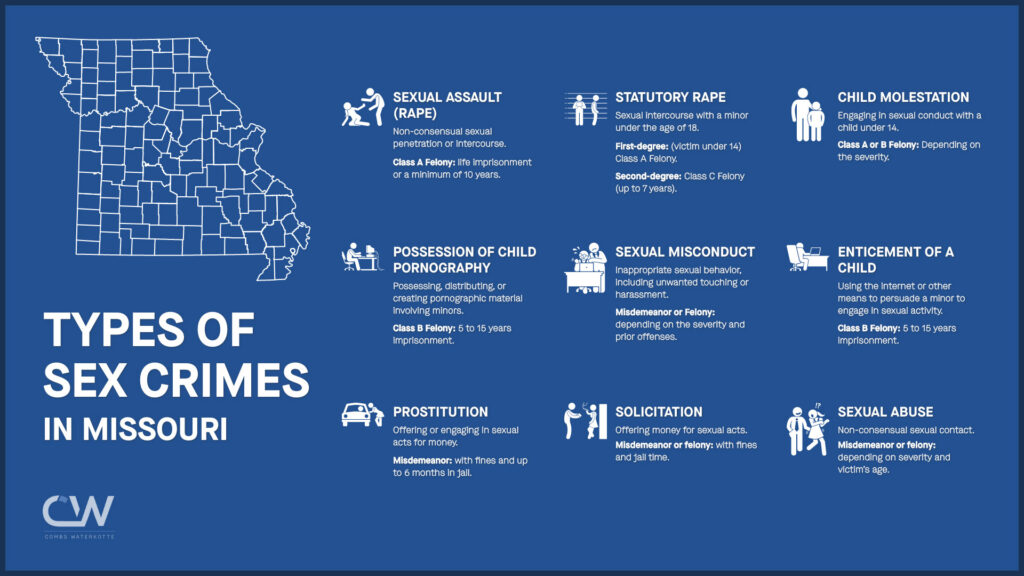
First-Degree Sexual Abuse
First-degree sexual abuse occurs when the accused makes sexual contact with someone else under any of the following circumstances:
- Using forcible compulsion
- When the victim is incapacitated
- When the victim lacks the capacity to give consent
- When the victim is incapable of giving consent
“Forcible compulsion” means the accused used either of the following while making sexual contact:
- Sufficient physical force to overcome reasonable resistance
- An express or implied threat that causes reasonable fear of death, serious physical injury, or kidnapping of the victim or another person
A victim is incapacitated when they’re temporarily or permanently rendered unconscious, unable to evaluate the nature of their actions, or unable to communicate a lack of consent. Therefore, someone who is intoxicated by drugs or alcohol is incapacitated, as is a comatose patient in a hospital.
The law determines the capacity to consent. Minors and people adjudged mentally incompetent lack the legal capacity to consent. In other words, even if they say “yes,” these people can’t give legal consent to sexual contact.
A person is incapable of consent when they either can’t consent or can’t communicate their consent. Someone who is asleep is incapable of consenting, even if they’re of legal age and mentally competent.
The state’s most serious sex offenses, first-degree rape and first-degree sodomy, require sexual intercourse or deviate sexual intercourse, respectively.
Intercourse involves penetration, however slight. Thus, if the contact between the accused and the alleged victim involves genital, oral, or anal penetration, prosecutors will likely pursue rape or sodomy charges.
By contrast, sexual abuse charges are geared toward other types of sexual contact that don’t involve penetration, including those that non-lawyers might call groping or molesting.
Notably, Missouri doesn’t have a statutory sexual abuse charge the same way it has statutory rape and statutory sodomy charges. Statutory rape occurs when someone has or attempts to have sexual intercourse with someone under 17. Statutory sodomy involves acts of deviate sexual intercourse with the same class of victims.
Instead of providing a separate offense of “statutory sexual abuse,” first-degree sex abuse charges include sexual contact with minors. If the alleged victim is under 14, the law mandates harsher punishment.
Second-Degree Sexual Abuse
Second-degree sexual abuse charges require proof that the accused purposely made sexual contact without the other person’s consent. There are a few situations where a person might not consent to sexual contact without solid evidence of incapacity, incapability, or force.
For example, someone might consent to non-sexual contact, such as kissing, but the other person might exceed the bounds of consent by engaging in sexual touching. Another example might occur where the alleged victim consents to sexual contact but changes their mind and withdraws their consent.
Second-degree sexual abuse charges may also apply to the following common examples of physical harassment:
- A stranger non-consensually groping someone in a crowd
- A doctor molesting a patient under the guise of an examination
- A boss touching an employee in a sexual manner without consent
In these situations, the prosecution may have a case for second-degree sexual abuse rather than a first-degree charge if the alleged victim is a mentally competent adult.
Defenses Available Against Sexual Abuse Charges in Kansas City, MO
If you’re accused of sexual abuse in Kansas City, a skilled criminal defense attorney may use any of the following defense strategies to challenge the charges against you.
Consent
Consent definitionally negates sex abuse charges. For this reason, evidence of legally valid consent disproves a key element of the crime.
In these cases, disputes frequently arise concerning whether consent was lawfully given and communicated. Consequently, merely alleging that the other person consented may not be enough to defend yourself. You may also need evidence, such as text messages sent before or after the encounter, to corroborate claims of consent.
Alibi
Alibi evidence demonstrates that you couldn’t have committed the offense in question. Typically, an alibi places the suspect or defendant at a different location than the crime scene.
Victims may falsely identify perpetrators in sexual abuse cases involving intoxication. An alibi supported by witness testimony or other evidence, such as security camera footage, might prove that you couldn’t have committed the alleged offense.
No Sexual Contact
You may have been present when the alleged offense took place, and you may even have engaged in some contact with the alleged victim. However, the contact might have been non-sexual. For example, you might have accidentally touched the victim. Since the statute requires purposeful contact, accidental touching doesn’t constitute a crime.
Similarly, touching for a purpose other than sexual gratification or terrorizing the victim may not meet the statutory standard. For instance, a coach touching a player’s chest to examine an injury likely wouldn’t qualify as sexual abuse.
Possible Punishment for Sexual Abuse Convictions in Missouri
Before sentencing defendants convicted of sexual abuse, the jury must determine whether the acts constituted an aggravated offense. Under Missouri law, an aggravated offense includes at least one of the following circumstances:
- The victim suffered a serious physical injury
- The perpetrator displayed a deadly weapon or a dangerous instrument to threaten the victim
- The perpetrator has a prior conviction for sex crimes against a minor
- The victim is related to the perpetrator
With these factors in mind, a judge can impose the following sentences for sexual abuse:
Offense
- First-degree sexual abuse, aggravated offense
- First-degree sexual abuse, minor under 14
- First-degree sexual abuse
- Second-degree sexual abuse, aggravated offense
- Second-degree sexual abuse
Possible Term of Imprisonment
- Five to 15 years
- Five to 15 years
- Three to 10 years
- Up to four years
- Up to one year
Why Hire Combs Waterkotte to Handle Your Sexual Abuse Case in Kansas City, MO?
Sexual abuse cases typically arise in one of two situations. In the first, the defendant is accused of touching a minor. In the second, an adult victim claims that they were touched without their consent. In both cases, prosecutors often use aggressive tactics to push defendants into accepting an unfair plea deal.

Read More:

We understand the complex dynamics at work in sex crime cases, and we’ll aggressively defend your right to a fair process as we seek a positive outcome for your situation.
Our skilled attorneys will conduct a thorough investigation, including carefully and critically reviewing the prosecution’s evidence. We’ll look for weaknesses in the prosecution’s case and raise any defenses the evidence may support.
How We Can Defend You Against Sexual Abuse Charges
We’ll start with a frank and non-judgmental conversation about what happened. Once we understand your side of the story, we’ll begin constructing a robust defense strategy. Our goal is to protect both your freedom and your reputation as much as possible.

We’ll use the findings of our investigation to negotiate with prosecutors. Depending on the circumstances, the evidence may persuade them to dismiss your charges. Alternatively, we can push for a reduction in charges that results in significantly less jail time.
If we can’t reach a fair resolution, we’ll present your case before a jury, laying out the mitigating circumstances and affirmative defenses that may secure an acquittal.
Contact Combs Waterkotte to Get a Strong Defense Against Your Charges
Sexual abuse is a serious crime in Missouri, especially if the victim is underage. Combs Waterkotte has successfully spared clients more than 1 million days in custody through aggressive and compassionate representation. Contact us online or call (314) 900-HELP to learn more about your rights and options for disputing your charges.

Legal Video:

Resources
For more information on criminal defense in Kansas City or anywhere else in Missouri, call the Combs Waterkotte criminal defense attorneys right away at (314) 900-HELP or contact us online for a confidential consultation.
How to Defend Against False Allegations of Sexual Misconduct in Kansas City
Why You Need a Lawyer Immediately if Accused of a Sex Crime in Kansas City
Free book
Charged With a Sex Crime? Common Defense Strategies in Sex Crime Cases
Combs Waterkotte is Missouri and Illinois’s leading sex crime defense law firm. Our team of expert criminal defense attorneys have handled over 10,000 cases – many just like yours – and have saved out clients from over 1 million days from jail or prison.

