
Full Order of Protection Hearing Defense Lawyer in St. Louis, MO
Hire the leading Order of Protection Law Firm in St. Louis, MO to protect your freedom, rights, and future. If you have been served or are trying to appeal, we can help.
TO COMBS WATERKOTTE,YOU ARE WHY WE EXIST.


Full Order of Protection Hearing Defense St. Louis, MO
A full order of protection can affect your career, where you can live, custody of your children, and leave a permanent mark on your record.
The impact can last long beyond the date the order expires. You need an experienced defense firm to fight in the upcoming hearing. Combs Waterkotte is ready to help. We will listen to your story and build a defense customized for your case.

I owe my life to Combs Waterkotte. If not for them, I would be spending the rest of my life behind bars. There is no amount of words that can explain what they did for me and my family. Its the highest recommendation that I can give.
Alexander B.
Felonies
Verify on

If I could give Steve and his team 10 stars I would in a heartbeat. Was facing more then one felony charge and after these guys found the arresting officer violated my 4th Amendment Rights and those charges were dismissed. My family and I can't thank you enough.
Dean J
Felonies
Verify on
I was hands down guilty. ON VIDEO !!! In a smaller town, and a job dealing with the public, this was devastating. I made one phone call and spoke for maybe 15 minutes. I DIDN'T appear in court. I am extremely impressed. QUIETLY relieved of the matter!
Y.I.V.
Theft
Verify on
My fiance had a felony drug charge and Combs Waterkotte got it dismissed! There were no fines, court cost, nothing. Chris is loyal, professional, knowledgeable, and a man of his word. We are forever grateful for you.
Kimberly T.
Drug Crimes
Verify on
If I was found guilty, it would have been over 100 years in prison. They promised me that they would fight like hell and get me out of it. After everything was done, I just felt free. Like this wasn’t gonna end with me rotting away in a prison cell. I felt like I could start my life and have a fresh start.
Caleb
Assault 1st, Armed Criminal Action
Verify on
I was facing, probably 18 years… I actually got 5 years probation and 40 hours of community service. Without Combs Waterkotte’s help, I don’t think my family could have made it without me. It was just a written book to where it's a perfect ending.
Chris
Unlawful Use of a Weapon, Armed Criminal Action
Verify on
I went through what was supposed to be one of the top law firms in St. Louis. They said I wouldn't have no chance. I end up firing the other lawyer and everything and going with Chris. I felt like Combs Waterkotte actually did something for me and wasn't I wasn't just another number on somebody's desk.
Willy
DWI/DUI
Verify onI owe my life to Combs Waterkotte. If not for them, I would be spending the rest of my life behind bars. There is no amount of words that can explain what they did for me and my family. Its the highest recommendation that I can give.
Alexander B.
Felonies
If I could give Steve and his team 10 stars I would in a heartbeat. Was facing more then one felony charge and after these guys found the arresting officer violated my 4th Amendment Rights and those charges were dismissed. My family and I can't thank you enough.
Dean J
Felonies
I was hands down guilty. ON VIDEO !!! In a smaller town, and a job dealing with the public, this was devastating. I made one phone call and spoke for maybe 15 minutes. I DIDN'T appear in court. I am extremely impressed. QUIETLY relieved of the matter!
Y.I.V.
Theft
My fiance had a felony drug charge and Combs Waterkotte got it dismissed! There were no fines, court cost, nothing. Chris is loyal, professional, knowledgeable, and a man of his word. We are forever grateful for you.
Kimberly T.
Drug Crimes
If I was found guilty, it would have been over 100 years in prison. They promised me that they would fight like hell and get me out of it. After everything was done, I just felt free. Like this wasn’t gonna end with me rotting away in a prison cell. I felt like I could start my life and have a fresh start.
Caleb
Assault 1st, Armed Criminal Action
I was facing, probably 18 years… I actually got 5 years probation and 40 hours of community service. Without Combs Waterkotte’s help, I don’t think my family could have made it without me. It was just a written book to where it's a perfect ending.
Chris
Unlawful Use of a Weapon, Armed Criminal Action
I went through what was supposed to be one of the top law firms in St. Louis. They said I wouldn't have no chance. I end up firing the other lawyer and everything and going with Chris. I felt like Combs Waterkotte actually did something for me and wasn't I wasn't just another number on somebody's desk.
Willy
DWI/DUI
Full Orders of Protection Under Missouri Law
Orders of protection can only be issued by St. Louis circuit courts to individuals who meet certain qualifications. They generally must be either a family/household member who is an alleged victim of domestic violence, or anyone who is an alleged victim of stalking or sexual assault.
In Missouri, before receiving a full order of protection, the petitioner will file for an ex parte order of protection. An ex parte order is less restrictive, but can still radically alter the respondent’s life. And while they generally only last up to 15 days, the respondent does not get a chance to defend themselves against it.

If you’ve been served a court summons for a full order of protection hearing, call our offices today for a free, confidential case review: (314) 900-HELP
By the end of the 15 days, the court will hold a hearing between the petitioner and the respondent regarding a full order of protection. At this hearing, the petitioner will present evidence in favor of the restraining order, while the respondent will defend against it. The judge will make a ruling based on a preponderance of the evidence.
Why Combs Waterkotte is the best Law firm for your case.
Real results for people just like you.

Missouri Full Order of Protection Statutes Explained
Missouri has several laws regarding protective orders, but the main two regarding full restraining orders are RSMo § 455.020 and RSMo § 455.040. The first describes who is eligible; the second describes the hearing process.
Order of Protection Eligibility in Missouri
Orders of protection are available for alleged victims of domestic violence. The key factor in this is “domestic”; only family or household members are eligible in these cases. That includes:
- Current and former spouses
- Current and former cohabitants
- Current and former romantic partners
- Anyone biologically related to you
- Anyone related to you through marriage
- Coparents
In addition to alleged domestic violence victims, alleged stalking and/or sexual assault victims can also request a full order of protection against the alleged offender. The key difference is that no prior or existing relationship is required in these cases.
For the initial ex parte order, the petitioner only needs to show “good cause” that there is potential violence. In Missouri, witness testimony on its own is often enough to count as “good cause” for an ex parte order.
If an ex parte order is granted, the consequences are immediate. The restrictions go into effect before you even receive notice of them. They commonly include:
- Forbidding doing or threatening any of the following actions:
- Domestic violence against the petitioner
- Sexually assaulting the petitioner
- Stalking the petitioner
- Disturbing the petitioner’s peace
- Acting violently towards the petitioner’s pet
- Forbidding any forms of contact with the petitioner
- Forbidding entering the petitioner’s home (even if it is jointly owned)
- Temporarily giving full custody of children and pets to the petitioner

Order of Protection Hearing Process in Missouri
Whether or not an ex parte order is granted, the judge will issue a summons for a full order of protection hearing within 15 days. At this time, both sides will get to present their case on whether or not an order of protection is appropriate.
This case is similar to a trial, but without a jury. Instead, both parties will make their case directly to the judge. They will each get a chance to present evidence, call on witnesses, and provide their own testimony regarding the case.
The petitioner will get to go first, showing all of their evidence in favor of a protective order. The respondent’s lawyer will likely cross-examine any witnesses, looking for holes in their testimony. Then, the process is reversed: the respondent’s attorney will present defensive evidence while the petitioner will cross-examine.
The burden of proof in a Missouri order of protection case is a preponderance of the evidence. In layperson’s terms, that typically means ‘more likely than not.’ If the judge believes there is more than a 50% chance that the petitioner is correct, they will institute the full order of protection.
Defensive Strategies for a St. Louis Full Order of Protection Hearing
Defenses in a full order of protection hearing can take many forms, but are all centered around two main ideas: Attacking the credibility and veracity of the petitioner.
Credibility is how believable the petitioner is. If they present themselves well and tell a consistent story, the judge is more likely to believe them. If your attorney can poke holes in their narrative and show contradictions in it, this lowers their credibility.
In contrast, veracity has to do with how truthful the story itself is. If your defense team can bring evidence that contradicts the petitioner’s narrative, it will lower its veracity.
Here are some specific strategies your restraining order defense attorney might use:
- False Allegations: If the petitioner has an ulterior motive, such as during a divorce or custody dispute, your attorney can attack their credibility.
- Lack of Harm/Threat: This defense attacks veracity by presenting evidence that the harm or threat is exaggerated, or did not occur.
- Risk is Not Ongoing: If there was an incident, but no current threat, it’s possible to attack veracity by showing that a restraining order is not necessary.
- Alibi: If you have a solid alibi, that can attack both credibility and veracity by showing you could not have committed the alleged actions.
- Insufficient Evidence: If the petitioner failed to present evidence that reaches the burden of proof, your lawyer can highlight the lack of veracity.
If you receive a summons for a full order of protection hearing, it is critical that you attend. If you skip the hearing, the judge may decide to impose a restraining order because of the petitioner’s evidence and testimony. But if the petitioner doesn’t show up to the hearing, the judge will make a decision based solely on your defense.
Full Order of Protection Penalties
If a judge imposes a full order of protection on you in St. Louis, you’re going to face a variety of consequences, both formal and informal.
Formal Restrictions
In addition to the ex parte restrictions listed above, a full order of protection can:
- Give permanent custody of children to the petitioner
- Order the respondent to pay child and/or spousal support
- Order the respondent to pay for the petitioner’s housing
- Give the petitioner temporary possession of jointly owned personal property
- Order the respondent to enroll in a batterer’s counseling program
- Order the respondent to pay for the petitioner’s attorney and medical fees
These formal restrictions can last up to 1 year under ordinary circumstances, though the order of protection can be renewed annually. However, Missouri judges have the authority to extend the order up to 10 years in serious cases.
Even after the order expires, you could continue to face collateral consequences.
Collateral Consequences
On top of the formal conditions set forth in the order, you’ll also experience several collateral consequences:
- Restrictions on where you are allowed to live
- Ineligibility for certain jobs and professional licences
- Restrictions on your daily life and movements
- Denials for participation in children’s school or extracurricular activities
If you are also in a related criminal case, the full order of protection can affect that, too:
- You could have a harder time collecting evidence from your home
- You could face barriers contacting witnesses
- Your pretrial release conditions could be strengthened
- If you violate a restraining order, it can have dire consequences for the underlying case
To make things worse, protective orders cannot be expunged in Missouri. If you receive one, it will be on your record, permanently.
Penalties for Violating a Full Order of Protection
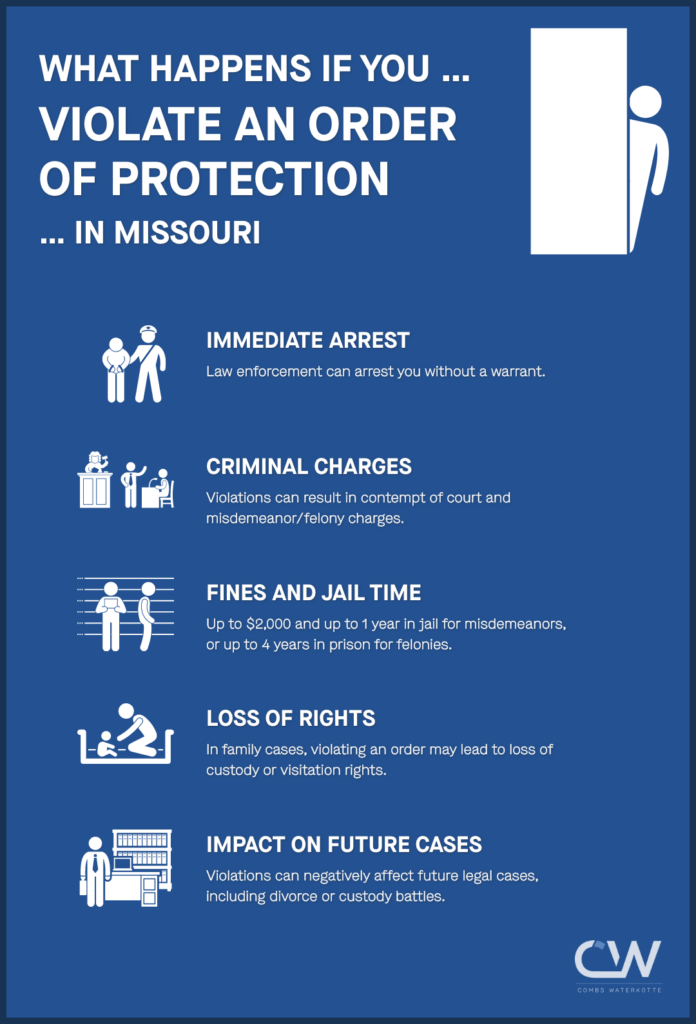
If you violate an order of protection, you won’t just be facing another civil lawsuit: You’ll be up against criminal charges.
For a first-time order of protection violation, you’ll be charged with a class A misdemeanor, with a maximum penalty of 1 year in jail and $2,000 in fines. However, if this is your second alleged offense within 5 years, the violation will be charged as a class E felony, with up to 4 years in prison and $10,000 in fines.
To make things worse, this conviction may be used against you in an underlying stalking, sexual assault, or domestic violence case.
If you’ve been accused of a restraining order violation, you’ll need an attorney experienced in St. Louis criminal defense as well as protective orders.
Combs Waterkotte: Missouri’s Leading Full Order of Protection Hearing Defense Lawyers

Combs Waterkotte’s attorneys have over 100 years of court experience and have handled over 15,000 client cases – many of them just like yours. We know the St. Louis justice system, what judges look for in full order of protection hearings, and how to build convincing defenses.
One of our managing partners, Steve Waterkotte, has successfully defended and/or appealed more orders of protection than any other lawyer in Missouri over the past 15 years. Because of his stellar reputation, he is commonly referred case by other lawyers and judges.


When you call us, you’re getting a chance to tell your side of the story. You’ll get expert help researching case law, gathering evidence, avoiding mistakes, and presenting your case in front of the judge. We’ll be by your side every step of the way.
Our Approach to Protective Order Hearing Defense
Every case starts with your initial call. Our office lines are open 24/7, so you can reach out as soon as you’ve been served. We’ll set up a free, confidential consultation where we can learn about your case and what your goals are. We’ll also discuss potential defensive strategies.
Once we’ve decided on a strategy, our investigative team will review any available evidence and search for additional data. Our attorneys will review everything, looking for items that will help your defense and/or erode the petitioner’s credibility.


At the hearing, we’ll challenge the petitioner’s narrative, cross-examine witnesses, dissect evidence, and present our defense, protecting your rights the whole way.
If the judge takes the side of the petitioner, it’s not over yet. We offer order of protection appeal services, and will comb over the hearing to look for due process violations and misapplications of the law.
Don’t Wait: Start Building Your Protective Order Hearing Defense Today

Your future and your freedom is important. And while a full order of protection isn’t a criminal charge, it can leave a lifelong negative impact. A ruling in your favor protects your career, your housing, and your reputation. And a defense attorney can help you get there.
Combs Waterkotte is ready to build a defense for your case. If you need a full protective order defense attorney in St. Louis, call us at (314) 900-HELP or use our online contact form to get started.
Resources
For expert legal representation on an order of protection in St. Louis and throughout Missouri, call the Combs Waterkotte criminal defense attorneys right away at (314) 900-HELP or contact us online for a free consultation.
Telling Your Side of the Story: Contesting an Order of Protection
How to Get an Order of Protection Dismissed
What to Do If You’ve Been Served
Domestic Violence & Orders of Protection
Common Defenses to Domestic Violence Charges
Why Hiring a Domestic Violence Defense Attorney Early in Your Case is Crucial

Free book
Telling Your Side of the Story: Contesting an Order of Protection
We specialize in defending individuals served with orders of protection in Missouri. We’ve published this ebook to help you understand the process, build a solid defense, and protect your rights.