

If you are under investigation or have been charged with federal conspiracy in West Virginia can place your freedom, career, and future at immediate risk West Virginia federal conspiracy defense lawyers represent individuals accused of conspiracy by challenging federal allegations and pursuing the strongest outcome available
Under federal conspiracy law, prosecutors can pursue charges without proving a completed crime, financial gain, or significant involvement. Prosecutors frequently rely on conspiracy allegations to strengthen their bargaining position, expand sentencing exposure, or force cooperation
Many individuals facing conspiracy allegations are surprised by the reach of federal conspiracy law and the speed at which investigations become prosecutions Combs Waterkotte‘s experienced West Virginia federal criminal defense lawyers defend individuals in West Virginia and nationwide against serious federal charges Our team aggressively pursues dismissals and charge reductions while remaining fully prepared to take cases to trial
Contact Combs Waterkotte at (314) 900-HELP or online to schedule your free consultation
Cases Handled
Over 10,000
Jail Days Saved
Over 1 Million
Google Reviews
500+ Perfect
Legal Experience
100+ Years
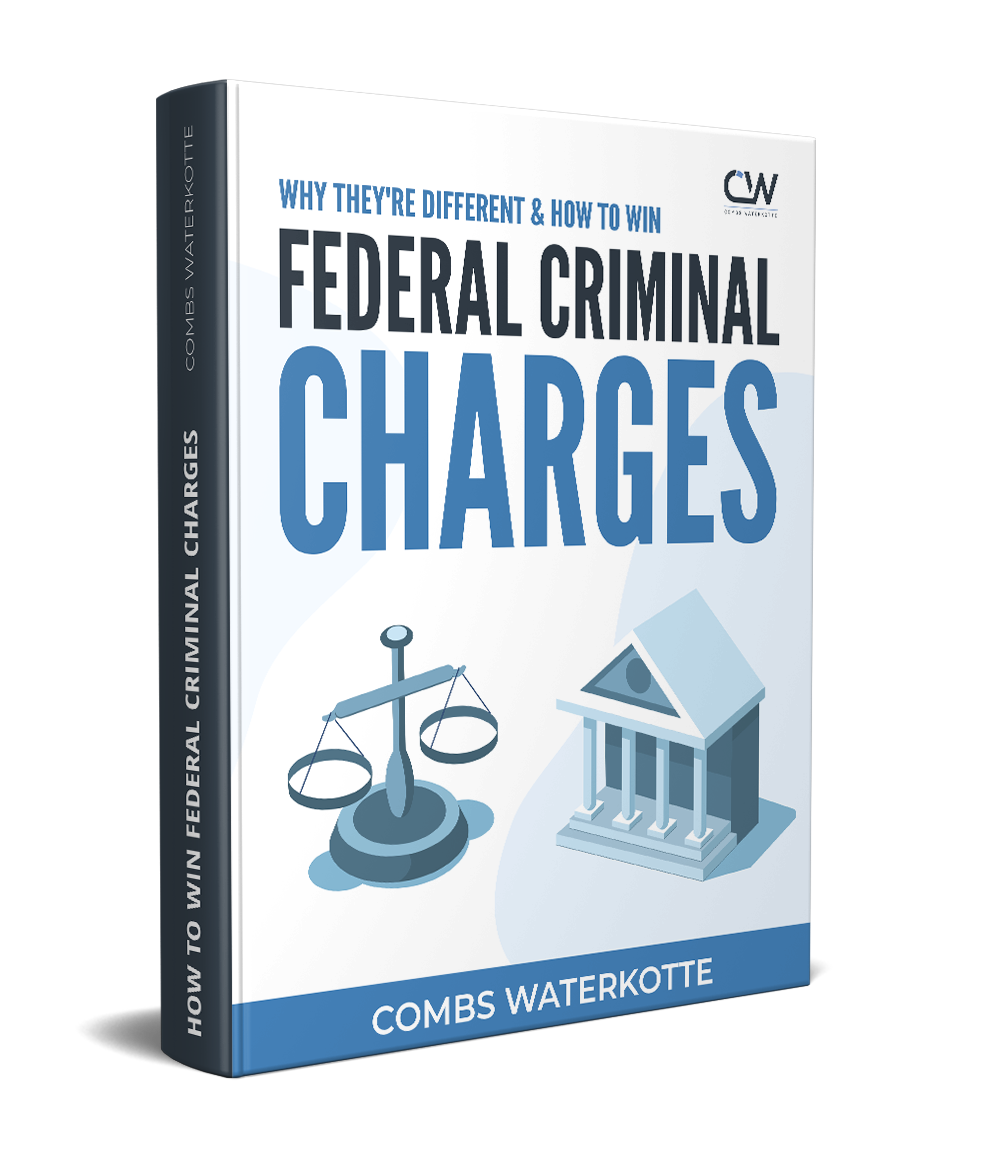
Free book
Facing Federal Criminal Charges? Why They’re Different and How to Win
Combs Waterkotte, a leading federal criminal defense law firm, has handled over 10,000 cases successfully. This ebook guides you through the federal criminal defense process, how federal charges are different, and how to win.
This page covers:
- What to do if you have been charged with conspiracy or are under federal investigation in West Virginia
- The legal requirements that transform alleged conduct into a federal conspiracy under U.S. law
- The most common types of federal conspiracy charges prosecutors bring
- How sentencing and punishment are determined in federal conspiracy cases
- Common defenses used to challenge federal conspiracy allegations
- Why hiring an experienced federal conspiracy defense lawyer matters
What to Know If You Are Facing Federal Conspiracy Charges or an Investigation in West Virginia
First things first: never speak to law enforcement without an attorney. They are never trying to “clear things up,” or “hear your side of the story.” They are trying to build a case, and anything you say can be used as evidence to convict you.
Many federal conspiracy investigations start well before an arrest is ever made. Unlike state cases in West Virginia, federal investigations may unfold quietly over months or even years, gathering evidence through surveillance, informants, financial records, and electronic communications.
You may be the subject of a federal investigation if:
- Federal agents requesting an interview or “just asking questions”
- A subpoena for documents, emails, phone records, or financial data
- Federal search warrants carried out at residences, workplaces, or storage facilities
- Discovering that associates or others connected to you have been arrested or charged
- Receiving a target letter or grand jury notice
In federal conspiracy investigations, honest or offhand statements may be interpreted as proof of intent or involvement. Prosecutors frequently use early statements to form the backbone of federal conspiracy cases.
An experienced West Virginia federal defense lawyer can:
- Step in during the investigation stage before formal charges are brought
- Communicate with investigators and prosecutors on your behalf
- Explain whether you are considered a witness, subject, or target
- Reduce the risk of self-incrimination during questioning
- Develop a defense strategy before charges are filed
- Retain investigators and expert witnesses to support your defense
When facing federal conspiracy charges in West Virginia, early representation may determine whether you face decades in prison or avoid severe consequences.
When Does Alleged Conduct Rise to the Level of a Federal Conspiracy?
To convict someone of conspiracy under federal law (18 U.S. Code § 371), the government must prove the following three elements beyond a reasonable doubt:
- Agreement Between Two or More People: Prosecutors must show that at least two people reached an agreement to violate federal law or defraud the U.S. government.
- Criminal Intent (Mens Rea): The person charged knowingly and voluntarily joins the plan, understanding the goal is to commit a crime.
- Overt Act (in most cases): A member of the alleged conspiracy commits an act, even a minimal one, in furtherance of the agreed-upon plan.
Conspiracy is treated as its own federal crime, meaning charges may be filed even if the underlying offense was never carried out.
Importantly, the agreement does not need to be formal or written. It may be inferred from conduct, communications, or circumstantial evidence. This flexibility is why conspiracy statutes are so aggressively applied in federal criminal cases.
You do not have to:
- Directly participate in the commission of the underlying crime
- Know the identities of all alleged co-conspirators
- Participate in every stage of the alleged plan
- Obtain financial gain or other benefits
Even limited or indirect involvement can be portrayed as participation in a conspiracy, particularly when prosecutors argue that actions were “reasonably foreseeable” within the scope of the agreement.
Federal Conspiracy Cases We Handle in West Virginia
Rather than charging conspiracy alone, federal prosecutors frequently rely on conspiracy allegations to widen responsibility, escalate potential penalties, and pursue complex multi-defendant prosecutions. Our West Virginia federal conspiracy defense lawyers at Combs Waterkotte defend clients against a wide array of federal conspiracy allegations, including:
- Drug conspiracy under 21 U.S.C. § 846, which does not require proof of an overt act and allows charges even when no drugs were seized or handled directly
- Conspiracy to commit wire fraud or mail fraud under 18 U.S.C. §§ 1343, 1341, frequently relying on electronic communications, banking activity, or alleged fraudulent schemes
- Financial, banking, and healthcare fraud conspiracy cases that rely heavily on records reviews and prosecutorial interpretations of complex transactions
- White-collar conspiracy charges, including tax conspiracy and money laundering conspiracy under 18 U.S.C. § 1956(h)
- RICO conspiracy and enterprise conspiracy charges under 18 U.S.C. § 1962(d), even when no individual racketeering acts are attributed to a specific defendant
- Conspiracy allegations involving public corruption or bribery under 18 U.S.C. §§ 201 and 666, commonly supported by circumstantial evidence
- Violent crime conspiracy allegations brought under 18 U.S.C. § 371, § 1959, or related statutes, even when the alleged plan never results in actual violence
Penalties for Federal Conspiracy Charges
Penalties for federal conspiracy convictions are often severe and may equal the punishment imposed for the underlying crime. Federal law allows courts to impose the same penalties for conspiracy as for the completed offense, regardless of whether the alleged crime was finished.
A conviction for federal conspiracy can result in a prison sentence of up to five years. Certain federal conspiracy statutes authorize courts to impose the same punishment as the underlying offense, including mandatory minimum prison sentences.
Possible consequences of federal conspiracy convictions in West Virginia include:
- Prison terms determined by the substantive offense connected to the alleged conspiracy
- Statutorily imposed mandatory minimum sentencing in drug cases, firearms offenses, and other federal conspiracies
- Court-imposed fines and restitution obligations tied to the alleged conspiracy
- Loss of assets the government alleges were used in or derived from the conspiracy
- Terms of supervised release imposed after any prison sentence
In sentencing federal conspiracy cases in West Virginia, courts apply the U.S. Sentencing Guidelines, emphasizing the full scope of the conspiracy instead of a defendant’s limited role. When calculating sentencing exposure, federal courts may evaluate:
- The duration and breadth of the alleged conspiracy
- The number of alleged participants and each person’s role
- Claims that the defendant held a leadership or supervisory role
- Conduct by other alleged conspirators attributed to the defendant
Because of how conspiracy law operates, defendants in West Virginia can be sentenced for conduct carried out by others despite limited participation. Challenging these sentencing factors is a central component of an effective federal conspiracy defense.
Common Defenses to Federal Conspiracy Allegations in West Virginia
Effective defense against federal conspiracy allegations in West Virginia requires a detailed analysis of both the evidence and the prosecution’s legal theory. Based on the specific allegations, potential defenses can include:
-
Absence of an Agreement
An actual agreement must be shown, and parallel conduct or casual communications do not, by themselves, prove a conspiracy. -
Absence of Knowledge or Intent
Without proof of knowing and intentional participation, a conspiracy conviction cannot stand. -
Simple Presence or Relationship
Being present at events, knowing individuals involved, or maintaining business or personal relationships is not enough to prove conspiracy. -
Withdrawal as a Defense
Evidence of timely withdrawal from the conspiracy can serve as a defense in some federal cases. -
Insufficient or Unreliable Evidence
Many conspiracy cases rely on cooperating witnesses, informants, wiretaps, or circumstantial evidence that may be challenged for credibility or legality. -
Unlawful Government Conduct
Constitutional violations such as illegal searches, unlawful monitoring, or improper wiretaps may lead to suppression of evidence or dismissal.
Skilled West Virginia federal conspiracy defense lawyers focus not only on trial strategy, but also on early motions and challenges designed to weaken the government’s case.
Why Clients in West Virginia Choose Combs Waterkotte for Federal Conspiracy Defense
Defending against federal conspiracy charges takes far more than routine criminal defense knowledge. They require a federal defense attorney in West Virginia who understands how federal investigations are built, how prosecutors apply pressure, and how conspiracy statutes are used to expand liability.
Combs Waterkotte’s West Virginia federal defense team handles high-stakes federal conspiracy cases, including prosecutions involving multiple defendants. With Combs Waterkote, you get:
- Personalized representation from a federal criminal defense lawyer in West Virginia, not a volume-based approach
- Our network of investigators and expert witnesses
- Over 100 years of combined experience winning cases
- Federal conspiracy defense lawyers prepared to go to trial while aggressively seeking dismissals or favorable plea outcomes
A disciplined defense strategy allows our West Virginia clients to protect their rights from investigation through trial.
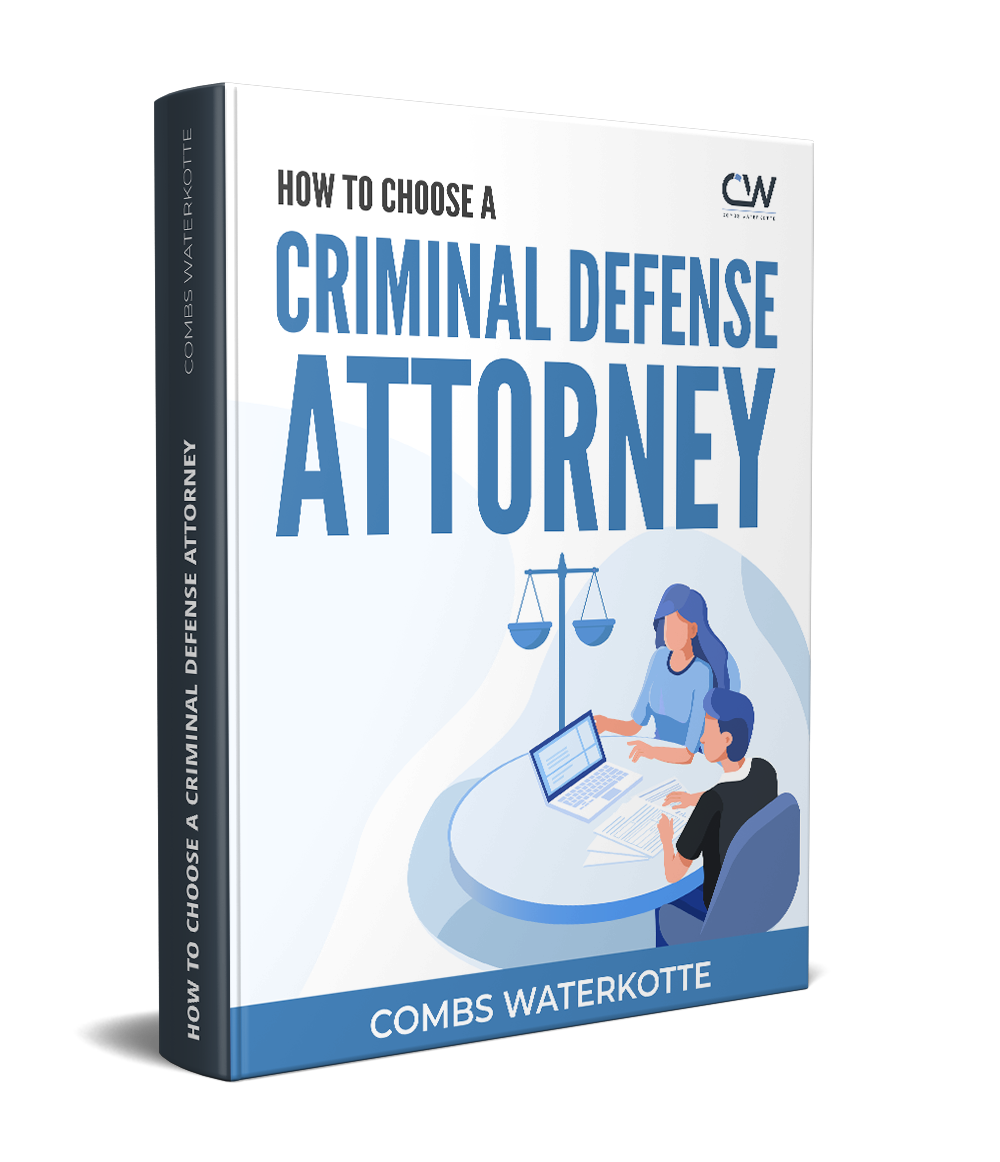
Free book
How to Choose a Criminal Defense Lawyer
Charged with a crime? The lawyer you hire matters. Combs Waterkotte, recognized for top-tier criminal defense in Missouri and Illinois, created this guide to help you find the right attorney. Learn what to look for, key questions to ask, and red flags to avoid.
Call an Experienced West Virginia Federal Conspiracy Defense Lawyer Today
If you have been charged with federal conspiracy in West Virginia or suspect you are under investigation, it is critical to seek legal counsel immediately. Early decisions can have long-term consequences in federal cases.
Speak with Combs Waterkotte by calling (314) 900-HELP or contacting us online to schedule a private consultation with a dedicated West Virginia federal conspiracy defense lawyer.
Frequently Asked Questions About Federal Conspiracy Charges in West Virginia
How is federal conspiracy defined?
Federal conspiracy is a charge alleging that two or more people agreed to commit a federal crime and took steps toward carrying it out, even if the crime was never completed.
Is completing a crime required for a conspiracy charge?
A completed crime is not required; agreement and intent may be sufficient for a conspiracy charge.
Is knowing all co-conspirators required?
Yes. A defendant does not need to know every person involved in the alleged conspiracy.
Can minor participation still lead to charges?
Even limited involvement can lead to charges, but the extent of participation is often a critical defense issue.
How serious are federal conspiracy charges?
Yes. Federal conspiracy charges frequently involve harsh penalties such as lengthy incarceration and mandatory minimum sentences.
Can federal conspiracy charges be dismissed?
Yes, in certain situations charges may be dismissed because of insufficient evidence, flawed legal theories, or constitutional issues.
Should I talk to federal investigators if I’m innocent?
You should consult a lawyer before speaking with investigators. Statements can be misinterpreted or used to support conspiracy allegations.
When is the right time to hire a federal conspiracy lawyer?
The sooner you speak with a federal conspiracy defense lawyer, the more impact early legal strategy can have on your case.

