

If you are under investigation or have been charged with federal conspiracy in Iowa can place your freedom, career, and future at immediate risk Iowa federal conspiracy defense lawyers work to defend clients against aggressive federal prosecutions while seeking dismissal, reduction, or acquittal.
Federal conspiracy statutes provide the government with sweeping authority to bring charges even when an alleged offense was never carried out, no money changed hands, or participation was minimal In many cases, conspiracy charges are used to increase leverage, apply harsher penalties, or pressure defendants into cooperation
Those accused of conspiracy are frequently caught off guard by how expansive these laws are and how rapidly federal cases escalate. Combs Waterkotte‘s experienced Iowa federal criminal defense lawyers represent clients locally and across the country in high-stakes federal criminal cases. While we seek favorable resolutions whenever possible, we are always ready to litigate in federal court to defend your future.
Speak with our legal team today by calling (314) 900-HELP or reaching out online for a free consultation
Cases Handled
Over 10,000
Jail Days Saved
Over 1 Million
Google Reviews
500+ Perfect
Legal Experience
100+ Years
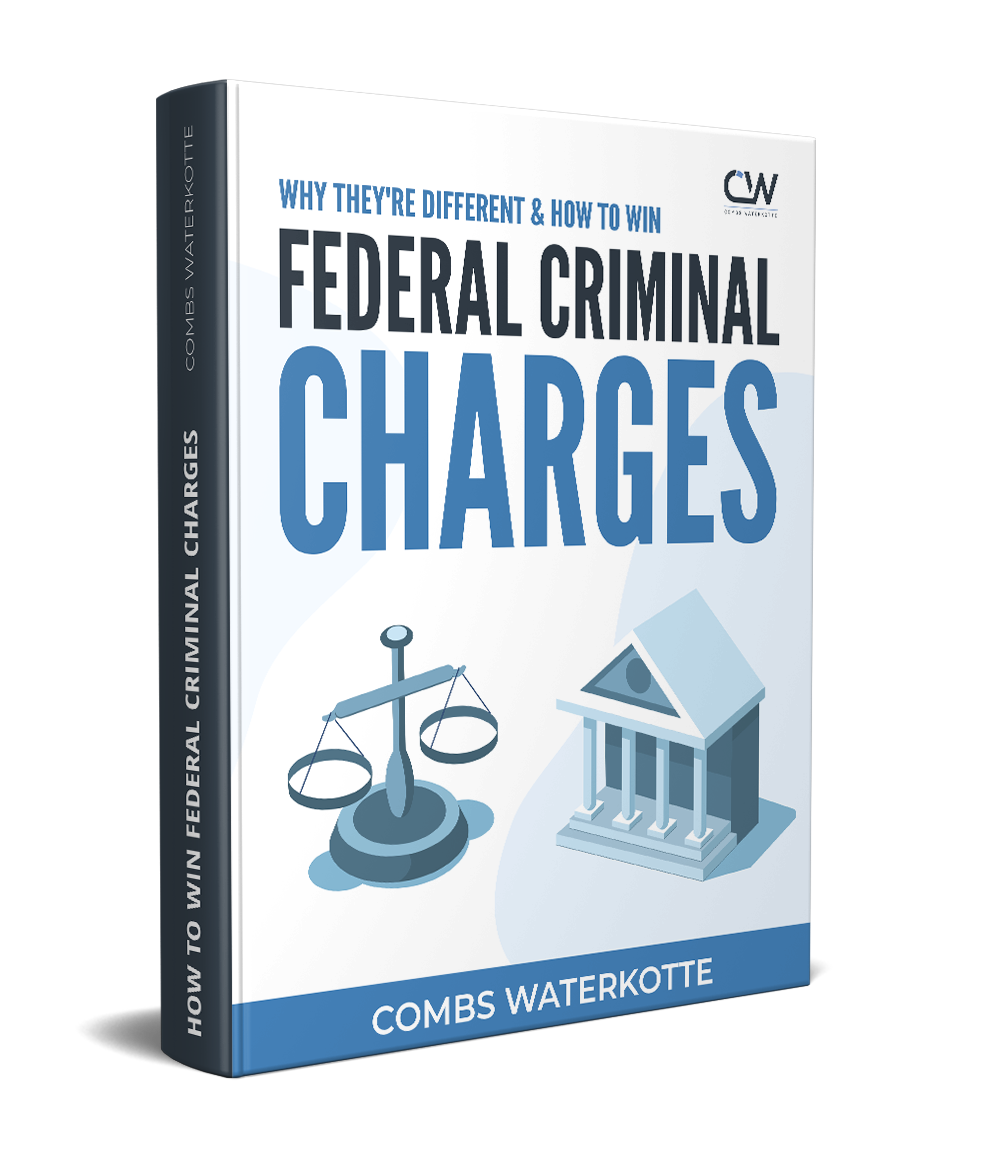
Free book
Facing Federal Criminal Charges? Why They’re Different and How to Win
Combs Waterkotte, a leading federal criminal defense law firm, has handled over 10,000 cases successfully. This ebook guides you through the federal criminal defense process, how federal charges are different, and how to win.
On this page, you’ll learn about:
- Steps to take if you are charged with conspiracy or believe you are under federal investigation in Iowa
- When a crime legally becomes a federal conspiracy under U.S. law
- The most common types of federal conspiracy charges prosecutors bring
- How sentencing and punishment are determined in federal conspiracy cases
- Legal defenses available to contest federal conspiracy accusations
- The importance of retaining an experienced federal conspiracy defense lawyer

What to Do If You’ve Been Charged With Conspiracy or Are Under Federal Investigation in Iowa
The most important rule is this: never speak to law enforcement without an attorney. Federal agents are not looking to resolve misunderstandings; their goal is to gather evidence that may later be used against you.
In many situations, federal conspiracy investigations are underway long before charges are filed. Federal authorities frequently spend months or years collecting evidence through surveillance, cooperating witnesses, financial records, and electronic communications before making arrests.
You are likely under investigation if:
- Being contacted by federal agents seeking an interview or informal conversation
- A subpoena for documents, emails, phone records, or financial data
- Federal search warrants carried out at residences, workplaces, or storage facilities
- Learning that others connected to you have been arrested or charged
- Receipt of a federal target letter or grand jury notice
In federal conspiracy investigations, honest or offhand statements may be interpreted as proof of intent or involvement. Federal prosecutors often rely heavily on statements made early in an investigation to build conspiracy allegations.
An experienced federal defense attorney in Iowa may be able to:
- Intervene before charges are filed
- Handle all communication with federal agents and prosecutors
- Explain whether you are considered a witness, subject, or target
- Reduce the risk of self-incrimination during questioning
- Develop a defense strategy before charges are filed
- Retain investigators and expert witnesses to support your defense
In federal conspiracy cases in Iowa, early legal guidance can be the difference between decades behind bars or being able to move on with your life quickly.
How Federal Law Determines When a Crime Becomes a Conspiracy
Under federal law (18 U.S. Code § 371), the government must prove three factors in order to gain a conviction on a conspiracy charge:
- Agreement: Prosecutors must show that at least two people reached an agreement to violate federal law or defraud the U.S. government.
- Criminal Intent (Mens Rea): The person charged knowingly and voluntarily joins the plan, understanding the goal is to commit a crime.
- Overt Act (in most cases): A member of the alleged conspiracy commits an act, even a minimal one, in furtherance of the agreed-upon plan.
Because conspiracy is a separate offense, an individual can face charges regardless of whether the planned crime was completed.
Prosecutors are not required to prove a formal or documented agreement, as intent may be inferred from behavior and communications. This flexibility is why conspiracy statutes are so aggressively applied in federal criminal cases.
To be charged with conspiracy, you do not have to:
- Personally carry out the alleged federal offense
- Be aware of every individual involved in the alleged conspiracy
- Participate in every stage of the alleged plan
- Obtain financial gain or other benefits
Even limited or indirect involvement can be portrayed as participation in a conspiracy, particularly when prosecutors argue that actions were “reasonably foreseeable” within the scope of the agreement.
Federal Conspiracy Charges We Defend in Iowa
Rather than charging conspiracy alone, federal prosecutors frequently rely on conspiracy allegations to widen responsibility, escalate potential penalties, and pursue complex multi-defendant prosecutions. Combs Waterkotte’s experienced Iowa federal conspiracy defense lawyers represent individuals accused of conspiracy in a broad spectrum of federal cases, including:
- Federal drug conspiracy cases brought under 21 U.S.C. § 846, where charges may proceed even if no drugs were seized or personally handled
- Conspiracy to commit wire fraud or mail fraud under 18 U.S.C. §§ 1343, 1341, frequently relying on electronic communications, banking activity, or alleged fraudulent schemes
- Conspiracy allegations involving healthcare fraud, bank fraud, or financial crimes, often built on document analysis and regulatory interpretations
- White-collar conspiracy allegations such as tax-related conspiracies and money laundering conspiracy under 18 U.S.C. § 1956(h)
- RICO conspiracy and enterprise conspiracy charges under 18 U.S.C. § 1962(d), even when no individual racketeering acts are attributed to a specific defendant
- Public corruption and bribery conspiracy under 18 U.S.C. §§ 201 and 666, often relying on circumstantial evidence of intent or agreement
- Conspiracy charges involving murder or violent federal crimes under 18 U.S.C. § 371, § 1959, or related statutes, regardless of whether violence was carried out
Federal Conspiracy Penalties and Sentencing Exposure
Federal conspiracy convictions frequently carry serious penalties comparable to those associated with the substantive offense. Federal law allows courts to impose the same penalties for conspiracy as for the completed offense, regardless of whether the alleged crime was finished.
A conviction for federal conspiracy can result in a prison sentence of up to five years. However, numerous federal statutes include their own conspiracy provisions, such as drug conspiracy or money laundering conspiracy, which allow courts to impose penalties equal to the underlying offense, including mandatory minimum sentences.
Individuals facing federal conspiracy charges in Iowa may be exposed to the following penalties:
- Prison sentences tied to the underlying offense, not merely the conspiracy itself
- Mandatory minimum sentencing requirements in drug, firearms, or other offense-specific conspiracies
- Substantial financial penalties, including fines and restitution orders
- Forfeiture of assets allegedly connected to the conspiracy
- Periods of supervised release following incarceration
In sentencing federal conspiracy cases in Iowa, courts apply the U.S. Sentencing Guidelines, emphasizing the full scope of the conspiracy instead of a defendant’s limited role. When calculating sentencing exposure, federal courts may evaluate:
- The length and scale of the alleged conspiracy
- The number of participants involved and their roles
- Whether the defendant is accused of leadership or organizational responsibility
- Conduct by other alleged conspirators attributed to the defendant
Because of how conspiracy law operates, defendants in Iowa can be sentenced for conduct carried out by others despite limited participation. Identifying and challenging these sentencing drivers is a critical part of any federal conspiracy defense.
Common Defenses to Federal Conspiracy Allegations in Iowa
Defending against federal conspiracy charges in Iowa demands close scrutiny of the government’s evidence and legal arguments. Based on the specific allegations, potential defenses can include:
-
Lack of an Agreement
An actual agreement must be shown, and parallel conduct or casual communications do not, by themselves, prove a conspiracy. -
Lack of Knowledge or Intent
A defendant cannot conspire to commit a crime they did not knowingly or intentionally agree to participate in. -
Presence Alone or Association
Mere presence, association with others, or routine business or personal relationships do not establish participation in a conspiracy. -
Withdrawal from the Conspiracy
Demonstrating withdrawal before further acts occurred may limit or eliminate liability in certain cases. -
Lack of Reliable Evidence
Evidence in conspiracy cases frequently comes from informants or wiretaps that can be challenged on credibility or legal grounds. -
Violations of Constitutional Rights
Illegal searches, unlawful surveillance, improper wiretaps, or violations of due process can result in suppressed evidence or dismissed charges.
An effective federal conspiracy defense in Iowa involves aggressive pretrial motions and challenges in addition to trial preparation.
Why Combs Waterkotte Is Trusted for Federal Conspiracy Defense in Iowa
Federal conspiracy cases demand more than general criminal defense experience. They require a federal defense attorney in Iowa who understands how federal investigations are built, how prosecutors apply pressure, and how conspiracy statutes are used to expand liability.
Combs Waterkotte’s Iowa federal conspiracy defense lawyers represent individuals facing complex federal charges, including multi-defendant conspiracy cases. With Combs Waterkote, you get:
- A federal criminal defense lawyer in Iowa who treats you as a person, not a case number
- Access to a trusted network of investigators and expert witnesses
- More than 100 years of combined federal criminal defense experience
- Trial-ready federal conspiracy defense attorneys who prepare every case for court while pursuing dismissal or favorable resolutions
A disciplined defense strategy allows our Iowa clients to protect their rights from investigation through trial.

Free book
How to Choose a Criminal Defense Lawyer
Charged with a crime? The lawyer you hire matters. Combs Waterkotte, recognized for top-tier criminal defense in Missouri and Illinois, created this guide to help you find the right attorney. Learn what to look for, key questions to ask, and red flags to avoid.
Contact a Trusted Iowa Federal Conspiracy Defense Lawyer Today
If you have been charged with federal conspiracy in Iowa or suspect you are under investigation, it is critical to seek legal counsel immediately. The steps you take early in a federal investigation can significantly impact your future.
Contact Combs Waterkotte at (314) 900-HELP or reach out online to arrange a confidential consultation with an experienced Iowa federal conspiracy defense lawyer.
Frequently Asked Questions About Federal Conspiracy Charges in Iowa
What does federal conspiracy mean?
Federal conspiracy is a charge alleging that two or more people agreed to commit a federal crime and took steps toward carrying it out, even if the crime was never completed.
Can I be charged without committing the underlying crime?
A completed crime is not required; agreement and intent may be sufficient for a conspiracy charge.
Is knowing all co-conspirators required?
Federal conspiracy law does not require awareness of all other alleged participants.
Does limited involvement matter in a conspiracy case?
Even limited involvement can lead to charges, but the extent of participation is often a critical defense issue.
Are federal conspiracy charges serious?
Yes. These charges often carry severe penalties, including long prison sentences and mandatory minimums.
Are dismissals possible in federal conspiracy cases?
Yes, in certain situations charges may be dismissed because of insufficient evidence, flawed legal theories, or constitutional issues.
Should innocent people speak with federal agents?
You should consult a lawyer before speaking with investigators. Statements can be misinterpreted or used to support conspiracy allegations.
How soon should I speak with a conspiracy defense lawyer?
You should contact a defense lawyer immediately if you suspect an investigation or have been charged, as early involvement matters.

