

DWI With Child Endangerment Lawyer Kansas City, MO
Facing charges for DWI with a child in the car in Kansas City, Missouri? Combs Waterkotte can protect your driver’s license and freedom.
TO COMBS WATERKOTTE,YOU ARE WHY WE EXIST.


DWI With Child Endangerment Lawyer in Kansas City, MO
Facing charges for driving while intoxicated (DWI) in Missouri can be overwhelming, especially if those charges involve child endangerment. The trial-ready attorneys at Combs Waterkotte know what’s at stake for both your future and your family, and you can count on us to use our over 100 years of combined legal experience to fight for the best possible outcome for your DWI and child endangerment case.

I owe my life to Combs Waterkotte. If not for them, I would be spending the rest of my life behind bars. There is no amount of words that can explain what they did for me and my family. Its the highest recommendation that I can give.
Alexander B.
Felonies
Verify on

If I could give Steve and his team 10 stars I would in a heartbeat. Was facing more then one felony charge and after these guys found the arresting officer violated my 4th Amendment Rights and those charges were dismissed. My family and I can't thank you enough.
Dean J
Felonies
Verify on
I was hands down guilty. ON VIDEO !!! In a smaller town, and a job dealing with the public, this was devastating. I made one phone call and spoke for maybe 15 minutes. I DIDN'T appear in court. I am extremely impressed. QUIETLY relieved of the matter!
Y.I.V.
Theft
Verify on
My fiance had a felony drug charge and Combs Waterkotte got it dismissed! There were no fines, court cost, nothing. Chris is loyal, professional, knowledgeable, and a man of his word. We are forever grateful for you.
Kimberly T.
Drug Crimes
Verify on
If I was found guilty, it would have been over 100 years in prison. They promised me that they would fight like hell and get me out of it. After everything was done, I just felt free. Like this wasn’t gonna end with me rotting away in a prison cell. I felt like I could start my life and have a fresh start.
Caleb
Assault 1st, Armed Criminal Action
Verify on

I was facing, probably 18 years… I actually got 5 years probation and 40 hours of community service. Without Combs Waterkotte’s help, I don’t think my family could have made it without me. It was just a written book to where it's a perfect ending.
Chris
Unlawful Use of a Weapon, Armed Criminal Action
Verify on
I went through what was supposed to be one of the top law firms in St. Louis. They said I wouldn't have no chance. I end up firing the other lawyer and everything and going with Chris. I felt like Combs Waterkotte actually did something for me and wasn't I wasn't just another number on somebody's desk.
Willy
DWI/DUI
Verify onI owe my life to Combs Waterkotte. If not for them, I would be spending the rest of my life behind bars. There is no amount of words that can explain what they did for me and my family. Its the highest recommendation that I can give.
Alexander B.
Felonies
If I could give Steve and his team 10 stars I would in a heartbeat. Was facing more then one felony charge and after these guys found the arresting officer violated my 4th Amendment Rights and those charges were dismissed. My family and I can't thank you enough.
Dean J
Felonies
I was hands down guilty. ON VIDEO !!! In a smaller town, and a job dealing with the public, this was devastating. I made one phone call and spoke for maybe 15 minutes. I DIDN'T appear in court. I am extremely impressed. QUIETLY relieved of the matter!
Y.I.V.
Theft
My fiance had a felony drug charge and Combs Waterkotte got it dismissed! There were no fines, court cost, nothing. Chris is loyal, professional, knowledgeable, and a man of his word. We are forever grateful for you.
Kimberly T.
Drug Crimes
If I was found guilty, it would have been over 100 years in prison. They promised me that they would fight like hell and get me out of it. After everything was done, I just felt free. Like this wasn’t gonna end with me rotting away in a prison cell. I felt like I could start my life and have a fresh start.
Caleb
Assault 1st, Armed Criminal Action
I was facing, probably 18 years… I actually got 5 years probation and 40 hours of community service. Without Combs Waterkotte’s help, I don’t think my family could have made it without me. It was just a written book to where it's a perfect ending.
Chris
Unlawful Use of a Weapon, Armed Criminal Action
I went through what was supposed to be one of the top law firms in St. Louis. They said I wouldn't have no chance. I end up firing the other lawyer and everything and going with Chris. I felt like Combs Waterkotte actually did something for me and wasn't I wasn't just another number on somebody's desk.
Willy
DWI/DUI
DWI Charge Enhancements Under Missouri Law
A first-offense DWI is a Class B misdemeanor in Missouri, carrying a jail sentence of up to six months. However, this offense can come with lengthier sentences if any of these aggravating factors come into play:
- Repeat offenses
- Passenger under 17
- Injury accident
- Serious injury accident
- Fatal accident
These aggravating factors are not cumulative, though. You generally won’t face penalties for both having a child passenger and prior DWI offenses, for instance. Instead, prosecutors will usually choose the one aggravating factor that carries the greatest penalty.
Keep in mind, however, that prosecutors can file additional charges stemming from the same offense. For example, if your child was in the vehicle when the police stopped you for DWI, you could face an enhanced DWI charge for having a passenger under 17 and a separate child endangerment charge for risking your child’s life and safety.

Protect your driver’s license and stay out of jail. Call Combs Waterkotte now at (314) 900-HELP or contact us online to take on your DWI with child endangerment case.
Why Combs Waterkotte is the best Law firm for your case.
Real results for people just like you.

DWI With Child Endangerment Offenses in the Missouri Revised Statutes
The Missouri Revised Statutes don’t have a single offense covering a DWI with child endangerment. As a result, you can face separate charges for a single incident.
DWI
DWI occurs when someone operates a motor vehicle while in an intoxicated condition. Someone is intoxicated when they are under the influence of controlled substances, illicit drugs, alcohol, or a combination of multiple substances.
You can be considered under the influence of a substance if it impairs your driving abilities. Officers may use a field sobriety test to verify impairment by measuring your physical and mental sharpness. The officer may record the test, and prosecutors may play the video at your trial to prove impairment.
DWI has a built-in enhancement when you drive with a passenger under 17. This enhancement only requires proof of the passenger’s age and that they were present in the vehicle. It doesn’t normally require proof that you endangered the passenger by crashing or allowing them to ride without a seat belt. Simply driving while intoxicated with a minor in the vehicle can support the enhanced penalty.
Additionally, a DWI charge doesn’t necessarily require proof that you were driving. “Operating” includes sitting in a parked vehicle if you have physical control of it, while physical control means that you have the intent and ability to drive.
This means that sleeping in a parked vehicle can constitute a DWI if you were in the driver’s seat and had access to the keys. If your child was in the back seat, you could face more serious penalties.
Driving With Excessive Blood Alcohol Content
Driving with excessive blood alcohol content (BAC) happens when you operate a vehicle with a BAC of 0.08% or higher. Your BAC is measured with a chemical test of your breath, saliva, blood, or urine.
This offense doesn’t generally require proof of intoxication. You can commit this offense with a high BAC, even if you passed a field sobriety test.
Penalties for this offense don’t include an enhancement for minor passengers. So if you have a high BAC and a minor in your vehicle, prosecutors must either file DWI charges with an enhancement for driving with a child or teenage passenger, or file a separate child endangerment charge against you.
First-Degree Child Endangerment
When it comes to DWI charges, first-degree child endangerment happens when someone does either of the following:
- Knowingly creates a substantial risk to the life or health of a child under 18
- Unlawfully possesses, sells, or transports fentanyl, carfentanil, amphetamine, or methamphetamine in the presence of a child under 18
DWI with child endangerment charges might be possible in a few scenarios. First, a driver might face these charges if they knew that they were too impaired to drive, but put the child in the car and drove anyway. The case for these charges could be stronger if the driver crashed or committed a serious traffic violation, such as going the wrong way on the freeway or driving at an excessively high speed.
Second, a DWI may be accompanied by first-degree child endangerment charges if the driver was high and had drugs in the car. In this scenario, the prosecution does not need to prove that the driver’s actions posed a risk to the child. Instead, the law merely requires proof that the child was in the presence of the substances.
Second-Degree Child Endangerment
Second-degree child endangerment happens when a person acts in a criminally negligent manner that creates a substantial risk to the life or health of a child under 17
A DWI with child endangerment charges could occur when the impaired driver transports a minor passenger despite being impaired. However, the prosecution must still prove criminal negligence. Criminal negligence means that the driver knew or should have known that they were too impaired to drive safely.
Educational efforts about drunk and drugged driving tend to be pervasive, so one could argue that all drivers know or should know the dangers of intoxicated driving. As a result, this charge could arguably be brought in any DWI or excessive BAC case involving a child passenger.
Whether you’re facing first- or second-degree charges, our attorneys can craft a personalized defense to help secure a positive outcome for your situation.
Potential Defenses Against Kansas City, MO, DWI With Child Endangerment Charges
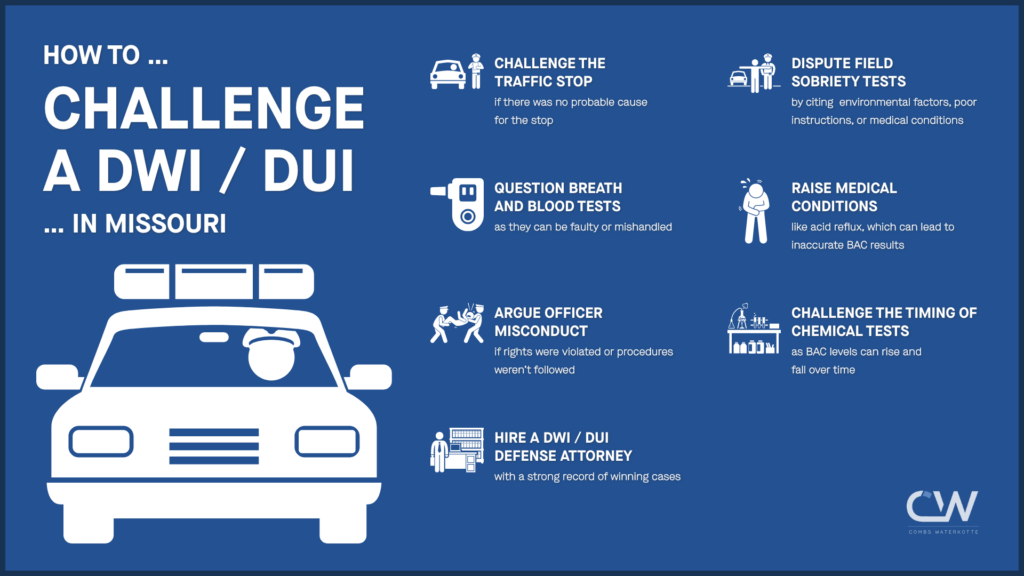
The criminal defense strategies our team may use to defend you from DWI with child endangerment charges will depend on the unique facts of your case, but here’s a closer look at some common defenses:
No Impairment
You might have an explanation for your appearance and performance on a field sobriety test. For example, you might have a medical condition, such as a brain injury, that might make it seem like you are impaired while still allowing you to drive safely. Your doctor can testify in your defense.
No Operation
We may be able to argue that you were not operating the vehicle. If you left the keys outside the car or locked in the trunk, you lacked actual control of the vehicle.

Involuntary Impairment
Involuntary impairment means that you did not know that you had been drugged. For example, we could use this defense if your non-alcoholic drink was spiked with GHB.
Necessity
You might have a defense if you had no choice but to drive your child while impaired. Suppose your child was injured during a camping trip. You had no cell service, and your child needed medical attention. We could argue that you needed to drive the child while you were intoxicated because waiting could have resulted in a serious injury or death.
Penalties for DWI With Child Endangerment in Kansas City, MO
The penalties for a DWI when you have a child in the vehicle depend on the specific charges. A DWI with a passenger under 17 is charged as a Class A misdemeanor and punishable by up to one year in jail.
Driving with excessive BAC is a Class B misdemeanor for a first offense. There is no enhancement for having a child passenger for this charge, so the penalty for this offense can involve up to six months in jail.
However, prosecutors can add first- or second-degree child endangerment charges. A first-degree charge is punishable by up to seven years in prison, while a second-degree charge can come with up to one year in jail. In either case, our lawyers can fight these charges on your behalf.
Why You Should Hire Combs Waterkotte for Your Kansas City DWI With Child Endangerment Case

Our firm has saved clients over 1 million days of imprisonment since its founding. We know that prosecutors fight aggressively in DWI cases involving child passengers because they believe they are protecting children. However, these cases often result from misunderstandings or mistakes.

Legal Video:

We provide compassionate and non-judgmental representation to all of our clients. You can count on us to fight for your best interests throughout the process.
How We Defend You From DWI With Child Endangerment Charges in Kansas City, MO
Our lawyers will learn your side of the story and use your version of the events to tailor a defense to your case. We will then gather evidence to help support your defense, including medical testimony and scientific evidence.


We can negotiate for a dismissal or a plea deal, and we can even pursue diversion if you have a relatively clean record. At the same time, we prepare your case for trial along the way. If we cannot secure a positive outcome before trial, we can take your case to court and advocate for an acquittal from the jury.
Contact Combs Waterkotte for Help With Your DWI Case

A DWI combined with child endangerment charges could result in significant jail time, especially for repeat DWI offenders. The skilled team at Combs Waterkotte has significant experience with all types of intoxicated driving crashes.
Don’t leave your future or custody rights to chance. Contact us online or at (314) 900-HELP to learn how we can fight for you when you face DWI and child endangerment charges today.
Resources
For more information on criminal defense in Kansas City or anywhere else in Missouri, call the Combs Waterkotte criminal defense attorneys right away at (314) 900-HELP or contact us online for a confidential consultation.
Can You Drive After Being Charged With a DWI/DUI?
How does a DUI affect insurance rates?
How Likely is Jail Time for a First Time DUI/DWI Offense in Missouri?
How does a DWI or DUI affect your driver’s license?
Can a DWI or DUI be expunged in Missouri?
Should/Can I Refuse a Blood Test?
Should I Blow if I Get Pulled Over for a DWI/DUI in Missouri?

Free book
Don’t “Blow” Your DWI/DUI Case: Key Mistakes to Avoid
Combs Waterkotte, Missouri and Illinois’s leading DWI/DUI law firm, has handled over 10,000 cases successfully. This ebook guides you through the DWI/DUI defense process and helps you avoid key mistakes.

