






Additional Links
- Top 10 Orders of Protection Questions
- Can a Child Abuse Accusation Send Me to Jail?
- What Are Common Reasons Orders of Protection Are Granted in Missouri?
- Can I Challenge an Order of Protection in Missouri?
- How Much Does it Cost to Hire a Lawyer?
- If I’m Innocent, Do I Still Need a Criminal Defense Attorney?
- What is the Best Defense in a Criminal Case?
- What to Do After You’re Arrested: A Step-by-Step Legal Guide
Second Degree Child Endangerment Attorneys in St. Louis
In St. Louis, a second degree child endangerment charge can lead to fines, jail or prison time, custody issues, restraining orders, and a slew of other long-term issues. Because these allegations involve children, St. Louis prosecutors take them very seriously and tend to seek the maximum sentencing penalties.
At Combs Waterkotte, we understand that these charges often result from misunderstandings, exaggerated claims, or even outright lies. When you trust us with your second degree child endangerment case, we’ll do everything in our power to get you the best result we can.
Facing a second degree child endangerment charge in St. Louis, Missouri? Contact Combs Waterkotte online or call us at (314) 900-HELP today to start building your criminal defense.
When you hire us, we start with a free, confidential conversation to ascertain all of the facts of your case. Our experienced team of attorneys, paralegals, and law clerks then get to work to provide the best legal defense we can provide based on those facts.
If you’re ready to take on your second degree child endangerment charges, call (314) 900-HELP or reach out to us online. We’ll channel our experience and legal expertise into getting your charges reduced or dismissed and, if we need to, we’ll fight for a not-guilty verdict in court.
What Is Second Degree Child Endangerment in St. Louis?
Second degree child endangerment in St. Louis is a complex charge with quite a few components and definitions to understand. And while they’re not as severe as first degree child endangerment, these charges should still not be taken lightly.
According to Missouri law under RSMo §568.050, to qualify as second degree child endangerment, an offense must meet two requirements. The offender must:
- With criminal negligence, create substantial risk to the life, body, or health of a child under 17 years old
- Knowingly aid or encourage a child under 17 years old to commit a crime
The two most important terms to understand here are “criminal negligence” and “knowingly.” RSMo §556.061 provides us with their definitions under the law:
- Criminal negligence is the failure to be aware of a bad outcome where such failure is a “gross deviation” from what a reasonable person would do
- Knowingly means someone is fully aware of their conduct (or certain that their conduct will cause a specific result)
In other words, someone can be charged with second degree child endangerment either for severely ignoring possible risks to the welfare of a child, or intentionally helping or allowing them to commit a crime.
Actions That Can Lead to Second Degree Child Endangerment Charges in St. Louis
Between criminal negligence and knowingly aiding a child in committing a crime, there are several criminal actions that qualify someone for a second degree child endangerment charge in St. Louis.
Missouri law allows for parents or guardians to be charged with second degree child endangerment if they knowingly encourage a child to engage in conduct included in Missouri’s juvenile court statute, RSMo §211.031. Some of this conduct includes:
- The child is constant truant without justification, habitually absent from the home, or engaging in behavior that is a threat to their welfare (or someone else’s)
- The child commits a juvenile crime like theft, trespassing, or drug and alcohol-related crimes due to a parent or guardian’s negligence or encouragement
- The child commits criminal acts like theft, assault, weapons offenses, or other crimes under Missouri law due to a parent or guardian’s negligence or encouragement
A person can also be charged with second degree child endangerment if they knowingly encourage a child under 17 to enter a building known to be a “public nuisance.” Under RSMo §579.105, a public nuisance is:
- A building used for manufacturing drugs
- A building known to be a location of habitual illegal drug use
What Are the Penalties for Second Degree Child Endangerment in St. Louis?
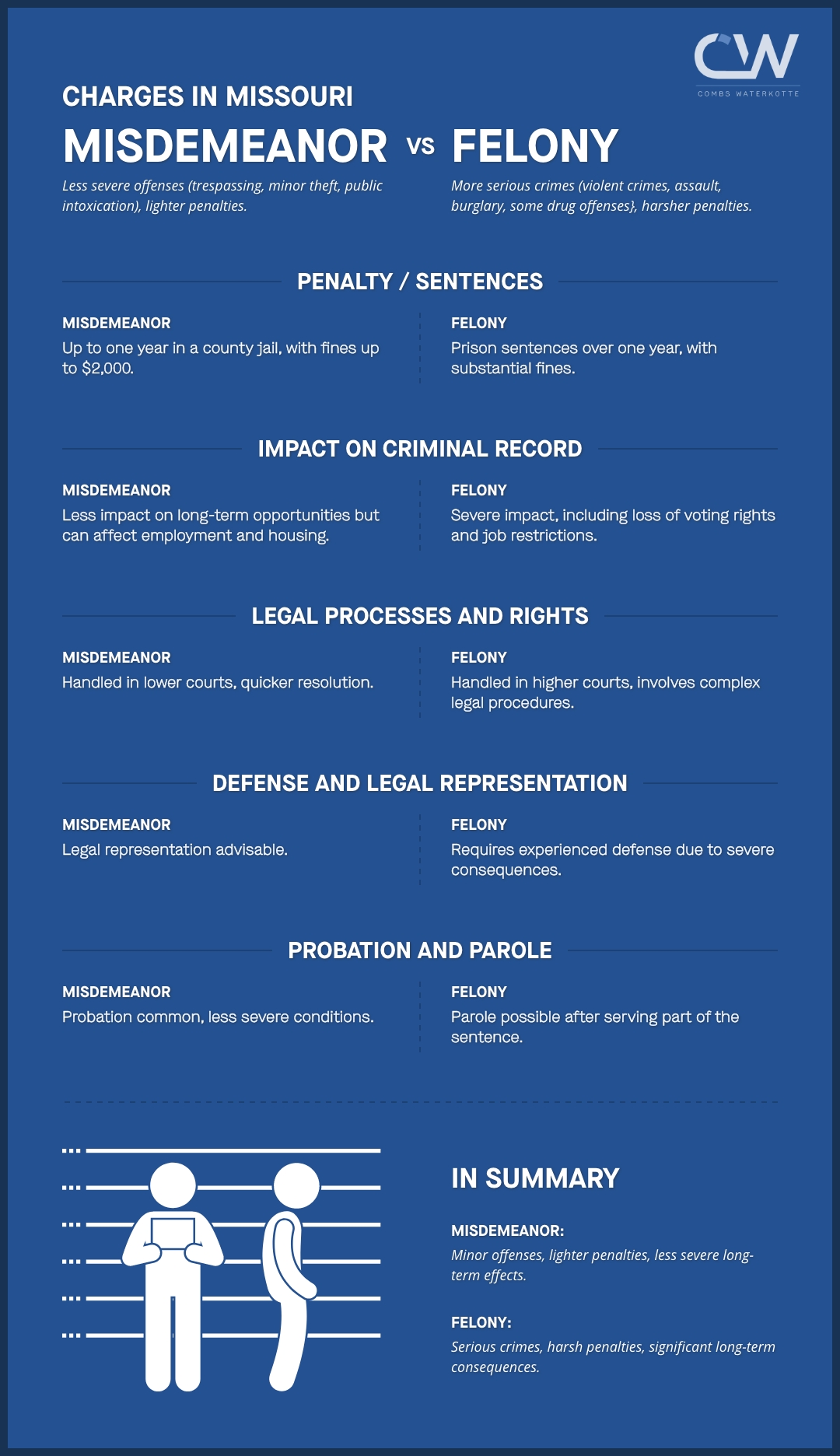
Second degree child endangerment can either be a misdemeanor or a felony in St. Louis. It’s typically charged as a Class A misdemeanor (with a sentence up to 1 year in jail), but if it’s someone’s second or subsequent offense, it’s charged as a Class E felony (with a sentence up to 4 years in prison).
Aside from any potential jail or prison sentences, though, a second degree child endangerment charge can come with other consequences in St. Louis, like:
- Investigation by the Missouri Department of Social Service’s Children’s Division, which can result in placement on the Child Abuse and Neglect Registry (CANRA)
- Orders of protection involving the child or other family members
- Child custody or visitation issues (including court-ordered supervision or restrictions)
- Probation conditions, including regular reporting, home visits, and compliance with treatment requirements
- Mandatory parenting classes, counseling, or other court-ordered programs
- Difficulty obtaining professional licenses in fields like teaching, healthcare, or childcare
- Difficulty finding (or keeping) employment, especially in fields involving children, like healthcare, education, or government work
- Loss of certain civil rights (like voting or firearm ownership) if the charge is a felony
What to Do If You’re Arrested or Charged with Second Degree Child Endangerment in St. Louis
Second degree child endangerment charges are serious in St. Louis. That’s why if you’re arrested or charged, it’s very important to take the following steps to help your criminal defense.
Invoke Your Right to Remain Silent
After providing law enforcement with basic identifying information, politely tell them that you’re invoking your right to remain silent. Do not try to explain what happened, as those statements can be used against you later. Speak only to ask for an attorney.
Contact a Criminal Defense Lawyer Immediately
The next thing to do is hire a criminal defense attorney experienced with second degree child endangerment charges. These cases are complicated, often involving police reports, witness statements, and sometimes Missouri Department of Social Services investigations. A defense attorney can guide you through the process.
Stay Calm and Cooperate with Police Officers
Even if you believe the accusation is unfair, remain calm and follow any lawful commands police give you. Resisting arrest can lead to additional charges. Don’t argue about parenting decisions or the child involved. Staying composed protects your rights and prevents the situation from escalating.
Do Not Consent to Searches without a Warrant
Police may ask to search your phone, home, or vehicle for evidence related to the alleged endangerment. Unless they provide you with a warrant, you can politely refuse. Your attorney can later challenge any unlawful searches if police proceed anyway.
Avoid Discussing the Allegations with Anyone
Do not talk about the incident with family, friends, neighbors, or especially the child involved. Any conversations, messages, calls, or social media posts may become evidence used against you. Only discuss the facts of the case with your attorney.
Preserve Evidence and Witness Information
Write down everything you remember about the situation involving the child: where you were, who was present, what was said, etc. Save texts, photos, or messages that may show the child was safe or properly supervised.
Carefully Follow All Bond or Court Conditions
Child endangerment charges usually come with strict release conditions, such as avoiding contact with the child or cooperating with child welfare investigations. Violating these conditions can lead to additional charges or your bond being revoked.
Criminal Defense Strategies Against Second Degree Child Endangerment Charges in St. Louis
A good criminal defense lawyer will thoroughly examine the facts of your case and strategize a legal defense based on the law and the evidence. Below are some of the most common criminal defense strategies used in St. Louis second degree child endangerment cases.
Lack of Intent
Second-degree child endangerment requires proof that the defendant knowingly created a substantial risk or encouraged unlawful conduct. If the parent did not know the child was engaging in dangerous or illegal behavior, the defense may be able to prove a lack of intent by the defendant.
Reasonable Parental Judgement
Parents are allowed to make reasonable decisions about the supervision and discipline of their child. A defense may argue that the child was properly supervised and that the situation did not create a substantial risk to the child’s health or safety under Missouri law.
False Allegations or Misunderstood Events
Child endangerment accusations sometimes arise during family disputes, custody battles, or neighborhood conflicts. A defense attorney may challenge witness credibility and show the allegations were exaggerated, misinterpreted, or motivated by personal conflict.
Lack of Substantial Risk to the Child
Prosecutors must show that the defendant’s actions created a real and substantial risk to the child’s life, body, or health. If the circumstances did not actually endanger the welfare of the child, the charge may not meet the legal threshold required for a conviction.
Fourth Amendment Violations
If law enforcement obtained evidence through an unlawful search of a home, vehicle, or phone, that evidence may have violated the defendant’s Fourth Amendment rights and could be suppressed in court. Without that evidence, prosecutors may lack the proof needed to support a second degree child endangerment charge.
Coercion or Duress
In some situations, a parent may have acted under threats or pressure from another person. If the defendant’s actions occurred because of coercion or duress, the law may recognize that the parent had no reasonable alternative.
Violations of Miranda Rights or Improper Interrogation
Statements made during police questioning can be challenged if officers failed to properly advise the defendant of their Miranda rights. If those statements are excluded due to Fifth Amendment violations, key evidence supporting the prosecution’s case may be weakened.