

First Degree Rape Lawyer Kansas City, MO
Hire the leading first degree rape lawyers in Kansas City, Missouri. Whether you’ve been arrested or charged, we can help you.
TO COMBS WATERKOTTE,YOU ARE WHY WE EXIST.


First Degree Rape Lawyer Kansas City, MO
A first degree rape accusation in Kansas City, Missouri can put your freedom, relationships, and reputation at risk. A conviction can result in life in prison and lifelong sex offender registration requirements. Given the high stakes, if you’re facing first degree rape allegations in Kansas City, Misouri, you need a good attorney right away.
Combs Waterkotte’s Kansas City sex crime defense lawyers will investigate the allegation against you, protect your rights, and prepare a defense based on the evidence. We’ve successfully defended clients against Missouri rape charges before, and we’re ready to help you. Call (314) 900-HELP now or contact us online for a free, confidential consultation.

I owe my life to Combs Waterkotte. If not for them, I would be spending the rest of my life behind bars. There is no amount of words that can explain what they did for me and my family. Its the highest recommendation that I can give.
Alexander B.
Felonies
Verify on

If I could give Steve and his team 10 stars I would in a heartbeat. Was facing more then one felony charge and after these guys found the arresting officer violated my 4th Amendment Rights and those charges were dismissed. My family and I can't thank you enough.
Dean J
Felonies
Verify on
I was hands down guilty. ON VIDEO !!! In a smaller town, and a job dealing with the public, this was devastating. I made one phone call and spoke for maybe 15 minutes. I DIDN'T appear in court. I am extremely impressed. QUIETLY relieved of the matter!
Y.I.V.
Theft
Verify on
My fiance had a felony drug charge and Combs Waterkotte got it dismissed! There were no fines, court cost, nothing. Chris is loyal, professional, knowledgeable, and a man of his word. We are forever grateful for you.
Kimberly T.
Drug Crimes
Verify on
If I was found guilty, it would have been over 100 years in prison. They promised me that they would fight like hell and get me out of it. After everything was done, I just felt free. Like this wasn’t gonna end with me rotting away in a prison cell. I felt like I could start my life and have a fresh start.
Caleb
Assault 1st, Armed Criminal Action
Verify on
I was facing, probably 18 years… I actually got 5 years probation and 40 hours of community service. Without Combs Waterkotte’s help, I don’t think my family could have made it without me. It was just a written book to where it's a perfect ending.
Chris
Unlawful Use of a Weapon, Armed Criminal Action
Verify on
I went through what was supposed to be one of the top law firms in St. Louis. They said I wouldn't have no chance. I end up firing the other lawyer and everything and going with Chris. I felt like Combs Waterkotte actually did something for me and wasn't I wasn't just another number on somebody's desk.
Willy
DWI/DUI
Verify onI owe my life to Combs Waterkotte. If not for them, I would be spending the rest of my life behind bars. There is no amount of words that can explain what they did for me and my family. Its the highest recommendation that I can give.
Alexander B.
Felonies
If I could give Steve and his team 10 stars I would in a heartbeat. Was facing more then one felony charge and after these guys found the arresting officer violated my 4th Amendment Rights and those charges were dismissed. My family and I can't thank you enough.
Dean J
Felonies
I was hands down guilty. ON VIDEO !!! In a smaller town, and a job dealing with the public, this was devastating. I made one phone call and spoke for maybe 15 minutes. I DIDN'T appear in court. I am extremely impressed. QUIETLY relieved of the matter!
Y.I.V.
Theft
My fiance had a felony drug charge and Combs Waterkotte got it dismissed! There were no fines, court cost, nothing. Chris is loyal, professional, knowledgeable, and a man of his word. We are forever grateful for you.
Kimberly T.
Drug Crimes
If I was found guilty, it would have been over 100 years in prison. They promised me that they would fight like hell and get me out of it. After everything was done, I just felt free. Like this wasn’t gonna end with me rotting away in a prison cell. I felt like I could start my life and have a fresh start.
Caleb
Assault 1st, Armed Criminal Action
I was facing, probably 18 years… I actually got 5 years probation and 40 hours of community service. Without Combs Waterkotte’s help, I don’t think my family could have made it without me. It was just a written book to where it's a perfect ending.
Chris
Unlawful Use of a Weapon, Armed Criminal Action
I went through what was supposed to be one of the top law firms in St. Louis. They said I wouldn't have no chance. I end up firing the other lawyer and everything and going with Chris. I felt like Combs Waterkotte actually did something for me and wasn't I wasn't just another number on somebody's desk.
Willy
DWI/DUI
How the State of Missouri Defines First Degree Rape
Under RSMo §566.030, first degree rape involves sexual intercourse with someone who is incapacitated, incapable of consenting, or lacks the ability to consent. The offense may also involve sexual intercourse through forcible compulsion.

“I recently went to trial with [Combs Waterkotte] and [they] won a ‘not guilty’ verdict for me… If you are looking for a lawyer, I would HIGHLY recommend [Combs Waterkotte]. I simply could have not been more happy with [their] performance. I was amazed.”
-Matt | Combs Waterkotte Client
Missouri’s sexual offense definitions define “sexual intercourse” as penile penetration of the female genitalia (even minimally). The best way to understand the offense is to look closely at specific definitions of the terms laid out in the statute.
What Counts as “Forcible Compulsion”?
Forcible compulsion includes physical force that overcomes reasonable resistance or a threat that creates a reasonable fear of death, serious injury, or kidnapping. The threat can either be made directly to the rape victim or to someone else.
Drugging a victim in order to incapacitate them is also a form of forcible compulsion under Missouri law. Having sex with a victim who has been drugged can result in a first degree rape charge.
Incapacity and Consent
Incapacity typically involves unconsciousness. However, it can also involve a physical or mental condition that prevents someone from understanding the sexual conduct or communicating their unwillingness. Under the law, alcohol consumption does not automatically mean incapacitation (but the facts differ from case to case).
A person is not considered to have consented to a sexual act when their consent comes as a result of force, duress, deception, or when the law considers the person to be unable to consent. Like incapacitation, consent often comes down to the specific circumstances of a particular sexual encounter.
Attempted First Degree Rape
A rape attempt requires proof that someone had a purpose to commit rape and that they took a substantial step toward that purpose. A completed sexual encountered is not required for an attempted first degree rape charge.
In Missouri, the penalties for first degree rape and attempted first degree rape are the same. In other words, you can face high-level felony exposure even without having committed a sexual act.
Why Combs Waterkotte is the best Law firm for your case.
Real results for people just like you.

First Degree Rape Compared with Other Missouri Sex Crimes
Missouri law outlines several different sexual offenses. The charge you face depends entirely on the alleged act, the extent of consent (or lack of consent), and the age of the alleged victim. Here are some of the most common Missouri sex crimes and the kind of conduct that can result in a charge:
| Offense | Distinguishing allegation |
|---|---|
| First degree rape | Intercourse involving forcible compulsion, incapacity, or inability to consent |
| Second-degree rape | Intercourse with the knowledge that the other person has not consented |
| First degree statutory rape | Intercourse with a child younger than 14 |
| First degree sodomy | Deviate sexual intercourse (including certain oral, anal, or digital acts) |
| First degree sexual abuse | Sexual contact involving forcible compulsion or incapacity |
Under RSMo §566.020, consent is not a recognized defense against sex crime charges involving a child younger than 14. Believing that a child was older than 14 years old is also not a defense against an offense that depends on a child being under 14.
Penalties for a First Degree Rape Conviction in Kansas City, MO
Unlike most criminal offenses, first degree rape in the state of Missouri is an unclassified felony. The first degree rape statute defines its own penalties for individuals convicted of the offense. These penalties include:
| First Degree Rape Conduct | Prison Sentence |
|---|---|
| Baseline offense | A term of at least 5 years (to life) |
| Aggravated first degree rape | A term of at least 15 years (to life) |
| Victim younger than 12 | Life in prison with parole eligibility after 30 years |
| Victim younger than 12 with statutory torture or depravity-of-mind | Life without parole or probation |
| Persistent sexual offender | Life without parole or probation |
| Predatory sexual offender | Life with a court ordered minimum before parole eligibility (lifelong parole supervision if released) |
The statute prohibits both suspended imposition and suspended execution of sentence for a first degree rape conviction. A first-time conviction does not make ordinary probation available.
When First Degree Rape Charges Becomes Aggravated
Under RSMo §566.010, an individual can face aggravated first degree rape charges when they:
- Cause a serious physical injury
- Threateningly display a deadly weapon or dangerous instrument
- Subject someone to intercourse or deviate sexual intercourse with multiple people
- Have a prior sex offense conviction
- Commit rape within an established pattern of activity involving two or more people
- Knowingly commit incestual rape against a descendant, sibling, stepchild, etc.
Separate persistent and predatory sexual offender provisions can require life prison sentences. Under RSMo §566.125, a prior rape or sodomy conviction can make someone a persistent offender. Predatory status can also involve earlier acts or multiple victims (even without a prior conviction).
Under Missouri law, first degree rape is also considered to be a dangerous felony. RSMo §558.019 requires individuals convicted of a dangerous felony to serve at least 85% of their sentence before parole or probation eligibility.
First Degree Rape and the Missouri Sex Offender Registry
First degree rape is a Tier III sex offense, the most serious under the law. Individuals convicted of Tier III sex offenses in Kansas City, Missouri may face:
- Lifetime sex offender registration: RSMo §589.400 requires Tier III offenders to register as sex offenders for life
- Frequent reporting: RSMo §589.414 requires in-person verification every 90 days and prompt updates when moving houses or traveling
- No expungement: RSMo §610.140 says that Tier III sex offense convictions do not qualify for expungement from a criminal record
Before you accept a potential plea decision, we explain your potential registration obligations, release restrictions, and possible consequences on employment, housing, and professional licensing. Remember: Getting a shorter prison term is not the only consequence that matters when facing a rape charge.
Criminal Defense Strategies Against First Degree Rape Charges in Kansas City, MO
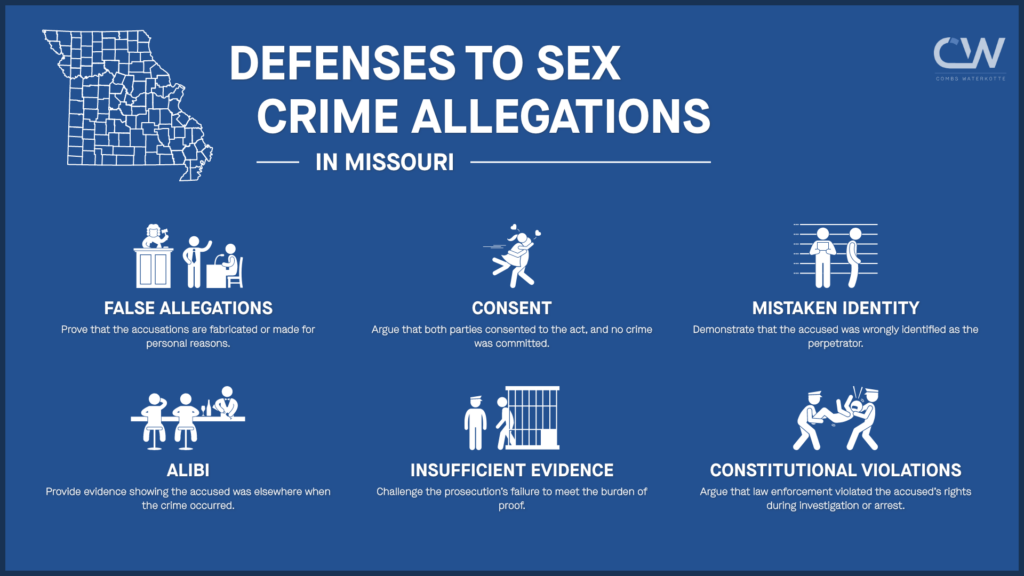
Depending on the allegations against you, your defense can take several forms. At Combs Waterkotte, we don’t apply a one-size-fits-all approach to defending against rape charges. Instead, we use several possible criminal defense strategies depending on what your case calls for.
Challenging Identification and the Timeline
To start, we compare witness accounts with location records, surveillance footage, work records, messages, and other available evidence. An alibi or mistaken identification may undermine your allegations. Where accounts conflict, we investigate the discrepancy rather than assuming the police got it right the first time.
Examining Consent, Capacity, and Alleged Force
When it’s legally available, evidence of consent may be central to your defense. We examine communications surrounding the encounter, witness observations, medical information, and any alleged threats or physical conduct. We also test whether the evidence actually establishes incapacity at the time of the alleged offense.
A prior relationship with an alleged victim does not itself establish consent. Missouri’s rape-shield law restricts evidence about prior sexual conduct and requires court approval for applicable exceptions. This means a defense must rely on admissible facts, not attacks on someone’s sexual history. We understand how to navigate these complex issues.
Reviewing DNA, Medical, and Toxicology Evidence
When it comes to the science, we evaluate sample collection, lab testing methods, chain of custody, timing, and whether expert opinions support the findings. DNA may help identify a person, but it does not necessarily resolve consent.
Conversely, a conviction does not always require DNA evidence. We seek qualified experts if we need to clarify disputed evidence.
Challenging Unlawfully Obtained Evidence
We also examine search warrants, phone searches, recorded interviews, and compliance with your constitutional rights. An unlawful search may support a motion to suppress certain evidence.
We also assess whether any statements you made were obtained unlawfully. Excluding evidence can completely change a case (though it does not automatically result in a dismissal).
What to Do If You Are Accused of Rape in Kansas City, MO
If you’re facing first degree rape allegations in Kansas City, Missouri, you need legal intervention right away. Your immediate priorities should include:
- Requesting an attorney: Always invoke your right to remain silent before answering police questions and ask for a lawyer right away.
- Preserving evidence: Keep complete messages, records, and potential witness information. Do not delete, alter, or fabricate anything.
- Avoiding contact with the alleged victim: Don’t ever confront your accuser, pressure witnesses, or ask others to intervene.
- Following court orders: Obey any bond or no-contact conditions, attend required hearings, and keep case discussions off social media.
Common Questions About Kansas City Rape Charges
Combs Waterkotte has decades of experience defending against rape charges in Kansas City, Missouri. And while we’ve heard hundreds of questions about the charges and the defense process over the years, the two most common questions we hear about rape charges are:
- Can charges be filed years after an alleged offense occurs?
- Can an accuser decide to drop charges on their own?
Can Charges Be Filed Years Later?
Yes. RSMo §556.036 allows prosecutions for first degree rape and attempted first degree rape to begin at any time—there is no statute of limitations. Don’t assume an older allegation is too late to prosecute. If you’ve been charged years after the fact, we can review the alleged offense date, applicable laws, and any evidence that may still be available.
Can the Accuser Drop the Case?
An accuser does not control a state prosecution. The Jackson County Prosecutor’s Office evaluates evidence and handles all charging decisions. Alleged victims can request for a case to be dropped, but a request not to proceed does not automatically end the case.
Changes in someone’s account or unwillingness to testify may affect the evidence. Your lawyer can address these issues as your case progresses.
Why Choose Combs Waterkotte for Your Kansas City First Degree Rape Case?

When you’re charged with an offense as serious as first degree rape, you need a defense team that takes both the allegations and your account just as seriously. Our team represents people facing serious sex crime accusations in Jackson County and throughout Missouri. We listen without judgment, explain the risks, and fight the prosecution at every step.


We prepare with trial in mind rather than treating a plea as an inevitability. That preparation also informs negotiations when a dismissal, reduced charge, or other resolution may be achievable. We’ll do everything in our power to reduce the impact of your first degree rape charges on your life and career.
How We Will Build Your First Degree Rape Defense
Our work begins by closely examining all of the evidence available in your case. We focus on:
- Preserving time-sensitive records: Seeking video, electronic communications, and other material before it disappears
- Testing the prosecution’s theory: Comparing statements, forensic findings, and independent records for meaningful inconsistencies
- Reviewing sentencing allegations: Examining claimed injuries, age, prior offenses, and any proposed enhancements
- Preparing for the next decision: Filing appropriate motions, evaluating offers, and developing a trial strategy with you


You will know what the state alleges, which issues remain disputed, and how each available option could affect your future.
Contact a First Degree Rape Lawyer in Kansas City Today

Do not wait for an investigation to become an arrest. Protect yourself proactively against your Kansas City, Missouri first degree rape charges. Combs Waterkotte can review your situation and help you understand the next steps. Call (314) 900-HELP or request a free, confidential consultation online to start building your defense.
Resources
For more information on criminal defense in Kansas City or anywhere else in Missouri, call the Combs Waterkotte criminal defense attorneys right away at (314) 900-HELP or contact us online for a confidential consultation.
What Happens When You Are Wrongfully Accused of a Sex Crime?
How Does the Sex Offender Registry Work in Missouri?
Do I Need a Lawyer if I’m Innocent in a Sex Crime Case?
Can I Sue for Being Falsely Accused of Sexual Assault?
What Are the Different Levels of the Sex Offender Registry in Missouri?
What is the Difference Between Sexual Assault and Rape?
Will I Have a Criminal Record if Convicted of Sexual Assault?
Can a Sex Crime Conviction be Expunged From My Record in Missouri?
Free book
Charged With a Sex Crime? Common Defense Strategies in Sex Crime Cases
Combs Waterkotte is Missouri and Illinois’s leading sex crime defense law firm. Our team of expert criminal defense attorneys have handled over 10,000 cases – many just like yours – and have saved out clients from over 1 million days from jail or prison.

