



Additional Links
- How DWI Manslaughter Differs from Vehicular Homicide in Missouri
- Keys to Hiring the Best DWI Manslaughter Defense Lawyer
- Don’t “Blow” Your DWI/DUI Case: Key Mistakes to Avoid
- How a Criminal Defense Attorney Can Protect Your Rights and Future
- How to Choose a Criminal Defense Lawyer
- Free Legal Books
- Defending Freedom Podcast

What Is Manslaughter in Missouri?
Missouri law lays out two different types of manslaughter: voluntary manslaughter, and involuntary manslaughter. There are also two different degrees of involuntary manslaughter: first-degree involuntary manslaughter and second-degree involuntary manslaughter.
Before I met [Combs Waterkotte], I was sitting in jail, and I felt like that was going to be my home for the next one hundred years... [They] promised me that [they] would fight like hell to get me out of it. And because of the hard work and the dedication that [they] put into my case... I am now serving two-and-a-half years of SIS probation, and it will never be on my record.
So I would highly recommend Combs and Waterkotte for anybody who’s looking for the best lawyer you can get.
-Caleb | Combs Waterkotte client
Whatever manslaughter charge you may be facing, each instance is charged as a felony and, as such, comes with lengthy prison sentences attached. That’s why it’s vital to hire a criminal defense attorney as quickly as possible. If you’re looking at a manslaughter charge, don’t wait — call (314) 900-HELP or reach out to Combs Waterkotte online.
Voluntary Manslaughter
Under RSMo §565.023, voluntary manslaughter is defined as:
- Killing someone in a way that would normally be charged as second-degree murder, but they did it under sudden passion arising from adequate cause, or
- Knowingly helping someone commit suicide
With this definition in mind, it’s important also to understand how Missouri defines second-degree murder under RSMo §565.021:
- Knowingly causing the death of another person or causing their death while trying to seriously hurt them, or
- Committing or trying to commit a felony, and someone is killed during that felony (or while fleeing from it)
So, a voluntary manslaughter charge essentially comes when committing second-degree murder under “sudden passion” with an “adequate cause.” But what do these terms mean? RSMo §565.002 tells us:
- Sudden Passion: Passion caused by provocation by the victim (or someone acting alongside the victim) in the heat of the present moment
- Adequate Cause: A cause that would produce such a level of passion in a reasonable person that would impair their self-control
For example, imagine someone suddenly walking in on their spouse carrying on an extramarital affair, and they immediately shoot and kill their spouse’s lover. Because this person committed the killing with adequate cause under a sudden passion, they would face a voluntary manslaughter charge (instead of a second-degree murder charge).
First-Degree Involuntary Manslaughter
Under RSMo §565.024, first-degree involuntary manslaughter is defined as:
- Recklessly causing someone else’s death.
The question naturally follows: What does “recklessly” mean? RSMo §562.016 tells us:
- A person “acts recklessly” when they know there is a serious risk that their actions could cause harm, but they ignore that risk and do it anyway, acting more carelessly than a reasonable person would in that same situation.
For example, imagine someone waving a loaded gun around during an argument, and the gun accidentally discharges, killing someone. In this instance, the person holding the firearm would face a first-degree involuntary manslaughter charge.
Second-Degree Involuntary Manslaughter
Under RSMo §565.027, second-degree involuntary manslaughter is defined as:
- Causing someone’s death by acting with criminal negligence.
So, what is “criminal negligence?” Again, RSMo §562.016 tells us:
- A person acts with “criminal negligence” when they fail to notice a serious risk that their actions could cause harm, even though a reasonable person in the same situation would have recognized the danger and acted more carefully.
For example, imagine a gun owner leaves a loaded handgun unlocked and within reach of small children. Then, one of the children picks up the firearm and accidentally shoots and kills another child. In this instance, the person who left the firearm within reach of the children would face a second-degree involuntary manslaughter charge.
What Are the Penalties for Manslaughter in Missouri?
Before outlining the penalties for voluntary and involuntary manslaughter in Missouri, it’s important to understand that, for involuntary manslaughter, the law calls for increased penalties for certain victims. These “special victim types are:
- Law enforcement officers
- A close family member (within second degree) of a law enforcement officer who was intentionally targeted
With that in mind, here are the penalties for voluntary and involuntary manslaughter in the state of Missouri:
- Voluntary manslaughter
- First-degree involuntary manslaughter
- Generally a Class C felony
- Can be enhanced to a Class B felony if the victim is a special victim
- Second-degree involuntary manslaughter
- Generally a Class E felony
- Can be elevated to a Class D felony if the victim is a special victim
What Constitutes Vehicular Manslaughter in Missouri?
The state of Missouri does not specifically have a statute that defines vehicular manslaughter, but there are instances where a person can be charged with involuntary manslaughter for killing someone with a vehicle:
- First-degree involuntary manslaughter
- Causing death while driving while intoxicated
- Causing death with a blood alcohol content of .08% or higher
- Second-degree involuntary manslaughter
- Causing a death in a car accident (in some instances)
What to Do if You’re Charged with Manslaughter in Missouri
Given the felony penalties and subsequent prison time that can come with a manslaughter charge in Missouri, facing this type of charge is incredibly overwhelming. There are certain things you can do from the outset, though, that can help your case significantly.
If you’ve been accused of or arrested for manslaughter in Missouri, it’s very important to take the following steps:
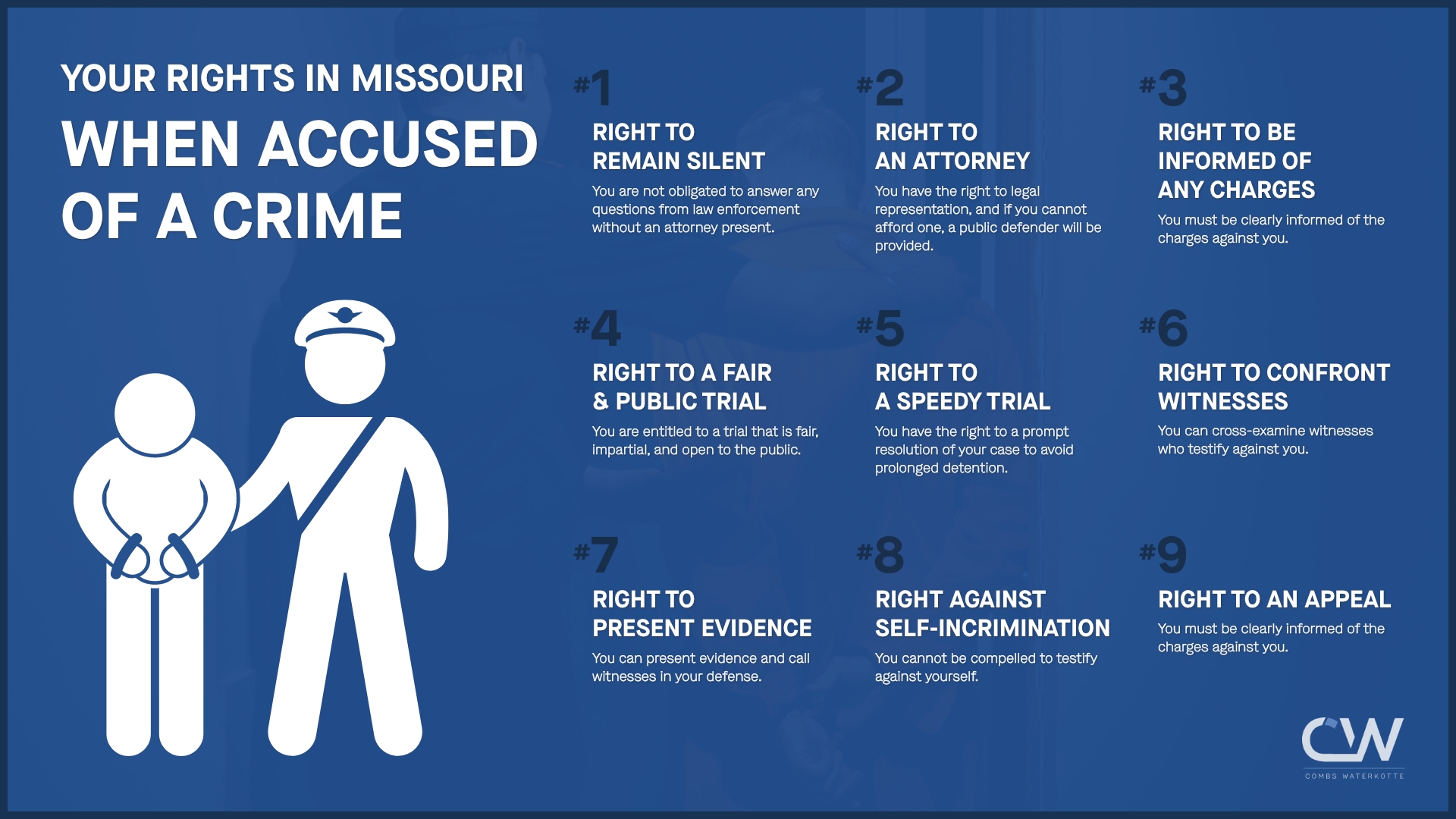
- Invoke your right to remain silent immediately. Do not answer police questions without an attorney present.
- Request a criminal defense lawyer right away. Manslaughter is a serious felony that can carry decades in prison.
- Do not discuss the incident with anyone. This includes friends, family, coworkers, or posts or comments on social media.
- Do not consent to searches. Unless officers have a valid warrant, politely decline any search of your home, phone, or vehicle.
- Preserve potential evidence. Save texts, call logs, photos, video footage, and identify witnesses who may support your defense.
- Strictly comply with bond conditions. Any violation can result in jail and severely harm your case.
- Avoid contact with the alleged victim’s family or witnesses. Even well-intentioned communication can be used against you.
Manslaughter Criminal Defense Strategies in Missouri
Despite the seriousness of a manslaughter charge in Missouri, there are plenty of effective defense strategies a good lawyer can use to help reduce or dismiss your charges or, if necessary, achieve an acquittal at trial.
- Self-Defense / Defense of Others: Missouri law allows the use of reasonable force (including deadly force in certain circumstances) to protect yourself or others from imminent harm. This may apply in some situations of manslaughter accusations.
- Fourth Amendment Violations: If law enforcement conducted an unlawful search or seizure, critical manslaughter evidence may be suppressed.
- Fifth Amendment / Miranda Violations: If statements were obtained in violation of your constitutional rights, they may be excluded from your manslaughter case.
- Lack of Intent: Many manslaughter charges hinge on the defendant’s mental state. If the required intent cannot be proven, the manslaughter charge may be reduced or dismissed.
- Lack of Recklessness: For first-degree involuntary manslaughter, prosecutors must prove conscious disregard of a substantial risk. Mere accident is not enough.
- Absence of Criminal Negligence: For second-degree involuntary manslaughter, the state must prove criminal negligence, not mere carelessness. If they can’t, charges may be reduced or dismissed.
- Causation Challenges: The prosecution must prove your conduct directly caused the death in question. Intervening events, medical complications, or third-party actions may prove it didn’t, making it easier to reduce or even dismiss manslaughter charges.