

DWI Accidents Lawyer Kansas City, MO
Hire the leading DWI Law Firm in Kansas City, MO to protect your driver’s license, freedom, and future. Whether you have been charged with a DWI or arrested, we can help.
TO COMBS WATERKOTTE,YOU ARE WHY WE EXIST.


DWI Accidents Lawyer Kansas City, MO
When the police responding to the scene of an accident accuse you of being intoxicated, you could face mandatory jail time, driver’s license suspension, and a permanent criminal record.
The criminal defense attorneys at Combs Waterkotte have spared our clients over 1 million days of imprisonment thanks to our knowledge and litigation skills. If you’ve been involved in a DWI accident, we can use our decades of experience to fight for your freedom.

I owe my life to Combs Waterkotte. If not for them, I would be spending the rest of my life behind bars. There is no amount of words that can explain what they did for me and my family. Its the highest recommendation that I can give.
Alexander B.
Felonies
Verify on

If I could give Steve and his team 10 stars I would in a heartbeat. Was facing more then one felony charge and after these guys found the arresting officer violated my 4th Amendment Rights and those charges were dismissed. My family and I can't thank you enough.
Dean J
Felonies
Verify on
I was hands down guilty. ON VIDEO !!! In a smaller town, and a job dealing with the public, this was devastating. I made one phone call and spoke for maybe 15 minutes. I DIDN'T appear in court. I am extremely impressed. QUIETLY relieved of the matter!
Y.I.V.
Theft
Verify on
My fiance had a felony drug charge and Combs Waterkotte got it dismissed! There were no fines, court cost, nothing. Chris is loyal, professional, knowledgeable, and a man of his word. We are forever grateful for you.
Kimberly T.
Drug Crimes
Verify on
If I was found guilty, it would have been over 100 years in prison. They promised me that they would fight like hell and get me out of it. After everything was done, I just felt free. Like this wasn’t gonna end with me rotting away in a prison cell. I felt like I could start my life and have a fresh start.
Caleb
Assault 1st, Armed Criminal Action
Verify on
I was facing, probably 18 years… I actually got 5 years probation and 40 hours of community service. Without Combs Waterkotte’s help, I don’t think my family could have made it without me. It was just a written book to where it's a perfect ending.
Chris
Unlawful Use of a Weapon, Armed Criminal Action
Verify on
I went through what was supposed to be one of the top law firms in St. Louis. They said I wouldn't have no chance. I end up firing the other lawyer and everything and going with Chris. I felt like Combs Waterkotte actually did something for me and wasn't I wasn't just another number on somebody's desk.
Willy
DWI/DUI
Verify onI owe my life to Combs Waterkotte. If not for them, I would be spending the rest of my life behind bars. There is no amount of words that can explain what they did for me and my family. Its the highest recommendation that I can give.
Alexander B.
Felonies
If I could give Steve and his team 10 stars I would in a heartbeat. Was facing more then one felony charge and after these guys found the arresting officer violated my 4th Amendment Rights and those charges were dismissed. My family and I can't thank you enough.
Dean J
Felonies
I was hands down guilty. ON VIDEO !!! In a smaller town, and a job dealing with the public, this was devastating. I made one phone call and spoke for maybe 15 minutes. I DIDN'T appear in court. I am extremely impressed. QUIETLY relieved of the matter!
Y.I.V.
Theft
My fiance had a felony drug charge and Combs Waterkotte got it dismissed! There were no fines, court cost, nothing. Chris is loyal, professional, knowledgeable, and a man of his word. We are forever grateful for you.
Kimberly T.
Drug Crimes
If I was found guilty, it would have been over 100 years in prison. They promised me that they would fight like hell and get me out of it. After everything was done, I just felt free. Like this wasn’t gonna end with me rotting away in a prison cell. I felt like I could start my life and have a fresh start.
Caleb
Assault 1st, Armed Criminal Action
I was facing, probably 18 years… I actually got 5 years probation and 40 hours of community service. Without Combs Waterkotte’s help, I don’t think my family could have made it without me. It was just a written book to where it's a perfect ending.
Chris
Unlawful Use of a Weapon, Armed Criminal Action
I went through what was supposed to be one of the top law firms in St. Louis. They said I wouldn't have no chance. I end up firing the other lawyer and everything and going with Chris. I felt like Combs Waterkotte actually did something for me and wasn't I wasn't just another number on somebody's desk.
Willy
DWI/DUI
Consequences of DWI Accidents
Most car crashes don’t carry criminal penalties because they result from simple carelessness or factors outside drivers’ control, such as weather conditions. However, some collisions can result in criminal charges. For example, prosecutors can file charges after incidents involving reckless driving and hit-and-run collisions.

“I am forever grateful to [Combs Waterkotte] for their exceptional service. I was charged with my second DWI and was very scared as to what might happen. [They were] able to get my charged [sic] reduced and my license was not suspended for one day. I would strongly recommend [them] to anyone charged with a DWI.”
-Joe | Combs Waterkotte Client
Some of the most serious traffic offenses occur when drivers cause accidents while intoxicated by drugs or alcohol. An impaired driver may face a sentence of up to life imprisonment, depending on their history of convictions and the outcome of the crash.
Why Combs Waterkotte is the best Law firm for your case.
Real results for people just like you.

DWI Accidents in the Missouri Revised Statutes
The Missouri Revised Statutes include a single law criminalizing driving while intoxicated (DWI), with penalties that vary based on whether a crash occurred.
Missouri’s DWI statute prohibits anyone from operating a vehicle while in an “intoxicated condition,” which means the driver is under the influence of alcohol, a controlled substance, or a combination of drugs and alcohol. The term “influence” means the substance has impaired the driver’s ability to operate a motor vehicle.
This impairment may be physical, mental, or both. Consequently, a police officer may suspect that a driver is intoxicated based on any of the following symptoms:
- Bloodshot eyes
- Slurred speech
- Incoherent, rambling, or confused answers
- Lack of coordination
- Inability to concentrate
A typical DWI case begins with an accident investigation. Since the collision has already occurred, the responding officer wouldn’t need to conduct a traffic stop; the driver should have already stopped at the crash site.
In the course of investigating the accident, the officer may come to believe that a driver was intoxicated based on observations and witness statements. The officer will often try to verify this suspicion by asking the driver to take a field sobriety test.
In Missouri, courts can admit videotaped field sobriety tests as evidence in a DWI trial. This footage is often captured by the officer’s body or dash camera.
Although video evidence can be powerful, it’s circumstantial. It doesn’t show what the accused driver did before or during the accident — it only shows the driver’s condition afterward. For this reason, prosecutors may need additional evidence, such as:
- Statements from passengers in the accused’s vehicle and crash victims who observed the accused’s driving
- Eyewitness testimony from bystanders who saw the accident happen
- Testimony from the investigating officer about the accused’s appearance and condition
Prosecutors can use this and other evidence to build a case that you were operating a vehicle in an impaired condition when the crash occurred. If the evidence persuades a jury beyond a reasonable doubt, the penalties you face will depend on your DWI record and the outcome of the collision.
The Role of Blood Alcohol Testing in DWI Accident Cases
The state has a separate statute that applies to drivers who operate motor vehicles with a blood alcohol content (BAC) over the legal limit. The differences between the excessive BAC and intoxicated driving statutes include the following:
- Prosecutors only need a test result over the limit to win an excessive BAC case
- Prosecutors can obtain an excessive BAC conviction without proof of intoxication
- The punishment for excessive BAC doesn’t vary based on crash outcome
Since excessive BAC cases are easier to prove, an officer in Kansas City who suspects intoxication will often ask the driver to provide a breath, urine, or blood sample.
While failing a chemical test could provide solid evidence in an excessive BAC case, it doesn’t prove impairment for an intoxicated driving charge for the simple reason that a driver could have a high BAC without being impaired. Metabolism, weight, and alcohol tolerance can reduce the effects of alcohol in some people.
Therefore, a driver who fails a BAC test at an accident scene isn’t necessarily at higher risk of an intoxicated driving conviction. Nevertheless, prosecutors will often charge such a driver with both intoxicated driving and excessive BAC. This strategy poses both risks and benefits to those accused of causing DWI collisions.
On one hand, they could face a conviction for excessive BAC even if they successfully defend against the intoxicated driving charges. On the other hand, a skilled criminal defense lawyer might persuade prosecutors to enter into a deal where the intoxicated driving charges are dismissed in exchange for a guilty plea to excessive BAC.
The penalties for excessive BAC don’t escalate with the severity of any resulting crashes. With this type of deal, then, a first-time offender might only receive probation or a short jail sentence, even after causing an accident.
Possible Defenses for DWI Accident Charges in Kansas City, MO
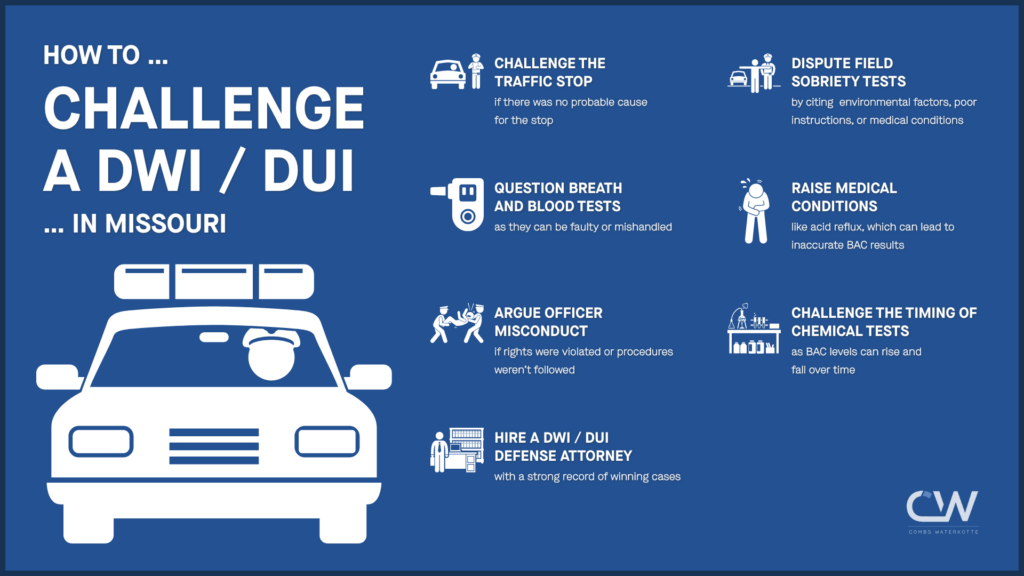
Your criminal defense lawyer may offer any of the following explanations to fight your DWI charges.
There’s Another Reason for a Failed Field Sobriety Test
A driver could fail a field sobriety test for many reasons, including:
- Health conditions, such as balance issues or brain injuries
- Shock or physical injury stemming from the collision
- Prescription medications that cause symptoms unrelated to driving ability
If prosecutors’ only evidence of impairment is that you failed a field sobriety test, you may be able to overcome the charges by citing the distress and trauma of the crash.
You Didn’t Cause the Accident
The police and the prosecution may simply assume that you caused the accident because you showed signs of impairment. However, impaired drivers are sometimes the victims of collisions.
For instance, suppose that the other driver ran a red light while texting and driving. An officer might blame you for the crash because you admitted to having a few drinks. However, your criminal defense attorney may be able to present eyewitness and expert testimony proving that you didn’t cause the collision.
While you could still face intoxicated driving or excessive BAC charges, your lawyer might be able to argue against enhanced penalties for causing a DWI accident.
You Weren’t Operating the Vehicle
One possible alibi that might help you avoid a conviction is that you weren’t the one operating the vehicle. In the confusion after a car accident, a witness may incorrectly identify you as the driver when you were actually just a passenger. Other witnesses and traffic camera footage might help confirm that someone else was doing the driving.
You Were Drugged Involuntarily
It can be difficult to prove a lack of intent in DWI cases. Generally, prosecutors don’t need to prove that you intentionally or knowingly drove while intoxicated.
However, you might have a viable defense if you were intoxicated against your will or without your knowledge. For example, you might be able to show that someone spiked your drink or gave you a cannabis edible without you realizing it.
This defense is more likely to succeed if you were completely unaware that the substance had been used. It may not work if you tasted alcohol in your “non-alcoholic” beverage but kept drinking it anyway.
Penalties Upon Conviction for DWI Accidents in Missouri
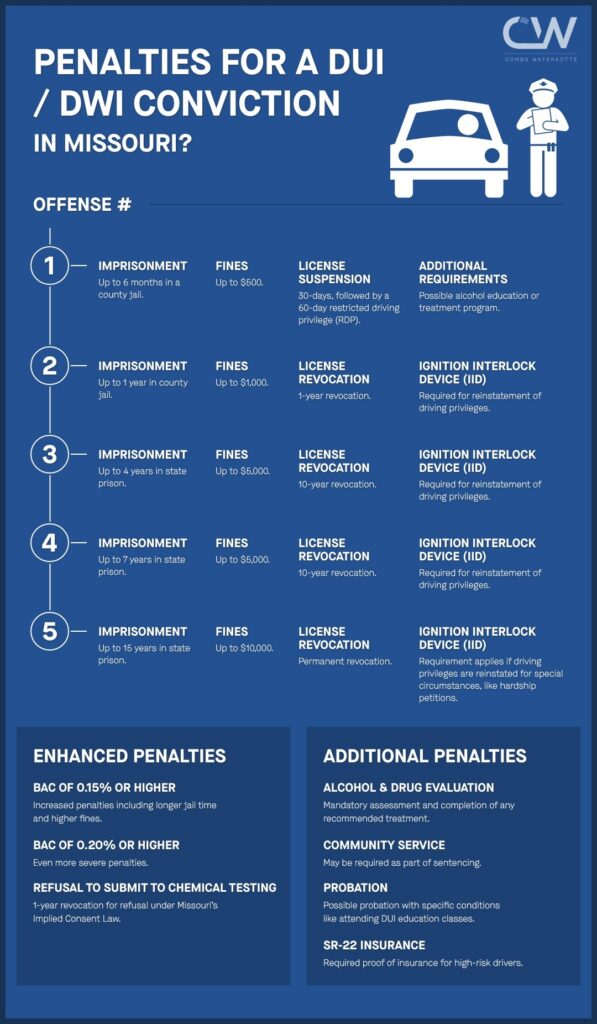
Prosecutors could charge you with a misdemeanor or a felony after a DWI crash, depending on the outcome and your history of DWI accidents.
In defining the crash outcome, the law uses two distinct phrases. “Physical injury” means any impairment in the use or function of a body part or member. Accordingly, a bruise or a concussion could qualify as a physical injury.
A “serious physical injury,” meanwhile, causes any of the following conditions:
- Substantial risk of death
- Serious disfigurement
- Protracted loss or impairment of a body part or its function
Using these definitions, DWI crash charges may fall into the following offense levels.
| DWI Offense | Offense Level |
|---|---|
| Property damage-only DWI crash | Class B or A misdemeanor |
| DWI crash causing physical injury | Class D felony |
| DWI crash causing serious physical injury | Class C felony |
| Fatal DWI crash | Class B felony |
| Fatal DWI crash by a repeat offender | Class A felony |
Why Choose Combs Waterkotte to Fight Your Criminal Charges in Kansas City, MO?

Our attorneys have handled countless DWI cases over their careers. While these charges might seem difficult to successfully challenge, we have the knowledge, skills, and resources to effectively undermine the prosecution’s case and build a solid defense against your DWI charges.


How We Can Defend You Against Charges Arising From a DWI Accident
Understanding what happened from your perspective is our highest priority. Vehicle accidents are complicated events and often result from many factors. When the state blames you for a crash, we may be able to pinpoint other contributing factors that were outside your control, such as another motorist’s actions.


We’ll present compelling evidence (including expert testimony, if applicable) to the prosecution to explain how the collision occurred. Depending on the circumstances, this information may persuade them to dismiss your case or offer a fair plea deal.
If they insist on taking your case to court, we’ll aggressively defend your freedom and reputation before a jury.
Contact Combs Waterkotte for a Rigorous Defense After a DWI Accident
Without the right legal representation, you could face up to life in prison after a DWI accident. Our team can craft a strong defense tailored for your specific situation. Contact us online or at (314) 900-HELP to learn more about how we can uphold your rights.
Resources
For more information on criminal defense in Kansas City or anywhere else in Missouri, call the Combs Waterkotte criminal defense attorneys right away at (314) 900-HELP or contact us online for a confidential consultation.
Hidden Costs of a DWI Conviction in Missouri
Can a DWI/DUI Be Reduced in Missouri?
How Do You Beat a DWI/DUI Charge in Missouri?
Step-by-Step Walkthrough of a Missouri DWI/DUI Traffic Stop
Can You Refuse a Breathalyzer Test?
How does a DUI affect insurance rates?
How long does a DWI or DUI stay on your record?
What Is an Administrative Alcohol Suspension, and How Can I Fight It?

Free book
Don’t “Blow” Your DWI/DUI Case: Key Mistakes to Avoid
Combs Waterkotte, Missouri and Illinois’s leading DWI/DUI law firm, has handled over 10,000 cases successfully. This ebook guides you through the DWI/DUI defense process and helps you avoid key mistakes.

