






Additional Links
- Top 10 Sex Crime Questions
- Can a Sex Crime Conviction be Expunged From My Record in Missouri?
- Can I Be Arrested for a Sex Crime Without Evidence?
- Can Sex Crime Charges Be Dropped?
- Do I Need a Lawyer if I’m Innocent in a Sex Crime Case?
- How Can a Sex Crime Accusation Affect My Employment and Personal Life in Missouri?
- How Can I Clear My Name After Being Falsely Accused Of a Sex Crime?
- If I’m Convicted of a Sex Crime, Do I Have to Register as a Sex Offender?
- Should I Talk to the Police Without a Lawyer if Accused of a Sex Crime?
- What Are My Rights When Accused With a Sex Crime?
1st Degree Child Molestation Attorneys in St. Louis, Missouri
It’s no secret that 1st degree child molestation accusations in the St. Louis area come with a social stigma. As criminal defense lawyers, though, the alleged offense itself is not our concern. At Combs Waterkotte, our primary objective is to provide our clients with the best criminal defense available, no matter the allegation.
1st degree child molestation charges are severe infractions that carry rigid sentences under Missouri law. If you’re facing child molestation allegations in St. Louis, contact Combs Waterkotte online or call us today at (314) 900-HELP.
Every person in St. Louis has a right to a criminal defense, and if you’re facing 1st degree child molestation charges, we want to provide that defense for you. We start each client off with a free consultative conversation to understand your view of the offense. Once we’ve established the facts of the case, our experienced team of lawyers, legal assistants, and paralegals starts to develop the strongest possible defense we can against your charges.
Our goal from the outset is to scrutinize all the available evidence and question police interrogation techniques to reduce or dismiss your charges (or to achieve an acquittal at trial if your case goes that far). So if you’ve been arrested or accused of 1st degree child molestation in St. Louis, Missouri, get in touch with the experienced sex crimes attorneys at Combs Waterkotte as soon as you can.

What Is 1st Degree Child Molestation in St. Louis?
There are plenty of sexual offenses outlined under Missouri law, and a good deal of them have to do with offenses against children. 1st degree child molestation is specifically covered in RSMo §566.067. The statute says a person commits child molestation in the first degree if:
- They subject a person less than 14 years old to sexual contact
- The offense in question is an aggravated offense
Aside from the requirement for the victim to be less than 14 years old, the key terms that constitute 1st degree child molestation in St. Louis are “sexual contact” and “aggravated offense,” both of which have detailed definitions in Missouri’s criminal code.
The Definition of Sexual Contact Under Missouri Law
RSMo §566.010 lays out the definition of sexual contact. It defines the term as:
- Touching another person with one’s genitals
- Touching the genitals, anus, or breasts of another person (including through their clothing)
- Causing semen to come into contact with another person
The most important aspect of the definition of sexual conduct under Missouri law is intent: the touching must have been done for the purpose of arousing or sexually gratifying the perpetrator.
The Definition of Aggravated Sexual Offense Under Missouri Law
Again, RSMo §566.010 defines aggravated sexual offenses under Missouri law. It refers to sexual offenses that involve serious or harmful circumstances, like:
- Causing a serious physical injury to the alleged victim during a sex offense
- Using or displaying a weapon (or something that could be used as one) in a threatening way during a sex offense
- Involving multiple people in the sexual act
- Having a prior conviction for certain sexual offenses or child pornography-related crimes
- Acting as part of a group or coordinated pattern of behavior with multiple participants
- Engages in a sex act with certain family members, including:
- A parent, grandparent, or child (by blood or adoption)
- A stepchild
- A sibling (full or half)
- An aunt, uncle, niece, or nephew
Any of these circumstances in conjunction with sexual contact with a child under 14 constitutes 1st degree child molestation in St. Louis, Missouri.
Offenses Charged Alongside 1st Degree Child Molestation in St. Louis
Oftentimes, 1st degree child molestation is not charged on its own in St. Louis. The offense overlaps with other sexual offenses under Missouri law and, as such, prosecutors tend to stack charges against offenders.
- First degree statutory rape (RSMo §566.032): Having sexual intercourse with someone under the age of 14
- First degree statutory sodomy (RSMo §566.062): Having deviate sexual intercourse with someone under the age of 14
- First or second degree sexual abuse (RSMo §566.100 / RSMo §566.101): Subjecting another person to sexual contact when they don’t consent or are in a compromised condition
- Enticement of a child (RSMo §566.151): Persuading or soliciting a child to engage in sexual conduct (whether in person or online)
Obviously, being convicted of any of these charges in addition to 1st degree child molestation can substantially increase any possible penalties one is likely to face.
Penalties for a 1st Degree Child Molestation Conviction in St. Louis
1st degree child molestation is a felony offense in St. Louis. The act is charged as a Class A felony, a conviction for which carries a prison sentence of 10 to 30 years or even life in prison.
There are also several mandatory minimums that come with a 1st degree child molestation conviction in St. Louis. Child molestation counts as a dangerous felony, a slew of offenses under Missouri law considered to be particularly punitive.
Dangerous felonies trigger Missouri’s so-called 85% rule, a provision in the law that requires a convicted felon to serve at least 85% of their sentence without exception. This means if you receive a 25-year prison sentence for 1st degree child molestation in St. Louis, you’ll have to serve at least 21 years and 3 months before you’re eligible for parole.
A conviction for 1st degree child molestation also requires registration on Missouri’s sex offender registry. RSMo §589.414 notes that 1st degree child molestation is a Tier III sexual offense, requiring a minimum of 25 years on the registry (under RSMo §589.400).
Steps to Take When Facing a 1st Degree Child Molestation Charge in St. Louis
By now, you should understand the gravity of a 1st degree child molestation allegation in St. Louis. That’s why it’s vital to take the appropriate steps to protect yourself and your rights if you’re facing child molestation charges. Combs Waterkotte’s experienced sex offense lawyers suggest doing the following if you’re arrested or charged with 1st degree child molestation.
Do Not Speak to Police or Child Advocacy Investigators
In child molestation cases, investigators are highly trained and often build cases through interviews and statements. Anything you say can be used to support the allegations against you. Politely invoke your Fifth Amendment right not to speak, and request an attorney immediately before participating in an interview or discussion with law enforcement.
Hire a Defense Attorney Experienced in Sex Crime Allegations
1st degree child molestation charges are prosecuted aggressively and often rely on specialized evidence (like forensic interviews). You need an experienced sex crimes attorney who understands how to challenge the evidence. Early involvement allows your lawyer to analyze the allegations, preserve evidence, and intervene before the case progresses further.
Strictly Avoid Any Contact with the Alleged Victim
Child molestation cases almost always involve orders of protection. Even indirect communication through family members or social media can lead to additional charges or bond revocation. This is especially important in cases involving family or household members where accidental contact can still create serious legal problems.
Be Extremely Careful in Any Family or Custody-Related Situations
Many allegations arise from divorce or custody disputes. Do not attempt to resolve the situation on your own. Avoid discussions with the child, the child’s guardians, or other family members about the allegations. Let your attorney handle all communications to avoid misunderstandings or additional accusations.
Preserve All Digital and Communication Evidence
Text messages, social media interactions, emails, and phone recordings are often central in child molestation cases. Do not delete anything. Even content that seems innocuous may provide context or contradict the allegations. Your attorney can use this information to challenge timelines, intent, or credibility.
Document Your Timeline and Interactions with the Alleged Victim
Write down all interactions you’ve had with the alleged victim, including dates, locations, and who else may have been present at the time of the incident. In cases that rely on testimony, establishing inconsistencies or alternative explanations can be critical to your defense.
Stay Off Social Media and Avoid Any Discussion of the Allegations
Prosecutors frequently review online activity in sex offense cases. Posts, messages, or even jokes can be taken out of context and used against you. Do not discuss the case publicly or privately online. The safest course is to avoid social media entirely while your case is pending.
Criminal Defense Strategies Against 1st Degree Child Molestation Charges in St. Louis
Despite the seriousness of a 1st degree child molestation charge in St. Louis, an experienced sex crimes lawyer can still develop a criminal defense strategy to fight the charges. Combs Waterkotte has handled hundreds of these cases over the years. Here are some of the most common defense strategies we use to fight child molestation allegations.
Lack of Sexual Intent
Most of the time, 1st degree child molestation charges hinge on whether the contact was for sexual arousal or gratification. If the alleged touching was accidental, incidental, or misinterpreted, the prosecution may not be able to prove the required intent beyond a reasonable doubt.
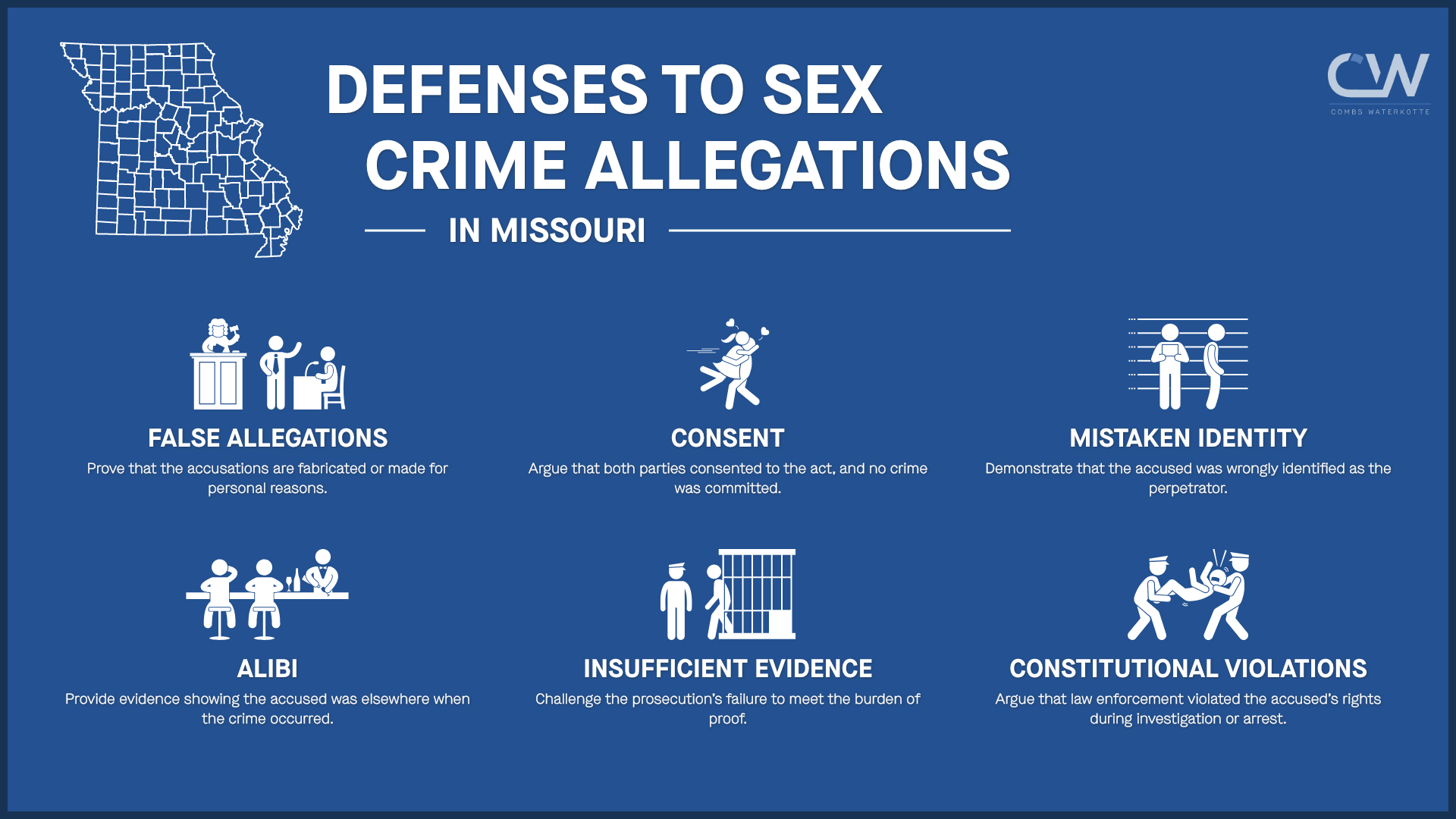
False Allegations or Motive to Fabricate
In some cases, allegations stem from custody disputes, family conflicts, or other outside influences. A defense attorney may investigate whether there is a motive to fabricate or exaggerate claims, including pressure from adults, retaliation, or coaching that may have influenced the allegations.
Challenging Interview Techniques
Child advocacy center interviews are often central to the prosecution’s case. However, these interviews can be flawed if investigators use leading questions, repetition, or suggestions. A defense lawyer may challenge the reliability of the interviews and expose inconsistencies or improper interviewing methods.
Inconsistencies in Statements or Timeline
Child molestation cases usually rely on statements rather than physical evidence. A lawyer will carefully analyze timelines, prior statements, and reports to identify inconsistencies. Even small contradictions can raise reasonable doubt about what actually occurred.
Lack of Physical Evidence
In some instances, there may be little or no physical evidence supporting the child molestation allegations. While not required for a conviction, the absence of medical findings, forensic evidence, or independent witnesses can be used to challenge the strength and reliability of the prosecution’s case.
Illegal Searches and Seizures
If law enforcement obtained evidence (like phones, computers, or personal property) without a proper warrant or probable cause, this may constitute a violation of your Fourth Amendment rights and that evidence may be suppressed. This can significantly weaken the prosecution’s case, especially when digital evidence plays a role in the allegations.
Fifth Amendment and Miranda Rights Violations
If police obtained statements without properly advising you of your rights or through coercive or improper interrogation tactics, those statements may be excluded on the basis of Fifth Amendment or Miranda rights violations. This is especially important in emotionally charged investigations where defendants may feel pressured to explain themselves.
Alibi
If evidence shows you were not present or could not have committed the alleged act, this can be a powerful defense. Phone records, GPS data, surveillance footage, or witness testimony may establish an alibi defense and prove that the allegations were mistaken or factually impossible.
Overcharging or Misclassification of the Offense
Prosecutors may charge 1st degree child molestation based on limited or ambiguous allegations. An attorney can argue that the facts do not meet the legal definition of the first degree child molestation statute, like a lack of “sexual contact” or “aggravated factors.”
In these instances, prosecutors may be forced to reduce the charge to a lesser offense or even dismiss the charge entirely.