

Second Degree Robbery Lawyer Kansas City, MO
Hire the leading second degree robbery defense law firm in Kansas City, MO to protect your freedom, record, and future. Whether you have been charged or are under investigation, we can help.
TO COMBS WATERKOTTE,YOU ARE WHY WE EXIST.


Second Degree Robbery Lawyer Kansas City, MO
A second degree robbery charge in Kansas City, Missouri can lead to years in prison and a Class B felony on your record. You can face this charge even if police didn’t find a weapon and any alleged injuries heal quickly. The best thing to do if you’ve been arrested or charged is to hire an attorney right away.
Combs Waterkotte’s Kansas City criminal defense lawyers are here and ready to defend you. We examine what was allegedly taken, how force was used, whether an injury occurred, and how police identified you. To get started, call (314) 900-HELP now.

I owe my life to Combs Waterkotte. If not for them, I would be spending the rest of my life behind bars. There is no amount of words that can explain what they did for me and my family. Its the highest recommendation that I can give.
Alexander B.
Felonies
Verify on

If I could give Steve and his team 10 stars I would in a heartbeat. Was facing more then one felony charge and after these guys found the arresting officer violated my 4th Amendment Rights and those charges were dismissed. My family and I can't thank you enough.
Dean J
Felonies
Verify on
I was hands down guilty. ON VIDEO !!! In a smaller town, and a job dealing with the public, this was devastating. I made one phone call and spoke for maybe 15 minutes. I DIDN'T appear in court. I am extremely impressed. QUIETLY relieved of the matter!
Y.I.V.
Theft
Verify on
My fiance had a felony drug charge and Combs Waterkotte got it dismissed! There were no fines, court cost, nothing. Chris is loyal, professional, knowledgeable, and a man of his word. We are forever grateful for you.
Kimberly T.
Drug Crimes
Verify on
If I was found guilty, it would have been over 100 years in prison. They promised me that they would fight like hell and get me out of it. After everything was done, I just felt free. Like this wasn’t gonna end with me rotting away in a prison cell. I felt like I could start my life and have a fresh start.
Caleb
Assault 1st, Armed Criminal Action
Verify on

I was facing, probably 18 years… I actually got 5 years probation and 40 hours of community service. Without Combs Waterkotte’s help, I don’t think my family could have made it without me. It was just a written book to where it's a perfect ending.
Chris
Unlawful Use of a Weapon, Armed Criminal Action
Verify on
I went through what was supposed to be one of the top law firms in St. Louis. They said I wouldn't have no chance. I end up firing the other lawyer and everything and going with Chris. I felt like Combs Waterkotte actually did something for me and wasn't I wasn't just another number on somebody's desk.
Willy
DWI/DUI
Verify onI owe my life to Combs Waterkotte. If not for them, I would be spending the rest of my life behind bars. There is no amount of words that can explain what they did for me and my family. Its the highest recommendation that I can give.
Alexander B.
Felonies
If I could give Steve and his team 10 stars I would in a heartbeat. Was facing more then one felony charge and after these guys found the arresting officer violated my 4th Amendment Rights and those charges were dismissed. My family and I can't thank you enough.
Dean J
Felonies
I was hands down guilty. ON VIDEO !!! In a smaller town, and a job dealing with the public, this was devastating. I made one phone call and spoke for maybe 15 minutes. I DIDN'T appear in court. I am extremely impressed. QUIETLY relieved of the matter!
Y.I.V.
Theft
My fiance had a felony drug charge and Combs Waterkotte got it dismissed! There were no fines, court cost, nothing. Chris is loyal, professional, knowledgeable, and a man of his word. We are forever grateful for you.
Kimberly T.
Drug Crimes
If I was found guilty, it would have been over 100 years in prison. They promised me that they would fight like hell and get me out of it. After everything was done, I just felt free. Like this wasn’t gonna end with me rotting away in a prison cell. I felt like I could start my life and have a fresh start.
Caleb
Assault 1st, Armed Criminal Action
I was facing, probably 18 years… I actually got 5 years probation and 40 hours of community service. Without Combs Waterkotte’s help, I don’t think my family could have made it without me. It was just a written book to where it's a perfect ending.
Chris
Unlawful Use of a Weapon, Armed Criminal Action
I went through what was supposed to be one of the top law firms in St. Louis. They said I wouldn't have no chance. I end up firing the other lawyer and everything and going with Chris. I felt like Combs Waterkotte actually did something for me and wasn't I wasn't just another number on somebody's desk.
Willy
DWI/DUI
Second Degree Robbery Charges in Kansas City, MO Explained
The difference between Missouri’s robbery charges comes down primarily to how the theft happened. Second degree robbery requires forcible stealing and physical injury. The value of the property doesn’t determine the charge, and prosecutors don’t have to prove that a weapon was involved.

Call (314) 900-HELP to speak to a Combs Waterkotte defense attorney about your second degree robbery charges. You can also use our online form to get in touch.
The best way to understand what constitutes second degree robbery and the severity of the charge is to compare it with other Missouri theft-related offenses.
Second Degree Robbery vs. First Degree Robbery in Kansas City
Second degree robbery requires someone to cause a physical injury. First degree robbery requires forcible stealing plus one of several other circumstances:
- A serious physical injury
- Being armed with a deadly weapon
- Using or threatening to use a dangerous instrument
- Displaying or threatening to use a weapon or dangerous instrument
- Taking a controlled substance from a pharmacy.
How serious an injury was can determine which robbery charge you face. A serious physical injury involves a substantial risk of death, serious disfigurement, or prolonged loss or impairment of a body function. Second degree robbery requires a physical injury, but not a higher level of harm required under the first degree robbery statute.
Robbery vs. Stealing
Ordinary Missouri theft charges involve intentionally taking another person’s property without consent or through deceit or coercion. Robbery adds force or threats of force tied to taking or keeping the property. The Missouri stealing statute often bases stealing penalties on the property’s value or type, while robbery focuses on how the theft happened and whether someone was injured.
Robbery vs. Burglary
Burglary involves unlawfully entering a building or inhabitable structure with the intent to commit a crime inside. It doesn’t require a completed theft, force against another person, or an injury. You may, however, still face both charges if prosecutors allege an unlawful entry followed by a robbery.
Why Combs Waterkotte is the best Law firm for your case.
Real results for people just like you.

Missouri’s Second Degree Robbery Statute Explained
RSMo §570.025 defines second degree robbery as forcibly stealing property and causing a physical injury to another person in the process. Prosecutors have to prove both of these elements in order for an individual to be convicted.
The State Must Prove Theft
Before prosecutors can prove robbery, they have to prove stealing. That means taking another person’s property or services with the intent to deprive the owner, without consent or through deceit or coercion. A misunderstanding, a dispute over shared property, or accidental possession may not establish that intent.
The State Must Prove Immediate Force
RSMo §570.010 defines “forcibly steals” as using physical force against another person or threatening its immediate use for either of these reasons:
- To prevent or overcome resistance to taking the property
- To make the owner hand over the property or do something that helps complete the theft
A threat of future harm may also support a stealing charge based on coercion, but it doesn’t necessarily meet robbery’s requirement of immediate force. And a fight over something unrelated doesn’t become a robbery charge just because property changed hands during the encounter.
The State Must Prove an Injury and Its Cause
Missouri’s criminal-code definitions describe a “physical injury” as a slight impairment of a bodily function or a temporary loss of use of any body part. This is a lower threshold than the “serious physical injury” that can support first degree robbery. However, prosecutors still have to show an injury occurred in order to charge second degree robbery.
Prosecutors may use photos, medical records, videos, witness accounts, and the alleged victim’s testimony to prove an injury. We look at whether the act meets the legal definition of robbery and whether the robbery actually caused the injury. A preexisting condition, a later incident, conflicting accounts, or a lack of impairment may undermine the prosecution’s charge.
Defense Strategies for Second Degree Robbery Charges in Kansas City
To combat robbery allegations, we review the evidence for weaknesses in the charge and the police investigation. Records, witnesses, expert opinions, and constitutional challenges may all help your defense. The following are some of the criminal defense strategies we may use.
Mistaken Identity or Alibi
A witness who saw someone briefly, under stress, or in poor lighting may make an honest mistake. Masks and suggestive police procedures can also make an identification unreliable. We compare descriptions, review surveillance, check phone and location records, and investigate other possible suspects. Receipts, work logs, videos, or witnesses may support an alibi defense.
Lack of Intent to Steal
You may have believed the property was yours, received it from someone else, intended only to borrow it, or never had control of it at all. A lack-of-intent defense challenges the “intent to deprive property” part of the charge before questions about force or an injury ever even come up.
No Connection Between Force and Theft
A fight and a property dispute can happen at the same time without amounting to robbery. We reconstruct your encounter to determine when the property was taken or kept, why force was used, and whether that force served any of the purposes required by the statute.
Challenge the Injury and Its Cause
Medical records or photos can help shed light on the real extent of an injury. Video evidence may show that the injury wasn’t even caused by you. We compare the initial report with later statements and consult medical professionals when necessary. If prosecutors can’t prove the required injury and its connection to the alleged robbery, the second degree charge may not stand (even if a property dispute remains).
Suppress Unlawfully Obtained Evidence
Police must respect the Fourth Amendment when stopping a suspect, entering a home, taking a phone, or searching a car. We review warrants, Miranda warnings, police questioning, and identification procedures for potential violations. A successful motion to suppress may keep statements, clothing, phone data, or other evidence out of the prosecution’s case.
Possible Penalties for Second Degree Robbery in Missouri
Second degree robbery is always a Class B felony in Kansas City, Missouri. Under RSMo §558.011, the prison range for a conviction is 5 to 15 years. The court may also order restitution to cover property loss, medical bills, or other legally recoverable losses, along with court costs.
Other elements of the offense may result in lack of parole eligibility or longer prison sentences.
Second Degree Robbery Is Not Automatically Subject to the 85% Rule
Missouri lists first degree robbery as a dangerous felony, but not second degree robbery. That means a second degree robbery conviction doesn’t automatically require you to serve 85% of your sentence before becoming eligible for parole. Your parole eligibility will depend on the offense date, consecutive sentences, prison rules, and any other convictions.
Probation may be available in a second degree robbery case, but eligibility doesn’t mean a judge will grant it. The alleged injuries, your criminal history, the effect on the victim, any plea terms, and local sentencing practices can all affect the decision.
Prior Convictions Can Mean a Longer Sentence
RSMo §558.016 allows a longer sentence when the court finds that someone is a persistent or dangerous offender. Under the statute, a persistent offender includes:
- A person with two or more prior felonies committed at different times
- One prior dangerous felony conviction
Prior convictions can potentially raise the sentencing range for a Class B felony from 5 to 15 years to 10 to 30 years in prison. Prosecutors must allege and prove the facts required in order to increase your sentencing range.
Why Choose Combs Waterkotte for a Kansas City Second Degree Robbery Case?

Combs Waterkotte has handled more than 15,000 criminal cases. We have more than 60 years of combined experience among our attorneys. We’ve defended Missouri felony robbery cases involving disputed eyewitness accounts, contested injuries, extensive digital evidence, and accusations that several people acted together.
As a trial-ready criminal defense firm, we prepare to challenge weak evidence, argue motions, and negotiate for a fair result. When going to trial is the best choice, we’ll be ready to present your defense to a jury. You’ll receive direct communication and honest advice about your risks, your options, and what comes next.


No lawyer can promise a dismissal, reduced charge, or acquittal. What we can offer is meticulous attention, a thorough investigation, and attorneys who take your defense incredibly seriously.
How Combs Waterkotte Will Take On Your Second Degree Robbery Charges
When we take on your case, we start preserving evidence and examining the prosecution’s case. Depending on the circumstances, our work may include:
- Gathering evidence: Obtaining police reports, dispatch recordings, body cam and surveillance footage, photos, medical records, warrants, and digital evidence
- Reconstructing what happened: Tracing when the property was taken, when force was used, and when the injury occurred
- Checking witness identifications: Comparing descriptions, reviewing lineups, locating witnesses, and checking phone or location evidence against the accusation
- Examining the injury claim: Reviewing medical records, preexisting conditions, photos, and changing accounts to determine what caused the alleged injury
- Preparing for negotiations or trial: Filing motions, weighing any plea offer against the possible penalties, and preparing witnesses and exhibits for trial.

Read More:

We’ll also explain bond conditions, court dates, and communications that could hurt your case and that you should avoid. Getting us involved early gives us more time to preserve video, locate helpful witnesses, and speak with the prosecutor before decisions become harder to change.
Contact a Second Degree Robbery Lawyer in Kansas City Today
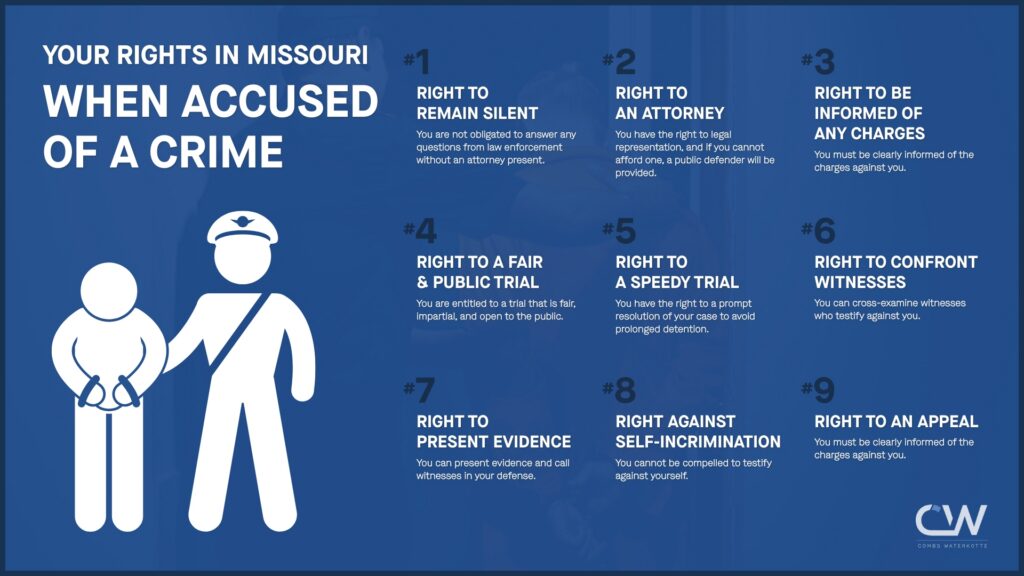
If police want to question you about a robbery, don’t assume you can clear things up on your own. You have the right to remain silent and ask for a lawyer, and you absolutely should. If charges have already been filed against you, your attorney can begin preserving evidence and challenging the case right away.
Contact Combs Waterkotte online today or call us at (314) 900-HELP for a confidential consultation about your second degree robbery charge in Kansas City. We’ll listen to what happened, explain the possible consequences and next steps, and start building a defense focused on your freedom and future.
Resources
For more information on criminal defense in Kansas City or anywhere else in Missouri, call the Combs Waterkotte criminal defense attorneys right away at (314) 900-HELP or contact us online for a confidential consultation.
What To Do If I’m Wanted For Questioning in Missouri
How Does Probation Work in Missouri?
What Are My Rights When Charged With a Crime in Kansas City?
Free book
How a Criminal Defense Attorney Can Protect Your Rights and Future
Combs Waterkotte has over 80 years of experience and over 10,000 cases handled. This ebook helps guide you through the criminal defense process and how an experienced, skilled defense attorney can keep your freedoms intact.

