Defendants charged with a crime in Kansas City face the full power and resources of the state or federal government. However, the criminal justice system has several built-in protections to provide a fair process.
The attorneys at Combs Waterkotte have over 100 years of experience protecting the rights of those accused of crimes. We defend clients by identifying possible rights violations and advocating aggressively for their interests.
Contact us online or at (314) 900-HELP to learn more about how we can help you if you’re facing Kansas City criminal charges.
This article covers the following topics:
- Where your rights as a criminal defendant come from
- The specific rights you have during a criminal prosecution
- How you and your lawyer can assert and defend your rights
Sources of Rights That Protect Criminal Defendants in Kansas City, MO
Legal protections for criminal defendants come from many sources. Many of the most valued rights arise from English and American common law. For example, the burden of proof for a conviction is a longstanding tradition adopted from English law.
Another source of legal rights comes from the U.S. Constitution. Both the body of the Constitution and its various amendments protect the rights of people charged with a crime in Kansas City. One of the most important rights, due process, is codified in the Constitution.
Finally, Missouri’s constitution and statutes define the rights of criminal defendants facing prosecution in the state. For example, the state determines the statute of limitations for prosecuting crimes and the procedures for turning evidence over to the defendant’s legal team.
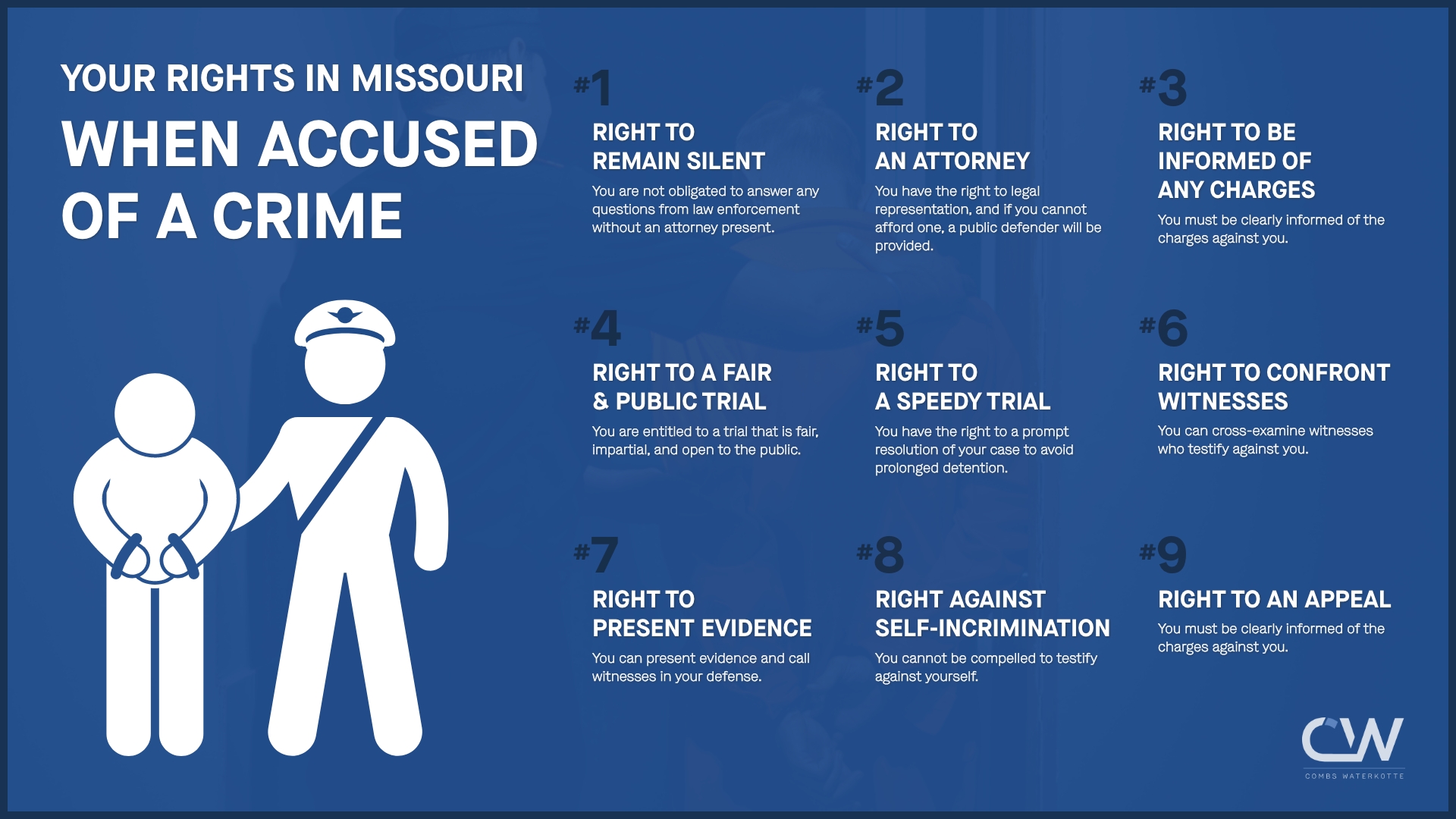
Rights You Have When Charged With a Crime in Kansas City
Here are some of the notable rights you have after prosecutors file charges:
Right to Due Process of Law
The Constitution guarantees your right to due process of law. This right has two aspects. First, you’re entitled to know the charges against you. A judge will formally read your charges during your arraignment.
Second, you have the right to present a criminal defense against those charges. In other words, the court cannot simply jump from the accusation to the punishment. You have the prerogative to dispute the case against you.
Right to Legal Representation
The Constitution also guarantees the right to the assistance of counsel. The court cannot deny you a lawyer if you want one. Moreover, the police must inform you about your right to a lawyer when they issue the Miranda warnings after your arrest.
Right to Reasonable Bail
Under the Constitution, the court cannot impose excessive bail. However, the Constitution gives states broad authority to interpret the bail clause.
Under Missouri law, courts grant bail or a release by considering the defendant’s flight risk, danger to others, and history of missing court. Additionally, a court can set higher bail or deny bail for certain violent crimes and sex crimes.
Right to the Presumption of Innocence
Two key elements of a criminal trial originate from the common law. These rules aren’t written; instead, they derive from English and American legal traditions.
First, you have the right to be presumed innocent. This means that the prosecution bears the burden of proving your guilt. If they can’t prove every element of the charged offense, you must be acquitted.
Second, prosecutors must prove the elements of an offense beyond a reasonable doubt. This evidentiary standard means that jurors can’t vote to convict if they harbor any doubt based on common sense or reason.
Right to a Jury Trial
The same Constitutional amendment that guarantees the right to the assistance of counsel also guarantees the right to a speedy trial by jury. The speedy trial clause prevents prosecutors from charging and jailing you, then leaving you there indefinitely.
The jury trial clause of the U.S. Constitution guarantees a jury trial anytime someone faces charges for an offense that carries a punishment of more than six months of incarceration. Thus, you have a right to trial by jury in all felony cases and the most serious misdemeanor cases.
The Missouri Constitution extends the right to a jury trial to all misdemeanor and felony prosecutions, excluding only minor infractions and violations of municipal ordinances.
Right to See Evidence and Cross-Examine Witnesses
The confrontation clause of the Constitution gives criminal defendants the right to see the evidence against them. Missouri enforces this right through discovery rules that require prosecutors to turn over all of their evidence to the defendant and their legal representative. This allows them to prepare a defense.
At trial, you have the right to cross-examine the witnesses against you. Cross-examination can reveal gaps in their testimony that may raise a reasonable doubt.
Suppose that an expert witness testifies that your financial records prove that you embezzled from your employer. Your lawyer could cross-examine them to prove that the deposits came from other sources, such as an inheritance or a second job.
Right to Be Free From Unreasonable Searches and Seizures
Once you’ve been charged with a crime in Kansas City, you can challenge how the police gathered the evidence used to prosecute your case. Per the Constitution, the police need a search warrant or proof that the search falls under a warrantless exception.
For example, in a prosecution for gun charges, you could challenge the search that recovered the illegal weapon if officers looked in your backpack without a warrant or probable cause to believe that you had committed a crime.
How a Kansas City Criminal Defense Lawyer Can Assert Your Rights
In most cases, your lawyer will exercise your rights in court. During the pretrial and trial phases of your case, they can file motions with the judge, who is supposed to act impartially in deciding the motions. In other words, the judge must ignore their biases and beliefs and apply the law as interpreted in precedential cases.
Sometimes, a trial judge may decide a motion inappropriately. If you’re eventually convicted, you can file an appeal to have an appeals court review and correct the judge’s incorrect decision.
Contact Combs Waterkotte if You’ve Been Charged With a Crime in Kansas City, MO
The law protects your rights to fair treatment, but you must know about these rights to assert them effectively. Contact Combs Waterkotte by calling (314) 900-HELP or filling out our online contact form to schedule a consultation with an experienced criminal defense attorney and discuss your rights in greater detail.