Federal felony lawyers Wisconsin. Facing a federal felony charge places you in one of the most serious legal situations imaginable. With federal prosecutors wielding expansive power, the full resources of the United States government are aligned against you, and a conviction can permanently impact your life. If you are facing charges or believe federal authorities may be investigating you, partnering with experienced Wisconsin federal felony lawyers is critical to defending your rights, your freedom, and your future.
Combs Waterkotte defends individuals facing federal felony charges in U.S. District Courts. Our Wisconsin federal criminal defense lawyers understand how federal cases are built, how prosecutors apply federal statutes, and how high the stakes are for people facing these charges. We combine expert, aggressive, and strategic legal defense while remaining mindful of the emotional and personal strain federal felony cases place on our clients and their families.
When you work with our Wisconsin federal felony lawyers, you work with a firm that sees you as more than just a file or case number. Reach out by calling (314) 900-HELP or contact us online to arrange a free, private consultation.
Access our Guide to Federal Felony Charges.
This page outlines:
- The key differences between federal felony charges and state criminal offenses
- How federal felony investigations and prosecutions typically unfold
- Common types of federal felony charges
- How experienced federal felony lawyers approach defense strategy
- The possible penalties and lasting consequences of federal felony convictions
- How experienced legal counsel can impact outcomes in federal court
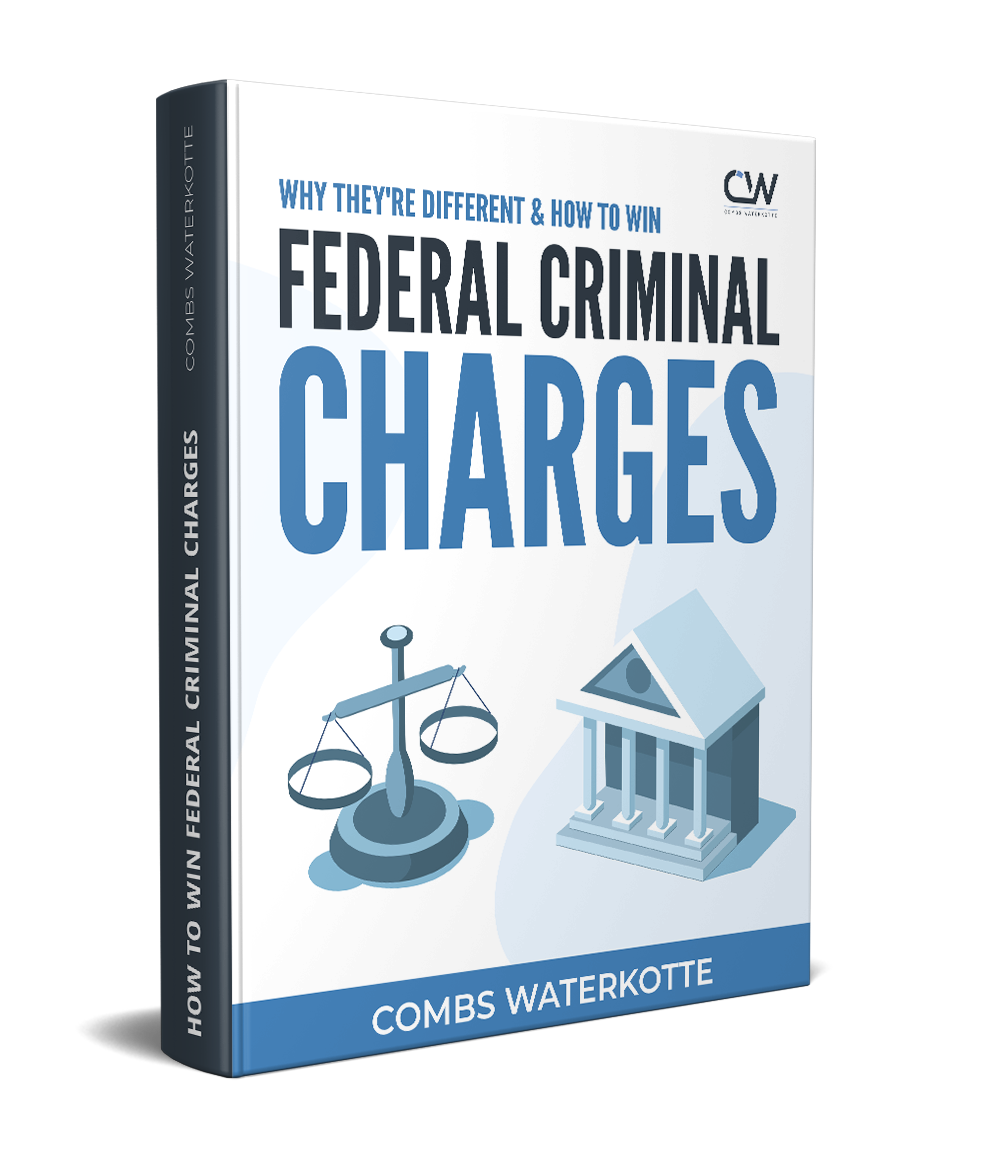
Free book
Facing Federal Criminal Charges? Why They’re Different and How to Win
Combs Waterkotte, a leading federal criminal defense law firm, has handled over 10,000 cases successfully. This ebook guides you through the federal criminal defense process, how federal charges are different, and how to win.
What Is a Federal Felony?
A federal felony involves criminal allegations prosecuted under United States federal law, not state law. These charges apply when alleged offenses trigger federal jurisdiction, such as cases involving interstate commerce, federal agencies, federal property, or laws enacted by the U.S. Congress.
Federal felonies differ from state charges not just in who brings the case, but in the seriousness of the penalties involved. Federal felony statutes often include mandatory minimum sentences, steep financial penalties, and long-term repercussions beyond imprisonment. Compared to state courts, federal judges are often restricted in their sentencing discretion once a guilty verdict is entered.
How Federal Felony Cases Differ From State Charges in Wisconsin
While state and federal charges may arise from similar conduct, they function very differently in real-world practice. In practice, federal felony cases usually involve more complexity, heavier documentation, and stricter procedures than state cases.
Federal felony matters often involve:
- Prolonged investigations that can take months or even years before charges are issued
- Formal charges issued through grand jury indictments instead of direct filings
- Evidence collected by agencies such as the FBI, DEA, ATF, IRS, or Homeland Security
- Strict evidentiary rules that regulate how evidence is gathered, disclosed, and litigated
- Mandatory minimum penalties and structured federal sentencing guidelines
Federal prosecutors often rely on financial records, electronic communications, surveillance, and cooperating witnesses to build their cases. Because of this, defending a federal felony charge requires a close review of how evidence was gathered, whether constitutional rights were respected, and how the law is being applied—often long before a case ever goes to trial.
Federal Felony Charges Our Wisconsin Defense Attorneys Handle
Federal felony cases cover a wide range of allegations, and the type of charge involved often determines how a case is investigated, prosecuted, and sentenced. Federal prosecutors rely on specific statutes to define these offenses and to structure indictments, plea negotiations, and sentencing exposure.
Our federal felony lawyers in Wisconsin represent clients facing a wide range of federal charges, including the following:
White Collar & Financial Crimes
White collar federal cases frequently center on allegations of fraud or financial wrongdoing supported by extensive document review, financial analysis, and electronic communications.
- Wire fraud (18 U.S.C. § 1343) — alleged misuse of electronic communications as part of a fraud scheme
- Mail fraud (18 U.S.C. § 1341) — alleged use of the postal system in connection with a fraud scheme
- Bank fraud (18 U.S.C. § 1344) — alleged fraud involving a financial institution
- Money laundering (18 U.S.C. § 1956, § 1957) — financial transactions tied to alleged unlawful proceeds
- Securities and investment fraud — claims that investors were misled through false or deceptive information
These cases often hinge on intent, context, and how prosecutors interpret complex transactions.
Federal Drug Offenses
Federal drug prosecutions often involve allegations of interstate activity, large quantities, organized distribution, or conspiracy-based charging.
- Drug distribution/trafficking (21 U.S.C. § 841) — accusations related to producing, distributing, or intending to distribute drugs
- Drug conspiracy (21 U.S.C. § 846) — alleged involvement in a coordinated plan to commit drug offenses
- Importation-related drug offenses (21 U.S.C. § 952, § 960) — alleged importation or related conduct
Investigations may involve informants, monitoring, intercepted communications, and multi-party indictments.
Firearms & Weapons Charges
Federal firearms offenses may be charged independently or in combination with other federal felony allegations, frequently carrying sentence enhancements.
- Unlawful possession of a firearm (18 U.S.C. § 922) — accusations of firearm possession when federal law prohibits ownership
- Possession of a firearm in furtherance of a felony (18 U.S.C. § 924) — claims that a firearm was possessed or used to advance another felony offense
- Straw purchase-related allegations (18 U.S.C. § 922) — accusations of buying or transferring a firearm on behalf of someone else
These cases often turn on possession, knowledge, and the government’s theory connecting the firearm to alleged criminal conduct.
Sex Crimes & Internet Offenses
Federal sex crime cases are pursued aggressively by prosecutors and commonly depend on digital data, internet activity, and forensic review.
- Sexual exploitation of a minor (18 U.S.C. § 2251) — allegations of creating or producing unlawful sexual content
- Possession of child pornography (18 U.S.C. § 2252) — allegations that illegal images or videos were found in a person’s possession
- Distribution of child pornography (18 U.S.C. § 2252) — accusations of sharing, sending, or making illegal material available to others
- Online enticement or exploitation offenses — allegations involving digital communications for unlawful purposes with minors
Defense strategies commonly focus on how electronic evidence was gathered, how devices were examined, and how online conduct is characterized.
Conspiracy & Multi-Defendant Federal Cases
Federal conspiracy charges are often used to bring multiple people into the same case, even when prosecutors cannot show that each person personally committed every alleged act. In conspiracy cases, prosecutors argue that legal responsibility arises from knowingly cooperating with others toward an unlawful objective.
- Federal conspiracy (18 U.S.C. § 371) — claims that an individual knowingly participated in a plan to commit a federal offense
- Drug conspiracy (21 U.S.C. § 846) — accusations of working with others in a drug-related conspiracy
- RICO offenses (18 U.S.C. §§ 1961–1968) — claims that an individual took part in an ongoing criminal organization
Federal conspiracy prosecutions frequently depend on circumstantial evidence, recorded communications, and cooperating witness testimony. Because these cases can be built on inference rather than direct proof, carefully examining credibility, intent, and the scope of alleged involvement is a critical part of the defense.
Cybercrime, Identity Theft & Computer Offenses
These federal cases commonly involve allegations concerning computers, internet activity, or digital data subject to federal jurisdiction.
- Computer fraud or unauthorized access (18 U.S.C. § 1030) — accusations of improper or unauthorized access to digital systems
- Identity theft (18 U.S.C. § 1028) — claims involving unauthorized use of another person’s identifying information
- Aggravated identity theft (18 U.S.C. § 1028A) — identity theft counts imposed in connection with a separate federal felony
Defense strategies frequently focus on how digital evidence was gathered, analyzed, and interpreted by investigators.
Federal Tax Crimes
These cases generally involve accusations of intentional tax law violations rather than clerical errors or reasonable disputes with the IRS.
- Tax evasion (26 U.S.C. § 7201) — allegations of willfully avoiding payment of legally owed taxes
- Filing false returns or statements (26 U.S.C. § 7206) — allegations of knowingly providing false or misleading information on tax documents
These cases often involve lengthy IRS investigations, detailed review of financial records, and attempts by prosecutors to reconstruct income, expenses, and transactions over time.
- Health care fraud (18 U.S.C. § 1347) — accusations of fraudulent billing or payment practices involving federal health care programs
- False statements to the government (18 U.S.C. § 1001) — accusations of providing inaccurate information during federal inquiries
- Kickback-related allegations (42 U.S.C. § 1320a-7b) — claims involving unlawful payments tied to referrals or federally funded services
These cases demand close examination of documentation, evaluation of intent, and understanding of intricate federal program requirements.
Federal Violent Crimes & Interstate Offenses
Some violent or serious offenses are handled in federal court due to interstate conduct, cross-border activity, or applicability of federal statutes.
- Hobbs Act robbery (18 U.S.C. § 1951) — accusations of robbery or extortion that allegedly affected interstate business or commerce
- Federal kidnapping (18 U.S.C. § 1201) — allegations that a kidnapping offense fell under federal jurisdiction
These prosecutions often expose defendants to significant penalties, with sentencing influenced by mandatory minimums and enhancement provisions.
Obstruction, False Statements & “Process Crimes”
These federal cases often involve charges tied to investigative conduct, regardless of whether the underlying allegations are proven. These allegations can significantly increase potential penalties.
- Obstruction of justice (18 U.S.C. § 1503, § 1512) — allegations of conduct intended to interfere with legal proceedings or witnesses
- False statements (18 U.S.C. § 1001) — allegations of giving incorrect or misleading information to federal investigators
These allegations often emerge quickly in federal cases, underscoring the importance of early legal representation.
How Wisconsin Federal Felony Lawyers Build a Defense
Federal felony cases require a methodical and strategic defense process. Our approach begins with a thorough review of the government’s case by our federal felony defense lawyers in Wisconsin.
Preparing a federal felony defense often involves:
- Examining the indictment and the statutes alleged to apply
- Reviewing law enforcement tactics for possible constitutional issues
- Seeking suppression of improperly obtained evidence
- Reviewing guideline-based sentencing exposure
- Preparing for litigation, negotiations, or trial proceedings
Each federal felony case presents unique facts and challenges. Our goal is to build a defense strategy that reflects the facts of your specific case, the applicable law, and the long-term interests of the client.
Federal Felony Classifications Under Federal Law
Under the federal system, felonies are organized into classifications tied to the maximum statutory penalties. The framework for these classifications appears in Title 18 of the United States Code, which organizes federal offenses by severity.
Federal felonies are divided into five classes, ranging from Class A (the most serious) to Class E (the least severe among felonies).
- Class A felonies — offenses subject to life sentences or, in rare cases, the death penalty
- Class B felonies — crimes carrying maximum penalties of twenty-five years or longer
- Class C felonies — offenses subject to sentences ranging from ten to under twenty-five years
- Class D felonies — felonies punishable by sentences ranging from five to under ten years
- Class E felonies — felonies punishable by prison terms greater than one year but under five years
While this classification system helps define the outer limits of punishment, federal sentencing is not determined by felony class alone. In practice, sentences are driven by the specific statute of conviction, any applicable mandatory minimums, and the federal sentencing guidelines, which account for factors such as offense conduct and criminal history.
Potential Penalties for Federal Felony Convictions in Wisconsin
A federal felony conviction can impact far more than incarceration alone, affecting many areas of a person’s life. The penalties imposed vary by charge and circumstances, but may include the following:
- Extended federal prison terms
- Large fines and court-ordered repayment of money
- Supervised release requirements after serving a prison sentence
- Loss of firearm ownership rights and other civil liberties
- Long-term damage to career opportunities, licenses, and reputation
Federal sentencing rules allow limited flexibility, making early involvement by an experienced Wisconsin federal felony lawyer critical to limiting potential consequences.
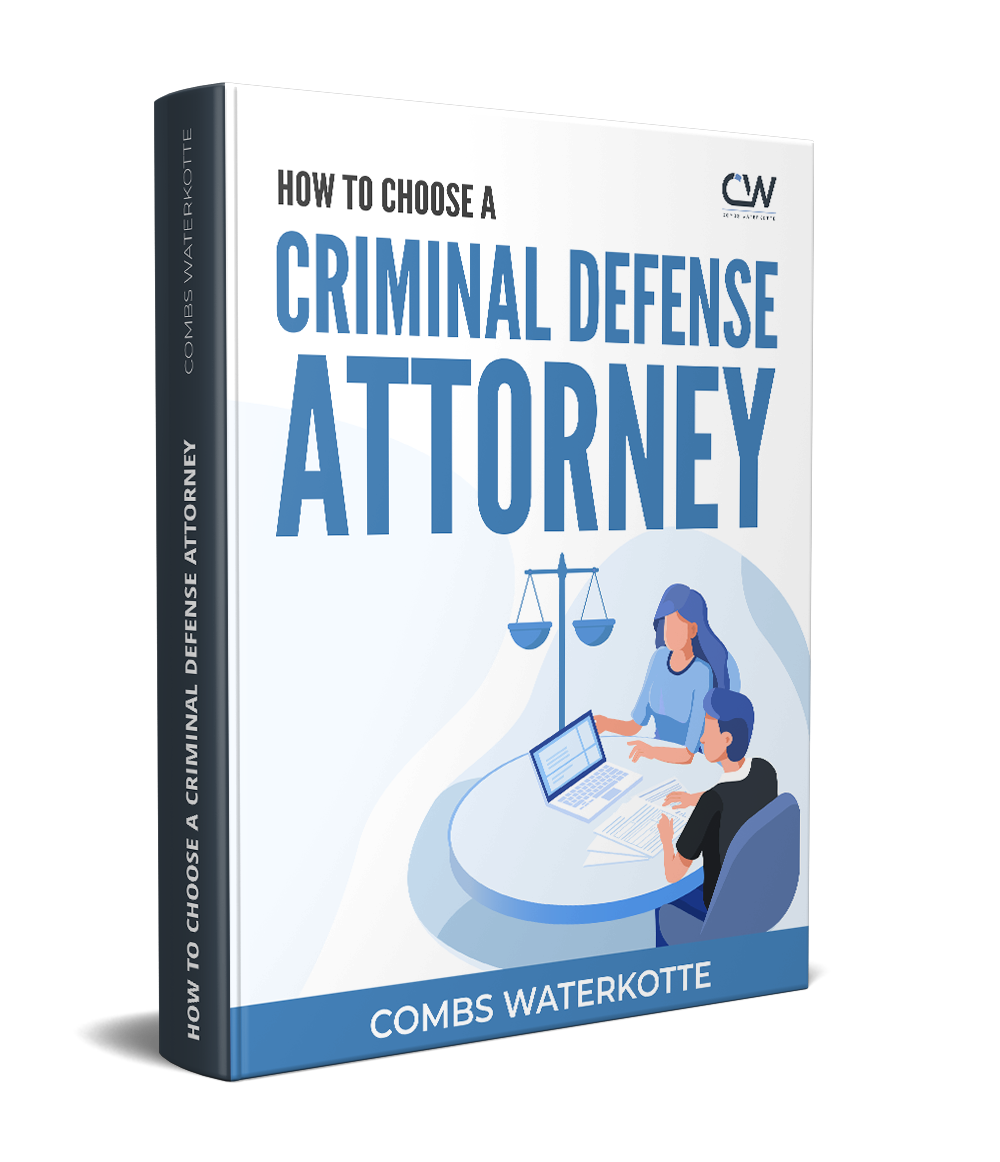
Free book
How to Choose a Criminal Defense Lawyer
Charged with a crime? The lawyer you hire matters. Combs Waterkotte, recognized for top-tier criminal defense in Missouri and Southern Illinois, created this guide to help you find the right attorney. Learn what to look for, key questions to ask, and red flags to avoid.
Why Clients Trust Combs Waterkotte’s Wisconsin Federal Felony Lawyers
When federal charges are involved, you need legal representation that understands federal law, federal courts, and how to stand up to the resources of the U.S. government.
Our clients trust Combs Waterkotte for the following reasons:
- Dedicated experience handling federal felony cases
- Carefully tailored defense strategies for every client
- Straightforward and transparent communication at every stage
- Availability at all hours to discuss your case
- Empathetic advocacy and a willingness to fight for our clients
- Representation that treats you as an individual, not a file
Understanding the gravity of these cases, we treat every federal felony matter with the utmost seriousness.
Speak With Our Wisconsin Federal Felony Lawyers Today
Anyone facing federal felony allegations should act quickly to secure legal representation. Early guidance can help you understand your options and make decisions that protect your long-term interests.
For a confidential conversation about your case, call (314) 900-HELP or contact Combs Waterkotte online to speak with experienced federal felony lawyers ready to fight for your rights.