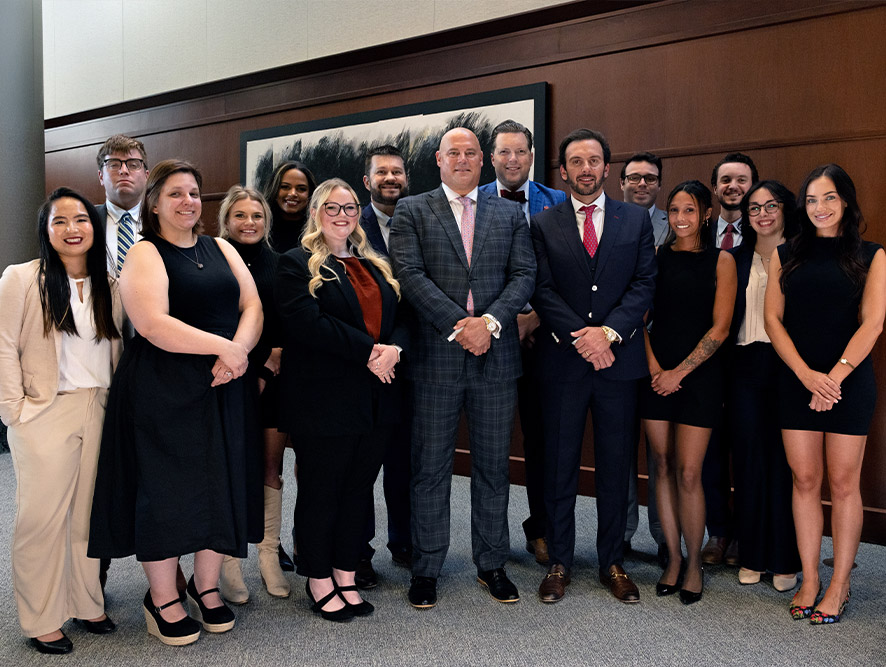
Federal felony lawyers Florida. When federal felony allegations arise, the legal consequences can be immediate and overwhelming. Federal prosecutors have broad authority, you have the force of the full United States government working against you, and convictions can carry life-altering consequences. Whether formal charges have already been filed or you suspect a federal investigation is underway, experienced Florida federal felony lawyers play a critical role in safeguarding your rights, your liberty, and your long-term interests.
Combs Waterkotte provides legal representation to individuals accused of federal felony offenses in U.S. District Courts. Our Florida federal criminal defense lawyers recognize how federal cases take shape, how aggressively prosecutors pursue convictions, and the gravity of these charges. Our approach blends experienced, assertive, and strategic advocacy with a clear understanding of the stress federal felony cases place on clients and their families.
When you hire our Florida federal felony lawyers, you hire a firm that treats you as a person, not a case number. You may contact us by phone at (314) 900-HELP or contact us online to request a free, confidential consultation.
Access our Guide to Federal Felony Charges.
This page outlines:
- An explanation of federal felony charges and how they differ from state-level crimes
- How federal authorities investigate and prosecute felony cases
- Common types of federal felony charges
- How experienced federal felony lawyers approach defense strategy
- The possible penalties and lasting consequences of federal felony convictions
- The importance of skilled legal representation in federal court
Free book
Facing Federal Criminal Charges? Why They’re Different and How to Win
Combs Waterkotte, a leading federal criminal defense law firm, has handled over 10,000 cases successfully. This ebook guides you through the federal criminal defense process, how federal charges are different, and how to win.
What Is a Federal Felony?
A federal felony is a criminal offense prosecuted under United States federal law rather than state law. These cases arise when alleged crimes fall under federal jurisdiction, such as crimes involving interstate commerce, federal agencies, federal property, or violations of specific statutes enacted by the U.S. Congress.
Federal felonies are distinguished not only by who prosecutes them, but by the severity of potential punishment. Federal felony statutes often include mandatory minimum sentences, steep financial penalties, and long-term repercussions beyond imprisonment. In contrast to many state-level cases, federal judges frequently have little discretion in sentencing after a conviction.
How Federal Felony Cases Differ From State Charges in Florida
Although state and federal criminal charges often involve the same crimes, they operate very differently in practice. In practice, federal felony cases usually involve more complexity, heavier documentation, and stricter procedures than state cases.
Federal felony prosecutions frequently involve:
- Long-term investigations that may span months or years before formal charges are brought
- Grand jury indictments rather than direct charging instruments
- Cases built through investigations led by agencies like the FBI, DEA, ATF, IRS, or Homeland Security
- Highly structured rules dictating how evidence is obtained, exchanged, and contested
- Federal sentencing guidelines and mandatory minimums
Federal prosecutors often rely on financial records, electronic communications, surveillance, and cooperating witnesses to build their cases. This makes early, detailed analysis of evidence collection, constitutional rights, and legal strategy critical, often long before a case reaches trial.
Federal Felony Charges Our Florida Defense Attorneys Handle
Federal felony matters encompass many different allegations, and the nature of the charge shapes every stage of the case. These cases are driven by federal statutes that determine how indictments are structured, how plea negotiations proceed, and what sentencing exposure exists.
Our Florida federal felony lawyers handle defense matters involving numerous types of federal charges, including the following:
White Collar & Financial Crimes
White collar federal cases frequently center on allegations of fraud or financial wrongdoing supported by extensive document review, financial analysis, and electronic communications.
- Wire fraud (18 U.S.C. § 1343) — allegations that electronic communications were used to further a fraudulent scheme
- Mail fraud (18 U.S.C. § 1341) — accusations that mail services were used to carry out a fraud
- Bank fraud (18 U.S.C. § 1344) — alleged fraud involving a financial institution
- Money laundering (18 U.S.C. § 1956, § 1957) — claims involving the movement of funds connected to alleged criminal activity
- Securities and investment fraud — accusations related to deceptive practices in investment offerings
The outcome of these cases often depends on how intent and complex transactions are interpreted by prosecutors.
Federal Drug Offenses
Federal drug charges are frequently based on alleged interstate activity, large-scale distribution, or conspiracy theories.
- Drug distribution/trafficking (21 U.S.C. § 841) — allegations of drug manufacturing, distribution, or possession with intent
- Drug conspiracy (21 U.S.C. § 846) — allegations of agreement or coordination to engage in drug crimes
- Importation-related drug offenses (21 U.S.C. § 952, § 960) — allegations involving cross-border drug importation activity
Federal drug prosecutions often rely on informants, electronic surveillance, wiretaps, and cases involving multiple defendants.
Firearms & Weapons Charges
In federal cases, firearms charges may be brought separately or alongside other felony allegations, commonly increasing sentencing exposure.
- Unlawful possession of a firearm (18 U.S.C. § 922) — accusations of firearm possession when federal law prohibits ownership
- Possession of a firearm in furtherance of a felony (18 U.S.C. § 924) — claims that a firearm was possessed or used to advance another felony offense
- Straw purchase-related allegations (18 U.S.C. § 922) — allegations that a firearm was acquired or transferred for someone prohibited
These cases often turn on possession, knowledge, and the government’s theory connecting the firearm to alleged criminal conduct.
Sex Crimes & Internet Offenses
Federal sex crime cases are prosecuted aggressively and often rely heavily on digital evidence, online activity, and forensic analysis.
- Sexual exploitation of a minor (18 U.S.C. § 2251) — allegations of creating or producing unlawful sexual content
- Possession of child pornography (18 U.S.C. § 2252) — accusations of possessing illegal visual material
- Distribution of child pornography (18 U.S.C. § 2252) — allegations that unlawful material was shared or disseminated
- Online enticement or exploitation offenses — allegations involving internet communications with minors for illegal purposes
Effective defense frequently depends on scrutinizing digital evidence collection, device searches, and how investigators interpret online behavior.
Conspiracy & Multi-Defendant Federal Cases
Prosecutors frequently use federal conspiracy charges to include multiple defendants in a single case, even when direct involvement in every alleged act cannot be proven. In conspiracy cases, prosecutors argue that legal responsibility arises from knowingly cooperating with others toward an unlawful objective.
- Federal conspiracy (18 U.S.C. § 371) — allegations of agreeing with others to engage in a federal crime
- Drug conspiracy (21 U.S.C. § 846) — allegations of being involved with others in a coordinated drug-related operation
- RICO offenses (18 U.S.C. §§ 1961–1968) — claims that an individual took part in an ongoing criminal organization
These cases are commonly built using indirect evidence, intercepted communications, and statements from cooperating witnesses. As these cases may hinge on inference, closely reviewing witness credibility, intent, and alleged scope of participation is vital to the defense.
Cybercrime, Identity Theft & Computer Offenses
Cybercrime cases at the federal level frequently center on alleged computer misuse, online conduct, or digital data involving interstate activity or protected systems.
- Computer fraud or unauthorized access (18 U.S.C. § 1030) — accusations of improper or unauthorized access to digital systems
- Identity theft (18 U.S.C. § 1028) — allegations of unlawfully using another individual’s identifying information
- Aggravated identity theft (18 U.S.C. § 1028A) — identity theft counts imposed in connection with a separate federal felony
Because these cases rely heavily on digital evidence, careful review of device data, online records, and forensic methods is essential.
Federal Tax Crimes
Federal tax felony cases usually involve allegations that someone intentionally broke tax laws, not simple filing errors or good-faith disagreements with the IRS.
- Tax evasion (26 U.S.C. § 7201) — accusations of deliberately trying to avoid paying taxes owed
- Filing false returns or statements (26 U.S.C. § 7206) — accusations of knowingly making inaccurate statements on tax returns
Federal tax cases frequently include extended IRS investigations, intensive examination of financial records, and efforts to reconstruct financial activity over long periods.
- Health care fraud (18 U.S.C. § 1347) — allegations that improper payments were obtained through Medicare or Medicaid programs
- False statements to the government (18 U.S.C. § 1001) — allegations involving misrepresentations made to federal authorities
- Kickback-related allegations (42 U.S.C. § 1320a-7b) — accusations of illegal kickbacks connected to services or referrals
Defending these cases often requires reviewing records in detail, examining intent, and navigating complex federal program rules and regulations.
Federal Violent Crimes & Interstate Offenses
Violent or serious offenses may be prosecuted federally when they involve interstate commerce, cross state boundaries, or fall under federal statutes.
- Hobbs Act robbery (18 U.S.C. § 1951) — claims involving robbery or extortion alleged to have impacted interstate commerce
- Federal kidnapping (18 U.S.C. § 1201) — allegations of kidnapping involving travel across state lines or federal jurisdiction
Convictions in these cases can result in severe punishment, including mandatory minimum sentences or enhanced penalties depending on the circumstances.
Obstruction, False Statements & “Process Crimes”
In federal investigations, additional charges may arise from a person’s responses or actions during the investigative process, even when the primary allegations remain disputed. Process-related allegations often carry substantial additional penalties.
- Obstruction of justice (18 U.S.C. § 1503, § 1512) — accusations that actions were taken to obstruct an investigation or court process
- False statements (18 U.S.C. § 1001) — accusations of providing inaccurate information during a federal inquiry
Because these charges can develop rapidly, obtaining early legal guidance is critical when facing federal agents or inquiries.
How Florida Federal Felony Lawyers Build a Defense
Building a defense in a federal felony case requires discipline, preparation, and strategic planning. Before choosing how to respond, our Florida federal felony defense lawyers work to fully analyze the government’s allegations and evidence.
Defense strategy development frequently includes:
- Analyzing the charging documents and relevant statutes
- Analyzing investigative techniques for constitutional violations
- Identifying and challenging evidence obtained unlawfully
- Assessing potential sentencing exposure under the federal guidelines
- Preparing for litigation, negotiations, or trial proceedings
Federal cases vary widely based on facts and circumstances. The focus is on crafting a defense strategy that accounts for the case facts, applicable statutes, and the client’s long-term interests.
Federal Felony Classifications Under Federal Law
Under federal law, felony offenses are classified into categories based on the maximum potential penalty authorized by statute. The framework for these classifications appears in Title 18 of the United States Code, which organizes federal offenses by severity.
Felony offenses under federal law fall into five classes, with Class A representing the highest severity and Class E the lowest.
- Class A felonies — offenses punishable by life imprisonment or, in the most severe cases, the death penalty
- Class B felonies — offenses punishable by a maximum sentence of twenty-five years or more
- Class C felonies — felonies punishable by prison terms of ten years or more, but less than twenty-five
- Class D felonies — crimes carrying maximum penalties between five and under ten years
- Class E felonies — felonies punishable by prison terms greater than one year but under five years
Felony class provides a framework for punishment, but sentencing in federal court involves additional considerations. In practice, sentences are driven by the specific statute of conviction, any applicable mandatory minimums, and the federal sentencing guidelines, which account for factors such as offense conduct and criminal history.
Potential Penalties for Federal Felony Convictions in Florida
A conviction for a federal felony can have wide-ranging effects that go far beyond the sentence imposed. Depending on the charge and the details of the case, possible consequences may include:
- Lengthy periods of incarceration in federal prison
- Significant fines and mandatory repayment of funds
- Continued supervision after completion of a prison term
- Losing the right to own firearms and other legal rights
- Serious, long-term effects on employment, professional licenses, and reputation
Because federal sentencing is highly structured, working with an experienced Florida federal felony lawyer early can be essential to minimizing or avoiding long-term penalties.
Free book
How to Choose a Criminal Defense Lawyer
Charged with a crime? The lawyer you hire matters. Combs Waterkotte, recognized for top-tier criminal defense in Missouri and Southern Illinois, created this guide to help you find the right attorney. Learn what to look for, key questions to ask, and red flags to avoid.
Why Clients Trust Combs Waterkotte’s Florida Federal Felony Lawyers
When facing federal felony charges, you need attorneys who understand federal law, federal procedure, the realities of federal prosecution, and who can fight back against the full strength of the U.S. government.
Clients choose Combs Waterkotte because we provide:
- Concentrated experience defending federal felony charges
- Strategic, individualized case preparation
- Open and clear communication from start to finish
- Responsive access whenever you need to talk about your situation
- Empathetic advocacy and a willingness to fight for our clients
- A firm committed to treating clients as people, not statistics
We know how much is on the line, which is why every federal felony case receives our full attention.
Speak With Our Florida Federal Felony Lawyers Today
If you are facing federal felony charges or believe you may be under investigation, do not wait to hire an attorney. Early guidance can help you understand your options and make decisions that protect your long-term interests.
Reach out by calling (314) 900-HELP or contacting Combs Waterkotte online for a confidential discussion with experienced federal felony lawyers prepared to defend you.