
Aggravated DWI Lawyer Kansas City, MO
Hire the leading aggravated DWI defense law firm in Kansas City, MO to protect your freedom, driver’s license, record, and future. Whether you have been charged or are under investigation, we can help.
TO COMBS WATERKOTTE,YOU ARE WHY WE EXIST.


Aggravated DWI Lawyer Kansas City, MO
An aggravated DWI charge in Kansas City is a serious problem. A conviction can mean years in prison, impacts on your job and future prospects, and a lengthy loss of your driver’s license.
At Combs Waterkotte, our Kansas City DWI lawyers can help you challenge your aggravated DWI charge. We examine whether police lawfully stopped you, what the evidence shows about driving and intoxication, and whether any chemical testing used was reliable. Call us at (314) 900-HELP to get started.

I owe my life to Combs Waterkotte. If not for them, I would be spending the rest of my life behind bars. There is no amount of words that can explain what they did for me and my family. Its the highest recommendation that I can give.
Alexander B.
Felonies
Verify on

If I could give Steve and his team 10 stars I would in a heartbeat. Was facing more then one felony charge and after these guys found the arresting officer violated my 4th Amendment Rights and those charges were dismissed. My family and I can't thank you enough.
Dean J
Felonies
Verify on
I was hands down guilty. ON VIDEO !!! In a smaller town, and a job dealing with the public, this was devastating. I made one phone call and spoke for maybe 15 minutes. I DIDN'T appear in court. I am extremely impressed. QUIETLY relieved of the matter!
Y.I.V.
Theft
Verify on
My fiance had a felony drug charge and Combs Waterkotte got it dismissed! There were no fines, court cost, nothing. Chris is loyal, professional, knowledgeable, and a man of his word. We are forever grateful for you.
Kimberly T.
Drug Crimes
Verify on
If I was found guilty, it would have been over 100 years in prison. They promised me that they would fight like hell and get me out of it. After everything was done, I just felt free. Like this wasn’t gonna end with me rotting away in a prison cell. I felt like I could start my life and have a fresh start.
Caleb
Assault 1st, Armed Criminal Action
Verify on

I was facing, probably 18 years… I actually got 5 years probation and 40 hours of community service. Without Combs Waterkotte’s help, I don’t think my family could have made it without me. It was just a written book to where it's a perfect ending.
Chris
Unlawful Use of a Weapon, Armed Criminal Action
Verify on
I went through what was supposed to be one of the top law firms in St. Louis. They said I wouldn't have no chance. I end up firing the other lawyer and everything and going with Chris. I felt like Combs Waterkotte actually did something for me and wasn't I wasn't just another number on somebody's desk.
Willy
DWI/DUI
Verify onI owe my life to Combs Waterkotte. If not for them, I would be spending the rest of my life behind bars. There is no amount of words that can explain what they did for me and my family. Its the highest recommendation that I can give.
Alexander B.
Felonies
If I could give Steve and his team 10 stars I would in a heartbeat. Was facing more then one felony charge and after these guys found the arresting officer violated my 4th Amendment Rights and those charges were dismissed. My family and I can't thank you enough.
Dean J
Felonies
I was hands down guilty. ON VIDEO !!! In a smaller town, and a job dealing with the public, this was devastating. I made one phone call and spoke for maybe 15 minutes. I DIDN'T appear in court. I am extremely impressed. QUIETLY relieved of the matter!
Y.I.V.
Theft
My fiance had a felony drug charge and Combs Waterkotte got it dismissed! There were no fines, court cost, nothing. Chris is loyal, professional, knowledgeable, and a man of his word. We are forever grateful for you.
Kimberly T.
Drug Crimes
If I was found guilty, it would have been over 100 years in prison. They promised me that they would fight like hell and get me out of it. After everything was done, I just felt free. Like this wasn’t gonna end with me rotting away in a prison cell. I felt like I could start my life and have a fresh start.
Caleb
Assault 1st, Armed Criminal Action
I was facing, probably 18 years… I actually got 5 years probation and 40 hours of community service. Without Combs Waterkotte’s help, I don’t think my family could have made it without me. It was just a written book to where it's a perfect ending.
Chris
Unlawful Use of a Weapon, Armed Criminal Action
I went through what was supposed to be one of the top law firms in St. Louis. They said I wouldn't have no chance. I end up firing the other lawyer and everything and going with Chris. I felt like Combs Waterkotte actually did something for me and wasn't I wasn't just another number on somebody's desk.
Willy
DWI/DUI
Aggravated DWI Charges Under Missouri Law
In Missouri, “aggravated DWI” doesn’t simply mean an especially serious DWI arrest. The term refers to a DWI committed by someone who meets the law’s definition of an “aggravated offender.” That classification depends on how many DWI offenses you have on your record.

Reach out to Combs Waterkotte online or call (314) 900-HELP today to fight back against your Kansas City, Missouri aggravated DWI charge.
How Missouri Classifies Repeat DWI Offenders
The state of Missouri classified individuals based on how many DWIs they’ve committed in the past. The classifications are:
- Prior offender: One prior offense within five years (Class A misdemeanor)
- Persistent offender: Two prior offenses (Class E felony)
- Aggravated offender: Three prior offenses (Class D felony)
- Chronic offender: Four prior offenses
- Habitual offender: Five or more prior offenses (Class C felony or Class B felony)
The five-year limit for prior offenders doesn’t apply to aggravated offenders. That means past DWI convictions can still affect the outcome, even if you assumed they were too old to affect your current case.
Why Combs Waterkotte is the best Law firm for your case.
Real results for people just like you.

Missouri’s Aggravated DWI Statutes Explained
Serious charges require serious evidence. And, in Kansas City, an aggravated DWI is a serious charge that either results from repeated offenses or particularly reckless circumstances. There are a lot of potential factors at play in an aggravated DWI, but generally, this is how the law addresses them.
Proving the Aggravated DWI Charge
Missouri’s DWI statute, RSMo §577.010, prohibits operating a vehicle while in an intoxicated condition. Under the law, “operate” means physically driving or being in control of a vehicle. An “intoxicated condition” means being under the influence of alcohol, a controlled substance, another drug, or a combination of them.
Prosecutors don’t need to prove a crash or a particular blood alcohol content (BAC) to establish DWI. They may rely on other factors, like:
- How you drove
- Statements
- Field sobriety tests
- Video evidence
- Breath or blood tests
- Toxicology results
- Witness testimony
An alcohol-related case may also involve a separate charge of driving with excessive blood alcohol content, which becomes a Class D felony if the state alleges and proves aggravated-offender status.
Who Qualifies as an Aggravated Offender?
RSMo §577.001 defines an aggravated offender as someone who meets either of these conditions:
- You have been found guilty of three or more intoxication-related traffic offenses committed on separate occasions
- You have been found guilty of two or more intoxication-related traffic offenses on separate occasions, and at least one involved injuring or killing another person
The prior offenses don’t have to be Missouri charges, either. An intoxication-related traffic offense may come from:
- Another state
- A county or municipal ordinance
- Federal law
- Military law
The definition includes DWI, excessive BAC, driving under the influence of alcohol or drugs, and qualifying intoxicated-driving offenses involving an injury or death.
How Prosecutors Must Prove Your Prior Record
RSMo §577.023 requires prosecutors to state the essential facts supporting aggravated status in the charging document. They must then prove that status to the judge beyond a reasonable doubt.
The judge then decides this issue outside a jury’s hearing, and your lawyer can confront and cross-examine witnesses and present evidence. Only findings of guilt entered before the current alleged offense count toward the aggravated offender status.
Defense Strategies for Aggravated DWI Charges in Kansas City
Your defense doesn’t stop at your current DWI allegation. At Combs Waterkotte, we also examine whether your prior record can actually qualify you as an aggravated offender. Problems with either part of the state’s case may change the outcome or reduce your felony classification. Here are some criminal defense strategies that can help your case.
Challenge the Stop, Operation, and Arrest
We check whether police had a lawful reason to stop you, whether they prolonged the stop without justification, and whether their search violated your rights. A successful Fourth Amendment challenge may keep evidence out of court.
We also examine whether you drove or operated the vehicle in the first place. Being near or inside a parked car isn’t enough on its own. Video, witness accounts, keys, vehicle data, and location records can help establish what happened.
Contest Intoxication and Field Sobriety Evidence
Poor performance on a roadside test doesn’t always mean intoxication. Fatigue, anxiety, injuries, and balance problems can affect the results. So can footwear, unclear instructions, weather, lighting, and the road surface.
Body cam footage may contradict the officer’s account of your speech, coordination, behavior, or test performance. In drug cases, finding a substance or a prescription doesn’t automatically establish that it impaired you when you drove.

Challenge Breath, Blood, and Toxicology Results
Missouri limits how chemical test results can be used as evidence when testing doesn’t follow approved methods and standards. We review equipment maintenance, operator permits, observation periods, and sample collection, storage, and handling. We also check for contamination, chain-of-custody problems, questionable lab methods, measurement uncertainty, and unsupported estimates of an earlier BAC.
Dispute Aggravated-Offender Status
A matching name in a database doesn’t prove you have a prior DWI. We check whether each record actually belongs to you, review the judgment and jurisdiction, and look at whether you had an attorney or waived that right.
We also verify offense dates and whether incidents were separate. Each offense must meet Missouri’s definition, including any injury or death offense used to support the charge. Clerical errors, duplicate entries, nonqualifying case outcomes, or insufficient proof may result in avoiding aggravated status.
Possible Criminal and License Penalties for Aggravated DWI in Missouri
Aggravated DWI is a Class D felony. Under Missouri’s felony sentencing ranges, you can face up to seven years in prison if convicted. The court may also impose a fine of up to $10,000, plus costs. Here are some of the consequences that come with an aggravated DWI conviction in Kansas City:
| Consequence | Current Missouri Rule |
|---|---|
| Felony classification | Class D felony |
| Prison sentence | Up to 7 years |
| Minimum time in custody | At least 60 days before parole or probation eligibility |
| Fine | Up to $10,000 |
| Suspended imposition of sentence | Not available for aggravated-offender DWI |
Aggravated offenders can’t replace the required 60 days in custody with community service. The court may also require continuous alcohol monitoring or frequent breath testing during probation or parole.
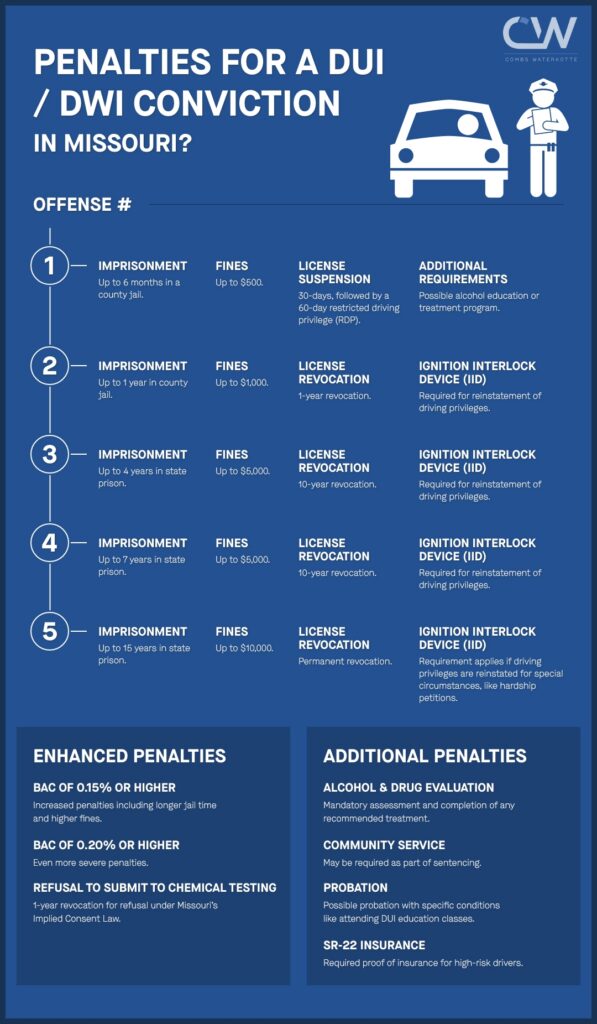
Separate Consequences for Your Driver’s License
According to the Missouri Department of Revenue’s DWI guidance, three or more intoxication-related traffic convictions result in a 10-year license denial. An aggravated-offender conviction ordinarily brings your record to that threshold. Separate from the criminal case, you may also face a BAC-based administrative action or a one-year chemical-refusal revocation. Drivers typically have just 15 days after receiving a BAC suspension or revocation notice to request an administrative hearing.
Getting your license back or obtaining a limited driving privilege depends on your full record and whether you meet the legal requirements. You may need to complete SATOP, provide proof of insurance, pay fees, or meet ignition interlock requirements.
Why Choose Combs Waterkotte for an Aggravated DWI Case?

Combs Waterkotte has handled more than 15,000 criminal cases and brings decades of combined experience to defending Missouri DWIs. An aggravated case requires more than a challenge to a breath test. Your lawyer also needs to understand felony procedures, drug and chemical testing evidence, proof of prior offenses, sentencing restrictions, and driver’s license law.


We explain your options, investigate promptly, and give you candid, judgement-free advice. When the evidence supports a dismissal or lower felony classification, we pursue it. We prepare thoroughly for negotiations and build a trial-ready defense when prosecutors won’t offer a fair resolution.
How Combs Waterkotte Will Take On Your Aggravated DWI Charges
When you hire us, we start with your court and license deadlines and gather any evidence that could be lost. We obtain police reports, video, test and lab records, your driving history, and certified court files. Our work on both the new charge and your prior record includes:
- Protecting your driver’s license: Identify deadlines and seek any available hearing, review, stay of license penalties, or driving privileges
- Reconstructing the encounter: Review your driving, the stop, statements, roadside tests, arrest, test request, and sample collection
- Checking every prior case: Confirm that each record belongs to you and check the outcome, legal representation, dates, separate incidents, jurisdiction, and statutory requirements
- Challenging the test results: Review breath test equipment maintenance, blood sample handling, toxicology, timing, measurement uncertainty, and issues that may require an expert
- Preparing for every outcome: Pursue dismissal, a lower offender classification, a fair agreement, or acquittal based on the evidence


Contact a Kansas City Aggravated DWI Lawyer Today

While one or two DWIs can potentially be manageable, a third DWI offense and aggravated DWI charge can start to have lasting effects on your life and your license. You need a law firm on your side who understands and is ready to fight to keep your freedom intact and your driving privileges uninterrupted. To get started, call (314) 900-HELP or contact Combs Waterkotte online now. We’ll review the new allegation and your prior record, address important deadlines, and get to work on your Kansas City aggravated DWI defense.
Resources
For more information on criminal defense in Kansas City or anywhere else in Missouri, call the Combs Waterkotte criminal defense attorneys right away at (314) 900-HELP or contact us online for a confidential consultation.
Can I Get a DWI or DUI Expunged?
What Is the Process of Going to Court for a DWI?
Can You Drive After Being Charged With a DWI/DUI?
Charged with a DWIDUI in Missouri? Here’s What You Need to Know
How does a DWI or DUI affect your driver’s license?
The Ultimate Guide to Marijuana Traffic Stops in Missouri
Should I Blow if I Get Pulled Over for a DWI/DUI in Missouri?

Free book
Don’t “Blow” Your DWI/DUI Case: Key Mistakes to Avoid
Combs Waterkotte, Missouri and Illinois’s leading DWI/DUI law firm, has handled over 10,000 cases successfully. This ebook guides you through the DWI/DUI defense process and helps you avoid key mistakes.